
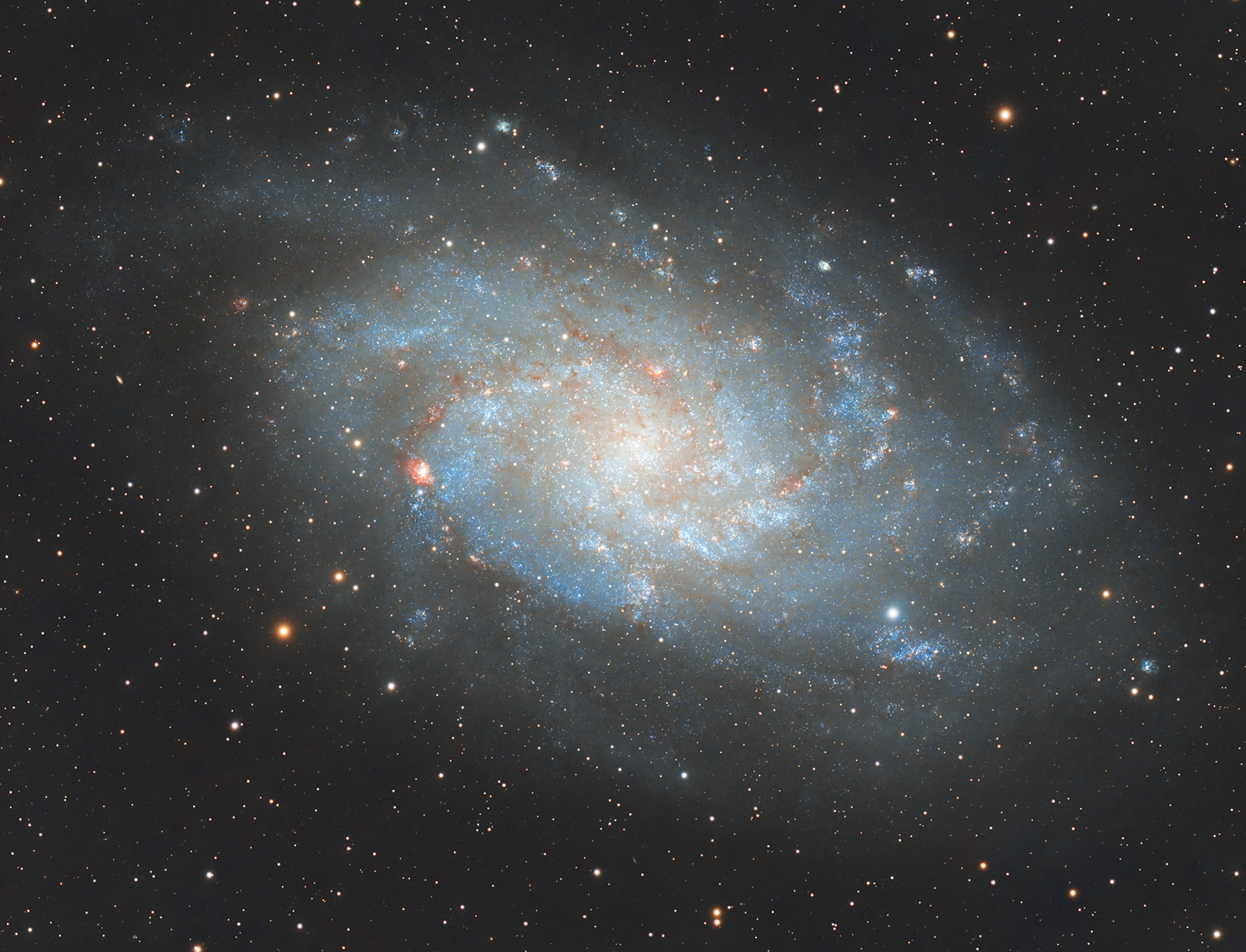
- name: Triangulum Galaxy (M33 / NGC 598)
- coordinates: RA: 01hr 33' 51"; DEC: 30º 39' 37"
- distance from our solar system: approx. 2.7 million light-years
- magnitude: 5.7
- apparent size: 1.2º x 0.75º
About the Triangulum Galaxy
The Triangulum Galaxy (Messier 33, NGC 598) is a spiral galaxy located approximately 2.7–3 million light-years away in the direction of the Triangulum constellation. It is the second largest galaxy in apparent size on the sky (after Andromeda - M31). Its major diameter is estimated at about 60,000 light-years and the minor one at 35,000–38,000 light-years.
Its large apparent size and relatively high brightness (magnitude 5.7 — allowing it to be observed with modest telescopes, binoculars, or even with the naked eye from very dark skies) make it suitable for imaging at relatively short focal lengths, around 300–700 mm (with a pixel size of 3.7 µm).
To photograph it, dedicated astro cameras (or DSLR cameras modified for astrophotography) are required.
M33 is very rich in emission nebulae dominated by hydrogen-alpha. For this reason, sessions using narrowband filters (Optolong L-Extreme, L-Ultimate, L-Para, etc.) to extract the red regions can be combined with sessions using simple UV/IR filters.
The optimal imaging period is August–October.
I photographed the galaxy in two sessions:
-
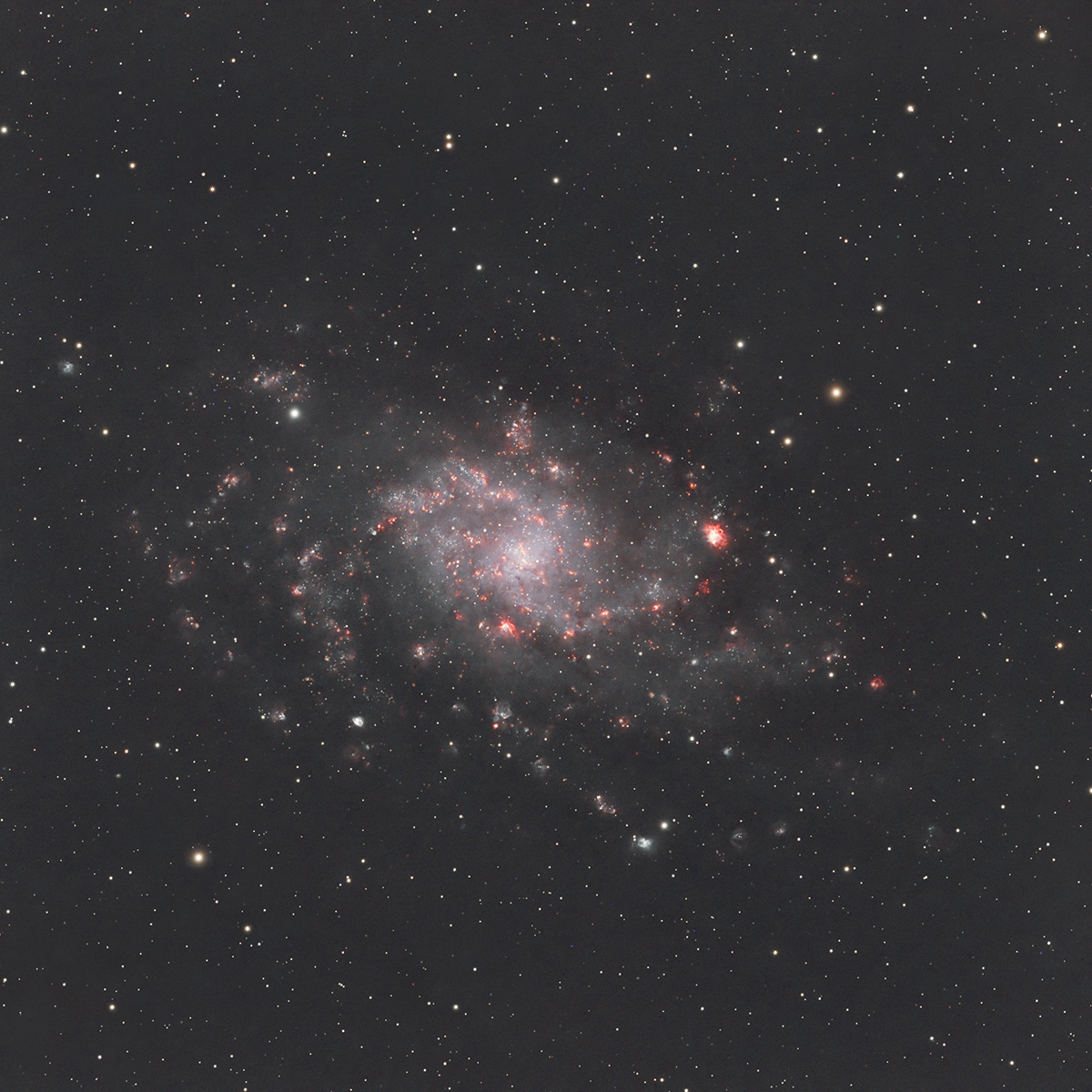
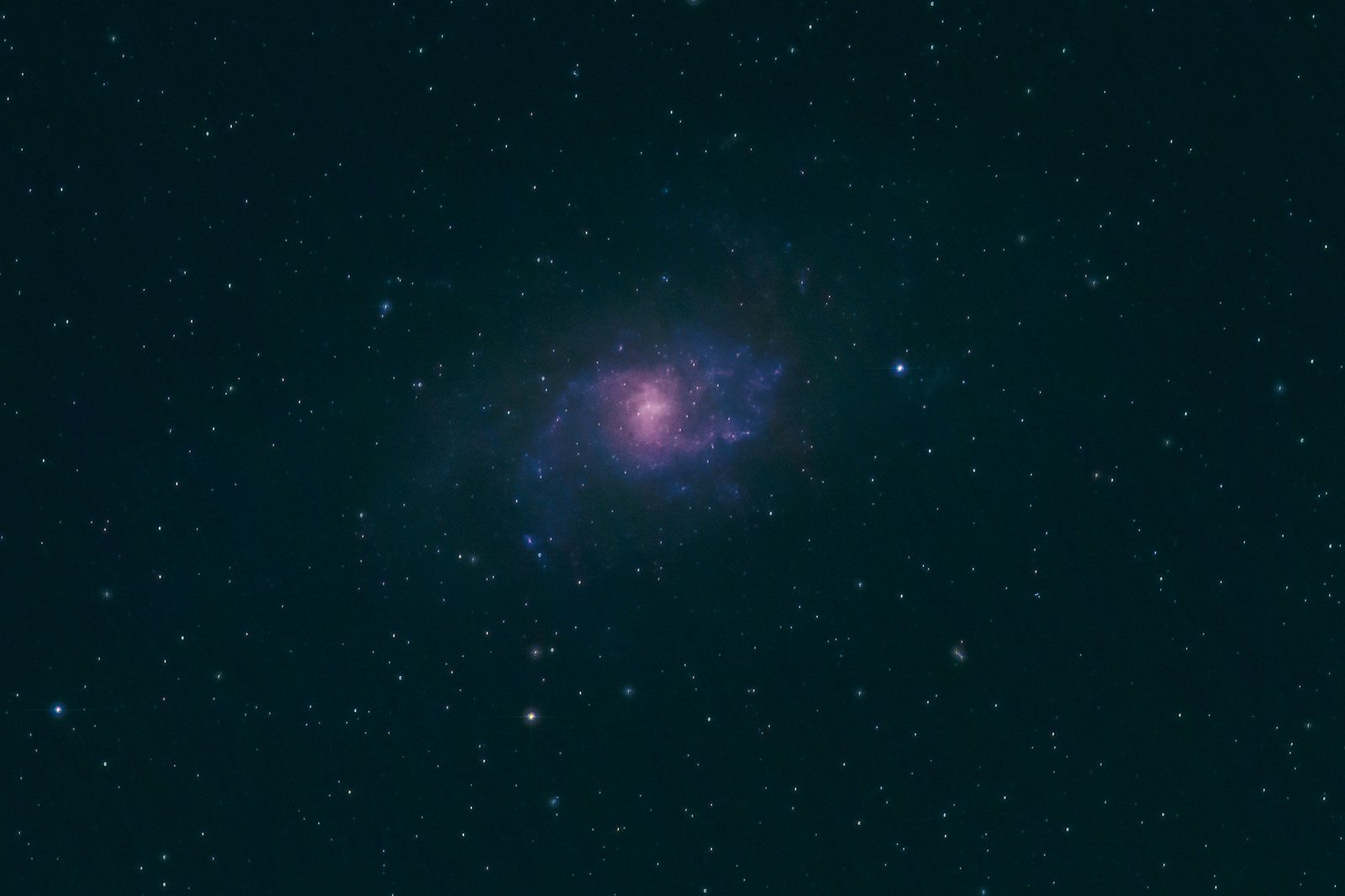
1. On August 8, 2021, from Orlești - Vâlcea (Bortle 4–5), from my backyard. I collected frames for 1 hour and 15 minutes using my old Canon 7D Mark I, unmodified, without filters, at ISO 3200. At that time, identifying and centering the target was an adventure, as I was using a SkyGuider Pro star-tracker and had not yet discovered plate-solving. Everything was done manually, using celestial reference points. Naturally, the process took a long time...
Lens used: Sigma 150–600 (@400mm, f/8), with focus achieved without a Bahtinov mask (I focused by observing stars in LiveView at maximum zoom). The resulting image is quite poor, but at that time I considered it a real success... it can be seen below. -
2. In the autumn of 2024, I revisited this target, this time using an Esprit 100ED telescope (550 mm, f/5.5), light pollution filters, and an EQ6-R GoTo mount.
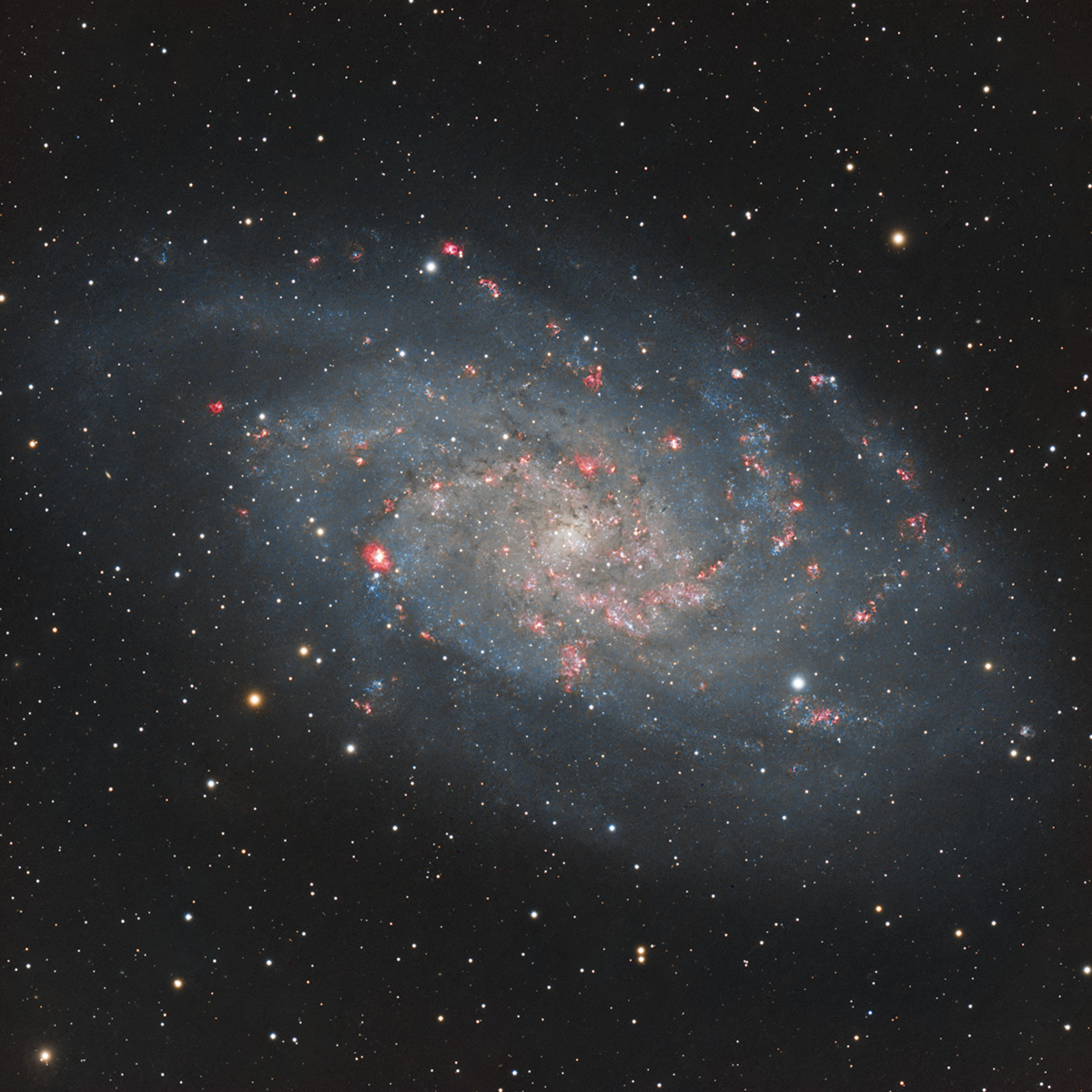
On September 27, 2024, I accumulated 8 hours from Orlești - Vâlcea (Bortle 4–5), RGB frames using an Optolong L-Pro filter.
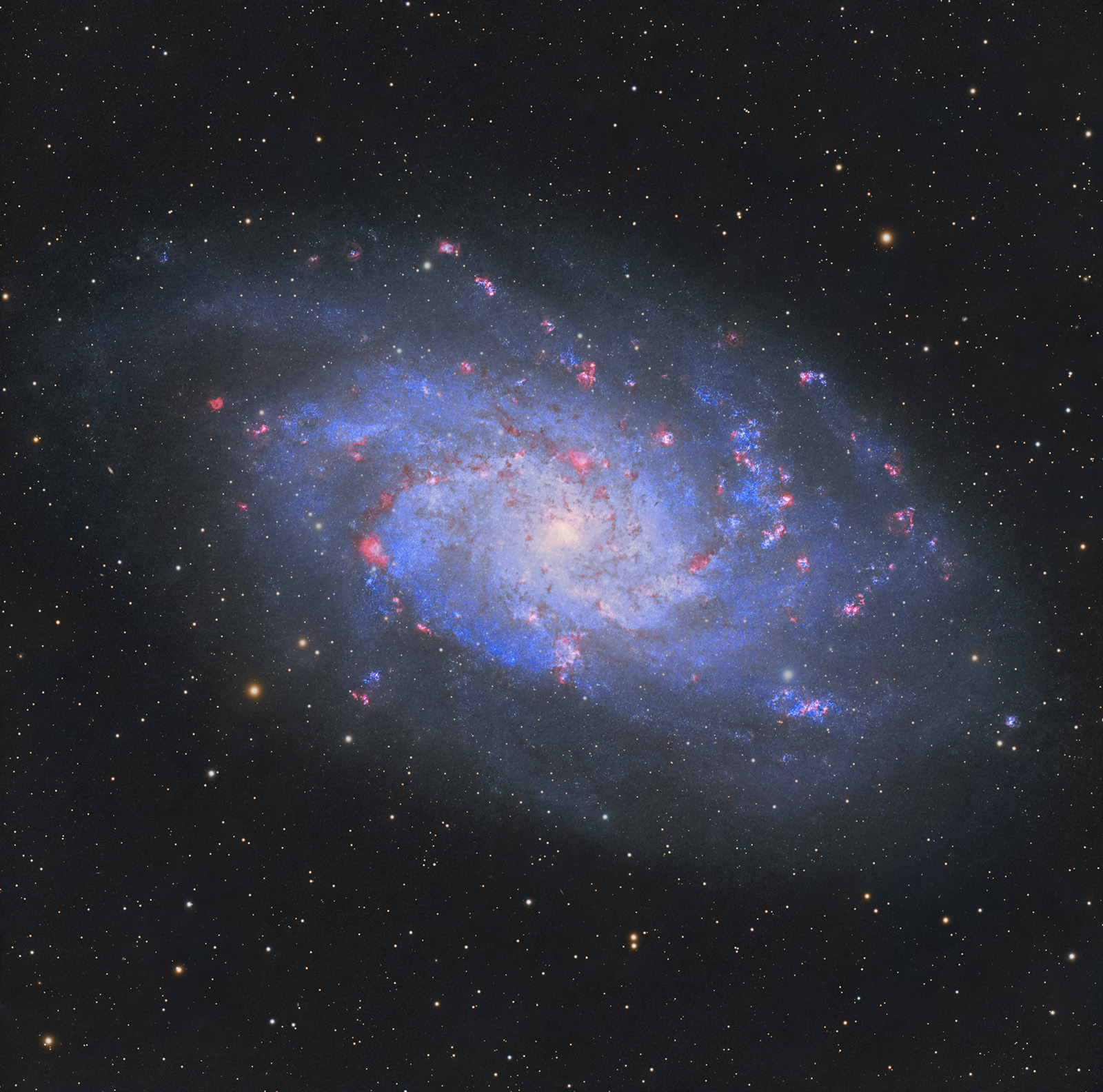
On October 7, I continued the project from Otopeni (Bortle 6–7), using an Optolong L-eXtreme narrowband filter (Ha & OIII - 7nm). The goal was to capture the numerous emission nebulae within the galaxy (the red regions). I collected an additional 5 hours and 21 minutes.
In the end, I was satisfied with the result. With more careful processing, an improved final image could likely be achieved. The main challenge lies in combining the Ha frames with the RGB ones.
How to find the Triangulum Galaxy in the sky
As shown, M33 lies between the Triangulum constellation and the constellations of Pisces and Andromeda. If you know how to identify the Andromeda Galaxy in the sky, you can relatively easily find the position of M33. The Triangulum Galaxy rises slightly later than Andromeda. The “W” shape of Cassiopeia can be used as a pointer toward M33.
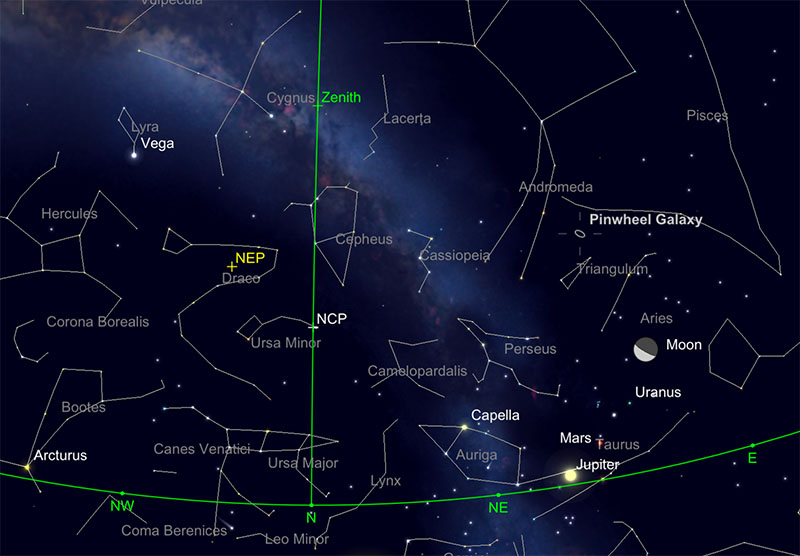
Image gallery - Triangulum Galaxy (M33)
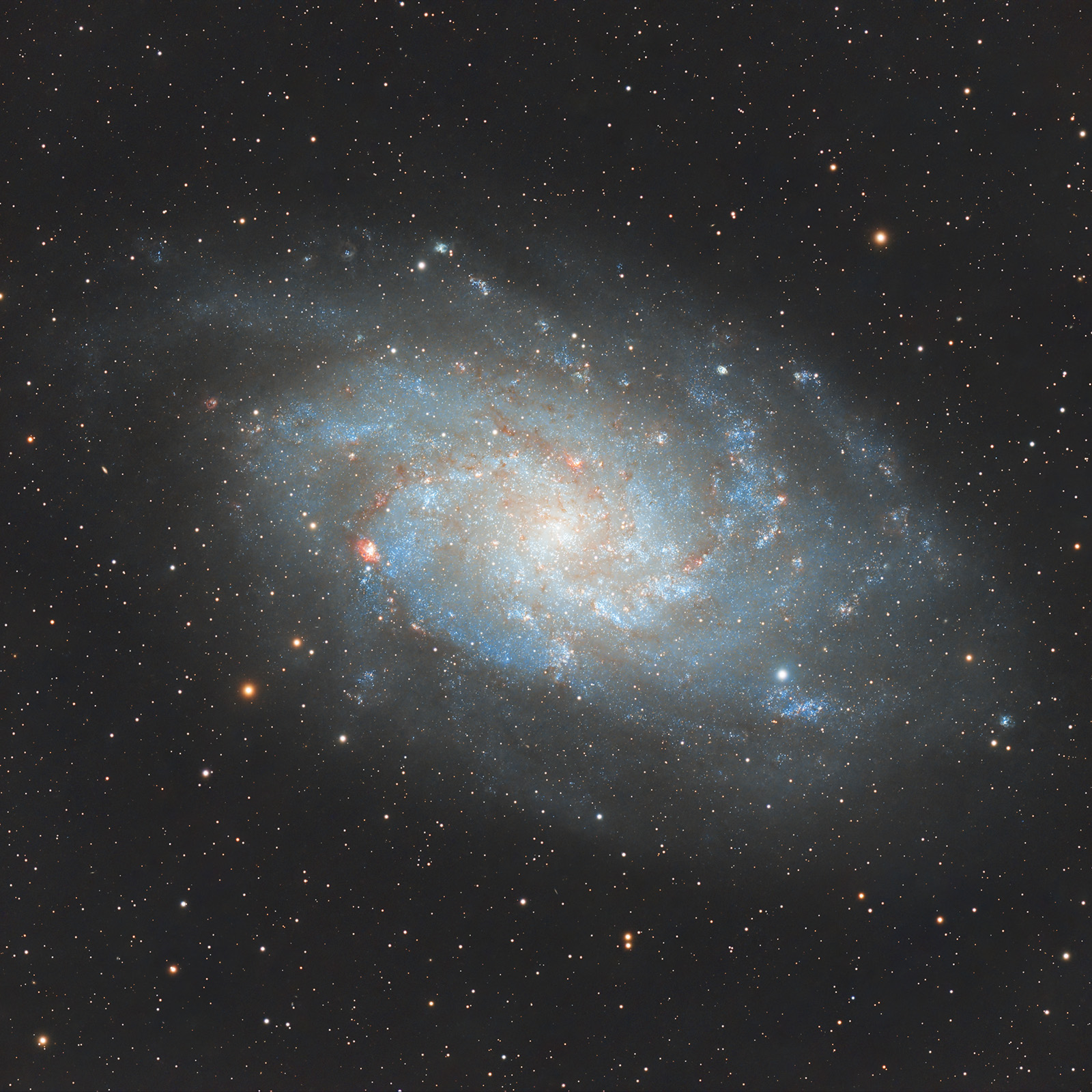
Combined image. 8 hours RGB frames + 5 hours L-eXtreme frames. Final version considered the best result.
Combined image. 8 hours RGB frames + 5 hours L-eXtreme frames. Version 2.
2021 imaging session. First image of the M33 galaxy taken on July 8, 2021, Orlești - Vâlcea, total integration time 1.5 hours. Canon 7D (ISO 3200), SkyGuider Pro, Sigma 150–600 (f/8.0, 400mm), no filters. Only 4 dark calibration frames... obviously a very unsatisfactory result.
Useful tips for photographing and processing images of the Triangulum Galaxy (M33)
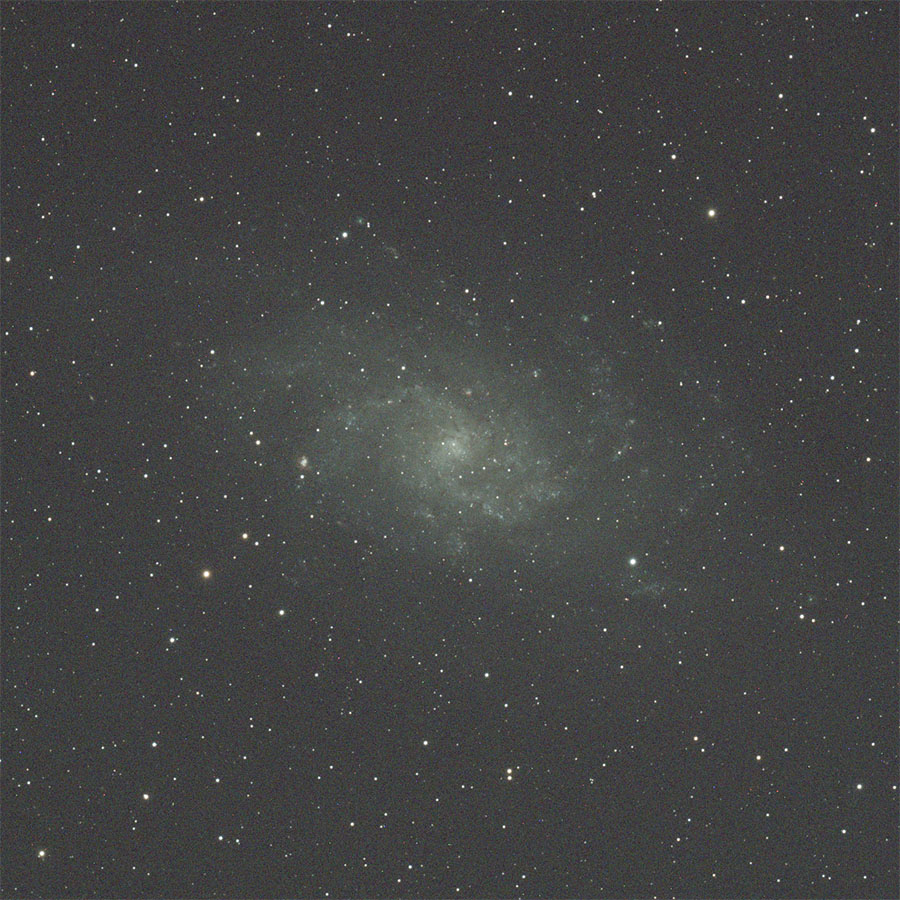

Single 3-minute frame (.fit; debayered, without other calibrations) vs. final processed frame
General steps in PixInsight are the following:
- check all light frames using Blink and remove those with errors
- create the master file by stacking all light frames and calibration frames (flat, dark and bias) in WBPP
- apply BlurXTerminator and Noise Reduction to the final master frame
- correct colors using SpectrophotometricColorCalibration, and reduce the green tint using SCNR
- optionally extract the background and correct the gradient if necessary: DynamicBackgroundExtraction / AutomaticBackgroundExtraction + GradientCorrection
- extract the stars using StarNet2; this results in a starless image and a stars-only image; both images are converted to 16-bit TIFF (i.e., transformed from linear to non-linear versions; from this point on, only non-linear versions are used)
- work only on the starless image: create a mask for the galaxy and apply various transformations in CurvesTransformation (contrast, saturation)
- finally, combine in PixelMath the modified starless image with the stars-only image: combine (Starless, Stars, op_screen())
I also recommend the following tutorials:
Add H-alpha to a galaxy using PixInsight (and a mask trick!)
and
* NEW* Adding H-Alpha To RGB Data Made Extremely Easy!
which present two different methods for adding the Ha signal extracted from dual-band filter (L-eXtreme) data to RGB images.