
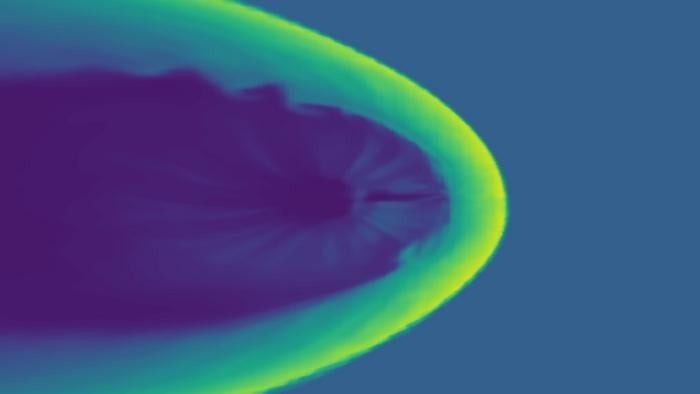
The Earth’s magnetic field serves as a crucial shield protecting life on our planet from harmful space radiation. Invisible to the naked eye, this magnetic field acts as an unseen barrier, blocking charged particles emitted by the Sun as well as cosmic rays from deep space, often stemming from distant stellar explosions called supernovae.
A recently published study, reported by Universe Today, offers new insights into how this magnetic shield asymmetrically filters incoming space radiation. Scientists have identified asymmetric space waves that outline the pressure exerted on the magnetic shield. These findings provide a clearer understanding of which regions of our magnetic field bear the greatest brunt from solar wind and cosmic particles.
But why is this magnetic field so vital? If solar radiation and charged particles impact Earth’s atmosphere without the filtering effect of the magnetosphere, the consequences could be severe. Intense radiation can damage satellites, disrupt communications, and endanger astronauts in orbit. Moreover, without this magnetic shield, the solar wind could gradually strip away Earth’s atmosphere over time, turning our planet into an inhospitable environment similar to what happened on Mars.
Researchers found that the distribution of space waves affecting the magnetic shield is not symmetric. This means certain regions of the magnetosphere experience much stronger atmospheric pressure and solar wind impact than others. This phenomenon has significant implications for our understanding of Earth’s magnetic field dynamics and its interaction with the space environment.
By combining satellite data and computer simulations, international teams have mapped these asymmetric space waves, which act as indicators of localized pressure on the magnetosphere. These discoveries allow for a more precise model of the protection Earth’s magnetic field offers against the bombardment of solar and cosmic particles.
Beyond the impact on space weather and technological systems, detailed knowledge of these high-pressure zones can also contribute to advanced protection strategies for future space missions and satellites. It also benefits the astronomical and astrophotography communities interested in observing cosmic phenomena safely.
Another remarkable aspect of this discovery is the revelation that the magnetic field is not a uniform shield, but a complex and dynamic system that reacts differently depending on the direction and intensity of incoming solar particles. This asymmetry affects not only how life on Earth is protected but also the long-term evolution of our atmosphere.
In conclusion, this new mapping of asymmetric space waves represents an important step toward understanding how Earth continuously withstands the dangerous influx of particles from space. For astronomy and astrophotography enthusiasts, this deeper knowledge offers valuable insight into the invisible mechanisms that safeguard us while influencing our cosmic observations. Earth’s magnetic field serves as a true cosmic guardian, and studying the space waves that shape its pressure is essential for preparing us to face future space challenges.
Source: Universe Today