
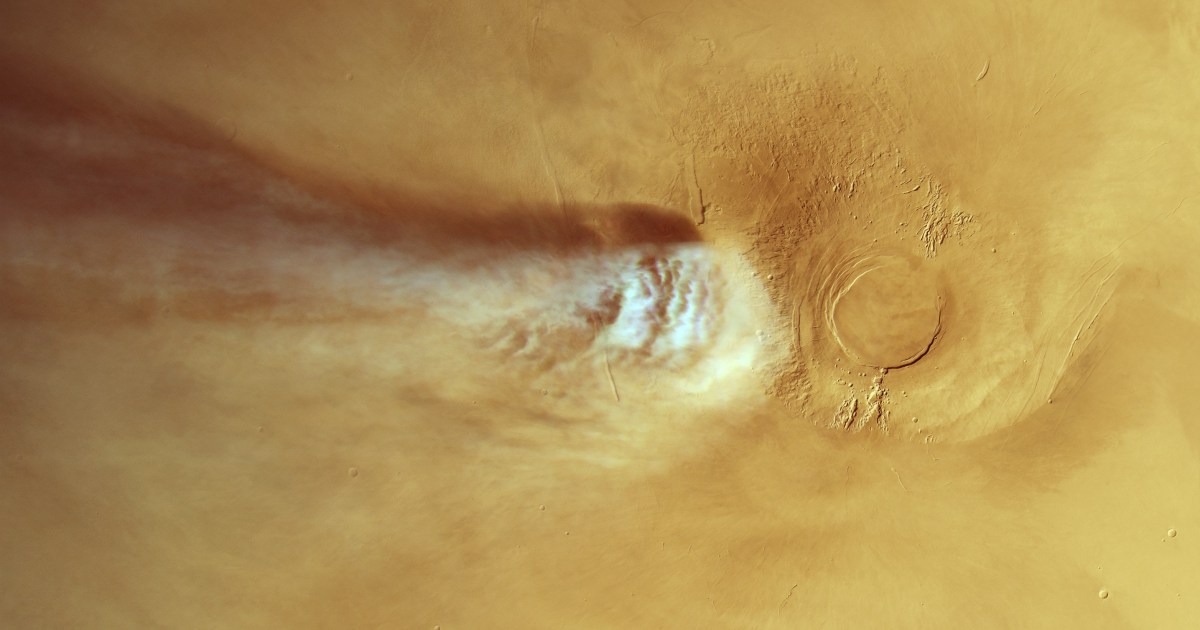
Every morning on Mars, an extraordinary atmospheric event unfolds, captivating scientists and space enthusiasts alike. Near the colossal Martian volcano Arsia Mons, a vast ice cloud stretches for approximately 1,100 miles (1,770 kilometers) across the sky, forming one of the most striking meteorological phenomena observed in the solar system. This extraordinary cloud formation, observed consistently at dawn, has puzzled researchers for many years due to its size, shape, and seemingly regular appearance.
Arsia Mons stands as one of the largest volcanoes not only on Mars but in the entire solar system, towering about 20 kilometers (12 miles) high – much taller than any mountain on Earth. Despite the thin, cold atmosphere on Mars, this gargantuan volcano creates conditions that give rise to a unique and massive ice cloud every Martian morning. The cloud is composed predominantly of ice crystals, producing a bright, sometimes slightly bluish-white structure hovering in the tenuous atmosphere.
Until recently, the exact mechanisms behind this massive cloud formation were largely theoretical. However, advances in computer modeling and atmospheric simulations have provided new insights into the intricate interplay of factors that create and sustain this extraordinary atmospheric spectacle.
The formation process involves the condensation of water vapor present in the Martian atmosphere at high altitudes, which then freezes into ice crystals due to the frigid temperatures. However, the story does not end there – winds, atmospheric pressure variations, and the unique orographic influence of Arsia Mons itself contribute critically. The mountain forces moist air upward, causing it to cool rapidly, which leads to the buildup of this gigantic ice cloud. This process is known as orographic convection, a mechanism also seen in Earth’s mountain weather systems but occurring under much more extreme conditions on Mars.
On Earth, orographic clouds are common in mountainous regions where moist air ascends slopes, cools, and forms clouds. The difference on Mars lies in its thin atmosphere, which holds far less water vapor, and the extreme temperature variations. These conditions create a ’strange’ or ’weird’ science puzzle, as the persistence and size of the cloud around Arsia Mons challenge many existing climatic models for Mars.
Understanding this cloud is not merely an academic exercise. It provides crucial data on the Martian water cycle and atmospheric dynamics. Water, in any form, is a critical resource for future manned missions and potential colonization efforts. Studying the ice clouds gives clues about water vapor transport, ice deposition, and sublimation rates in the Martian atmosphere, which in turn inform the design of life-support and resource-utilization systems.
Moreover, these clouds may serve as natural indicators of weather patterns on Mars, informing mission planning to accommodate weather variability and hazards posed by sudden climatic changes. Simulating and monitoring these phenomena enhances our preparedness for human explorers facing Mars’ harsh environment.
In addition to their scientific importance, these clouds have been captured in stunning detail by Martian orbiters such as Mars Express, providing breathtaking views that fuel the imaginations of both scientists and astrophotographers. These images reveal the ghostly, vast ice bridge cascading over the Arsia Mons, a visual testament to the dynamic and active Martian atmosphere.
The presence of such an imposing atmospheric feature underscores that Mars is far from a dead world; rather, it is dynamic with complex weather systems that both echo and differ from those on Earth. Discoveries like this deepen our understanding of planetary atmospheres and enrich our knowledge of the solar system’s diverse environments.
Ultimately, the Arsia Mons ice cloud is a window into Martian meteorology, showcasing atmospheric physics under alien conditions. It contributes significantly to our understanding of Mars’ climate—an essential step towards overcoming the challenges of future human exploration and colonization of the Red Planet. This weird and wonderful cloud is not only a scientific curiosity but also a beacon of what remains to be discovered on our planetary neighbor.
Source: astronomy.com