
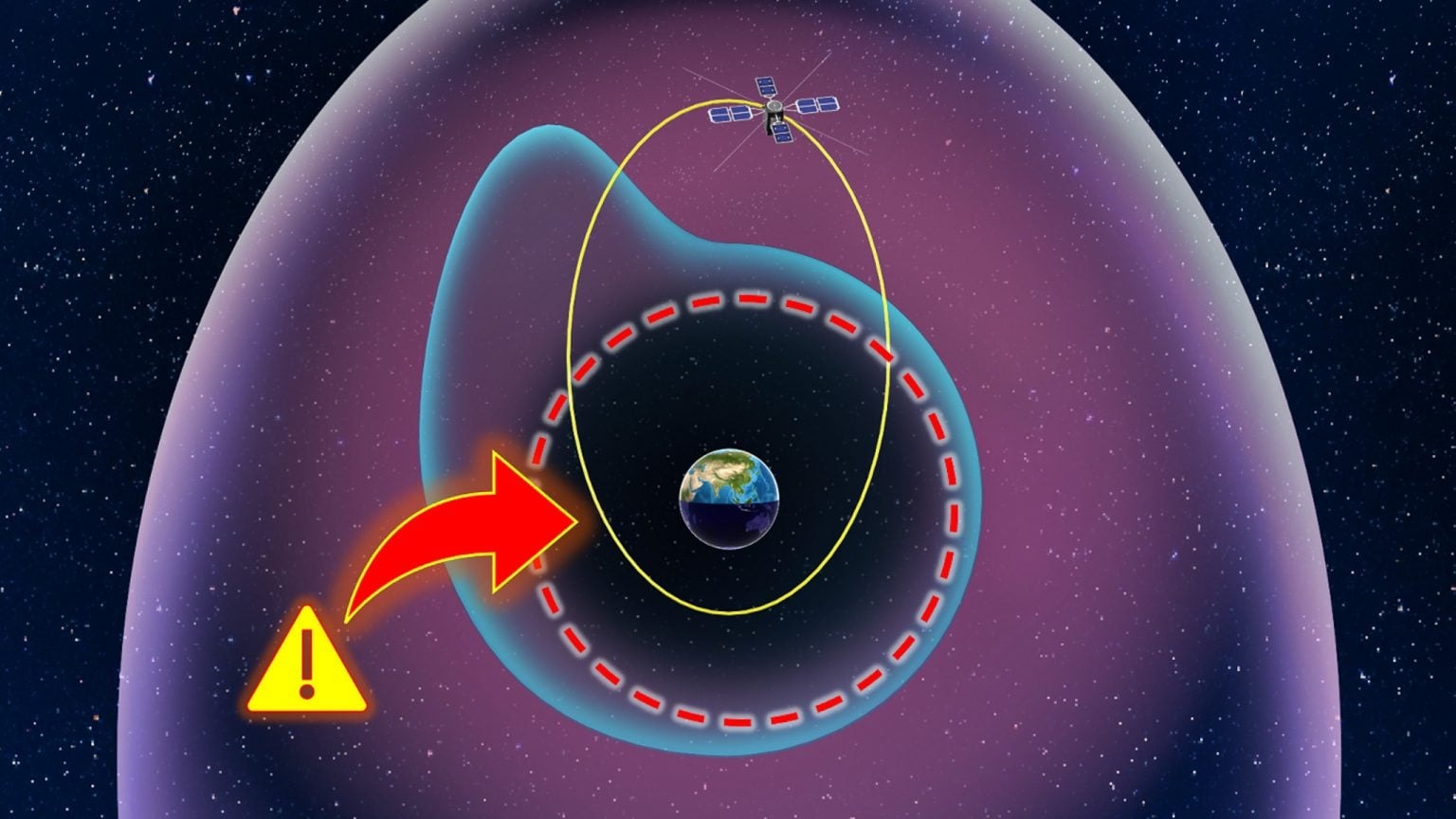
In May 2024, an intense solar storm captured the attention of astronomers and nature enthusiasts alike when spectacular auroras appeared as far south as Florida and Mexico. This event did more than dazzle skygazers; it also revealed a remarkable scientific discovery concerning Earth’s natural protective barrier against space radiation – a barrier previously thought to be impenetrable was breached from within by electrons accelerated to relativistic speeds.
A recent study published in the Geophysical Research Letters by Yoshizumi Miyoshi and his colleagues from Nagoya University sheds light on this unexpected phenomenon. They found that the interaction of electrons with special electromagnetic waves called chorus waves played a pivotal role in allowing energetic particles to penetrate Earth’s magnetosphere, the magnetic shield encasing our planet.
What is Earth’s space shield? The magnetosphere is a region dominated by Earth’s magnetic field, acting as a protective bubble against harmful solar and cosmic radiation. It deflects most charged particles delivered by the solar wind, channeling them toward the polar regions where they create beautiful auroras. Typically, this shield prevents highly energetic particles from reaching lower atmospheric layers or Earth’s surface.
However, the May 2024 solar storm was extraordinarily powerful, triggering not only stunning auroral displays but also complex physical processes that accelerated electrons to near light speeds. The research highlights a mechanism involving chorus waves, electromagnetic waves that propagate within Earth’s magnetosphere and contribute to increasing the energy of charged particles. Through their interaction with electrons in the Van Allen radiation belts – doughnut-shaped zones of charged particles encircling Earth – these waves helped accelerate the electrons to relativistic velocities.
In effect, this process created a breach in the magnetic shield, allowing electrons to penetrate deeper into regions they would otherwise be excluded from. This phenomenon challenges the traditional understanding of Earth’s radiation boundaries and demonstrates the dynamic nature of space weather interactions.
The implications of this discovery are significant for the protection of satellites and space technology. Relativistic charged particles can damage electronic components onboard spacecraft or disrupt communication and navigation systems. Furthermore, they pose risks to astronauts on future missions, particularly those venturing closer to radiation belts or low Earth orbit.
The scientific context of the study is based on the analysis of extensive data collected during and after the solar storm, combined with theoretical models and detailed simulations. Chorus waves are generated in the upper atmosphere and can energize electrons through a process akin to Fermi acceleration, vital in the spatial dynamics of charged particles. The surprising finding was that these waves could essentially breach what was previously deemed an invincible barrier, providing clearer insight into how Earth’s magnetosphere responds to intense solar pressure.
For astronomy and astrophotography enthusiasts, these findings enrich the understanding of natural phenomena that can be captured in stunning images. Auroras are not just visual spectacles; they are manifestations of complex physical processes shaping the near-Earth space environment.
Continued monitoring and research of solar-Earth interactions remain crucial in better predicting the effects of solar storms and preparing both terrestrial and space-based technologies for future challenges. Miyoshi and his team’s work opens a new chapter in understanding space radiation and magnetospheric protection, vital for space exploration and satellite safety.
In summary, the May 2024 solar storm has shown that even the most robust natural shields can become vulnerable under dynamic cosmic conditions. Electrons accelerated by chorus waves managed to penetrate previously impermeable zones, prompting a reevaluation of near-Earth space physics and a deeper appreciation of the intricate and beautiful universe we inhabit.
Source: Universe Today