
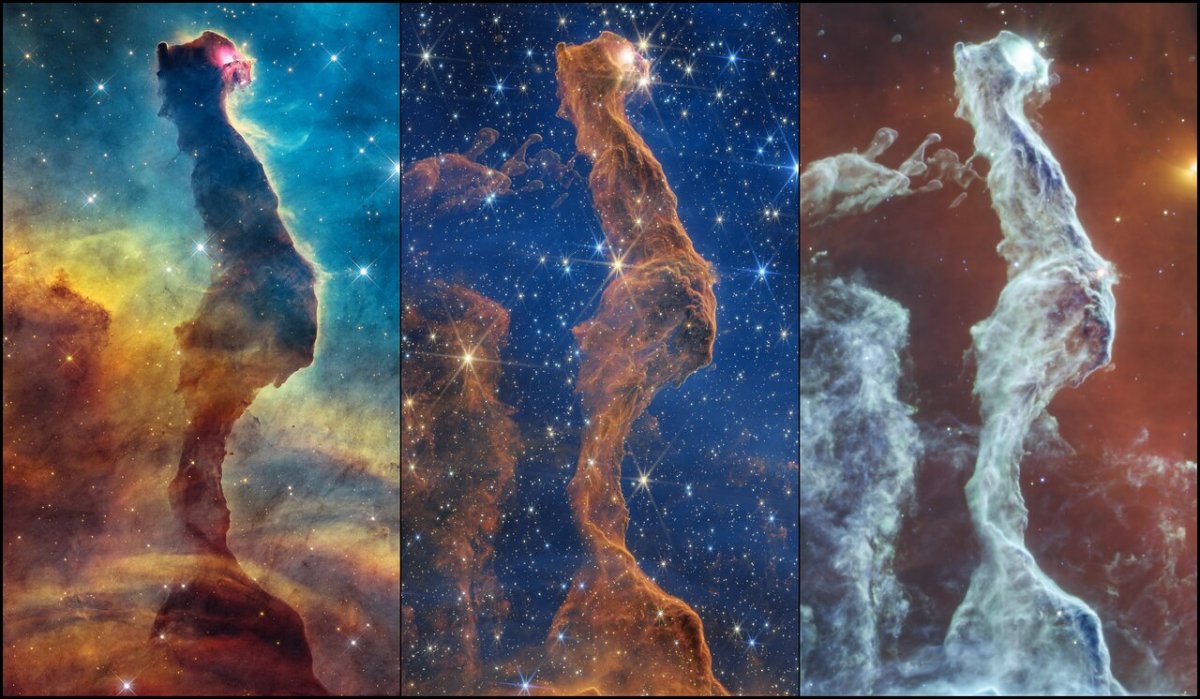
About 7,500 light-years away from Earth, deep within the vast expanse of the Carina Nebula, two of the world’s most advanced space telescopes, Hubble and James Webb, have captured complementary images revealing a haunting and mesmerizing star-forming scene. This event highlighted an enigmatic structure nicknamed the “Cat’s Head nebula,” a dark, elongated shape predominantly visible in visible light that conceals numerous young stars, newly formed and invisible to the naked eye and traditional telescopes.
The Carina Nebula is one of the largest and most active star-forming regions in the Milky Way, known for its massive clouds of gas and interstellar dust. These unique conditions provide a natural laboratory for astronomers to understand the complex processes through which stars are born. In the case of the Cat’s Head nebula, the presence of a gigantic dark dust pillar resembling a cat’s head shape stands as a spectacular example of how cosmic matter concentrates to give rise to new light and energy in the universe.
Images from the Hubble Space Telescope, observing in visible light, visually present this structure as a dark dust pillar—almost like a shadow cast in space that blocks the light of stars behind it. This enables us to understand how cosmic dust and interstellar gases can shape and influence their surroundings. Although young stars in these regions are difficult to detect in visible spectrum, Hubble provides subtle hints of their presence through faint glows and diffuse reflections around the dust pillar.
In contrast, images taken by the James Webb Space Telescope—observing in the infrared spectrum—offer an entirely different and much more detailed perspective of the same phenomenon. Infrared radiation can penetrate clouds of dust and gas that block visible light, allowing Webb to reveal a multitude of young stars still forming, along with previously unseen details of the structure and composition of the gas and cosmic dust that make up the nebula. Thus, Webb provides a true three-dimensional map of the whole star formation process, uncovering regions that until now appeared non-existent or completely hidden.
The combined images allow us to better understand the magical process behind star formation—a complex yet fundamental process for the existence of our universe. From the condensation of massive molecular clouds to the ignition of nuclear reactions in the core of young stars, it is all captured in a dance between light and darkness, between dust and the cosmic fire of creative energies.
Another important aspect highlighted by these observations is international and interdisciplinary collaboration. The Hubble telescope, launched in 1990 and still operational, and the James Webb telescope, NASA’s, ESA’s, and CSA’s newest and most powerful space observatory, demonstrate how technology and innovation in astronomy can work together to create images and information far richer than any single observatory.
For astronomy and astrophotography enthusiasts, this event is an endless source of inspiration. The image of the Cat’s Head nebula encourages amateurs and professionals alike to refine their techniques and equipment to capture celestial spectacles as faithfully as possible. Moreover, the study of these star-forming regions contributes to a deeper understanding of the origin of our solar system and, consequently, of life on Earth.
In conclusion, through the poetic and scientific eyes of the Hubble and James Webb telescopes, the universe reveals its secrets in a spectacular display. The Cat’s Head nebula shows us that beneath the sharp shadows of cosmic dust and darkness, new stars are born that, in time, may illuminate other worlds. A clear message that space exploration is not only a journey of technology but also one of human curiosity, the desire for knowledge, and admiration for our infinite cosmos.
Image credit: ESA/Webb
Source: ESA/Webb