
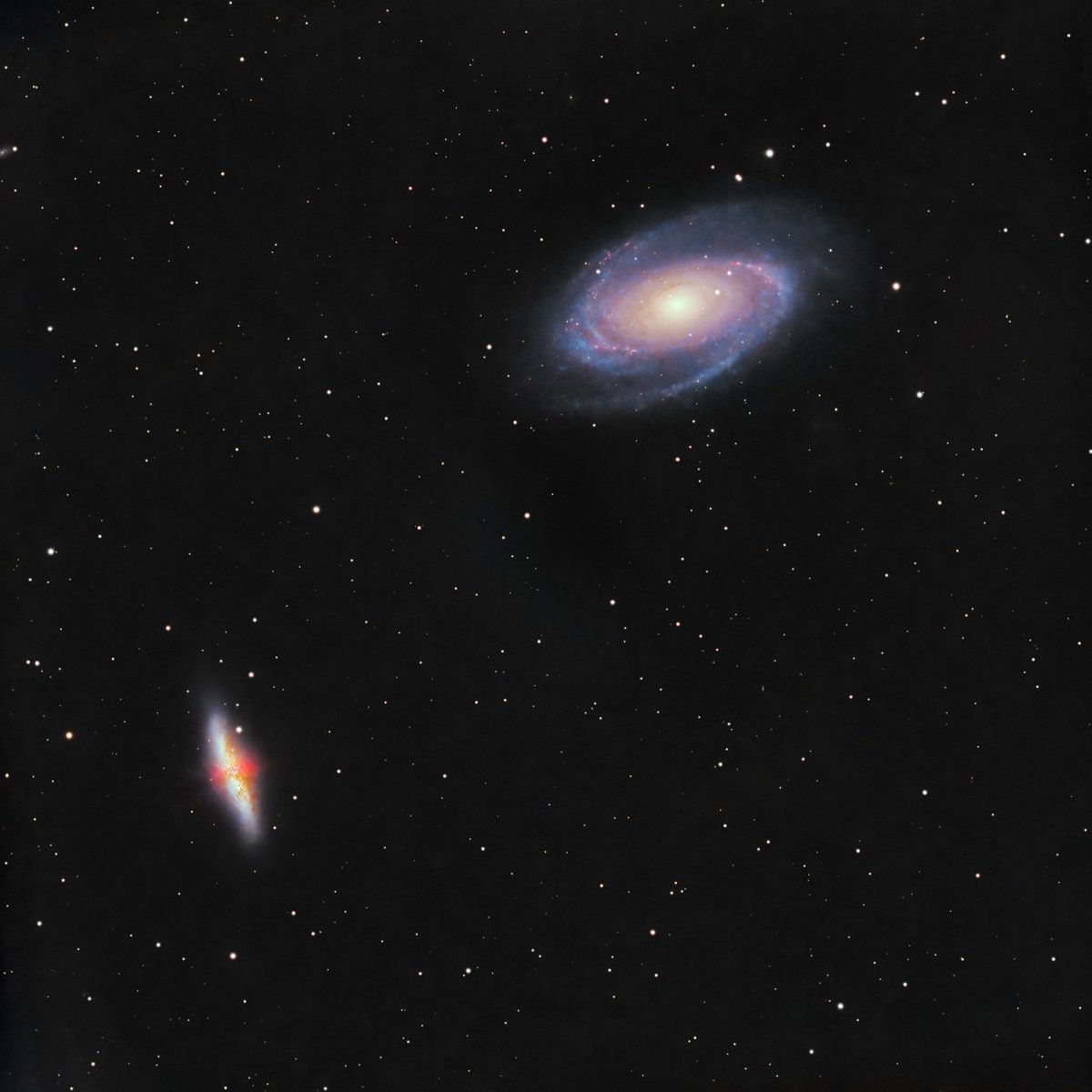
In the vast and mysterious universe, the Cigar Galaxy, also known as M82, offers us a spectacular cosmic show akin to a stellar fireworks display. This galaxy, located about 12 million light-years away in the constellation Ursa Major, has captivated astronomers and astrophotography enthusiasts with its intense star-forming activity.
The Cigar Galaxy is seen edge-on, which means we observe it from its side, seeing a thin, elongated disk that gives it its distinctive name. This perspective allows us to distinguish intricate structures that would otherwise be challenging to detect in two-dimensional views. What makes this galaxy truly fascinating are the red filaments of superheated gas blasted into space, reminiscent of gigantic fireworks.
These gas filaments result from a phenomenon known as a starburst – an intense episode of star formation. In M82’s case, this stellar frenzy was triggered by gravitational interaction with its larger neighbor, Bode’s Galaxy (M81). Such gravitational encounters disturb the gas and dust clouds within the Cigar Galaxy, compressing material and sparking a rapid increase in star formation.
This process is not merely a visual spectacle; it has profound implications for galactic evolution. Massive star formation releases enormous energy, and the radiation and stellar winds from young, massive stars drive gas out into the intergalactic medium, reshaping the galaxy’s long-term structure.
The stunning image captured by Adriano Anfuso from Wincrange, Luxembourg, resulted from an exposure time exceeding 20 hours, collecting an impressive amount of light and detail from this cosmic phenomenon. The photograph highlights not only the visual beauty but also the complex physical processes at work in this distant realm.
M82 remains a captivating research subject for astronomers, acting as a natural laboratory for understanding the connections between galactic interactions and star formation activity. Recent studies using advanced telescopes, including the facilities of the European Southern Observatory (ESO), have confirmed that such starbursts can dramatically alter galactic atmospheres, ejecting massive amounts of material and influencing the space between galaxies.
For astrophotography enthusiasts, capturing the Cigar Galaxy presents both a technical and artistic challenge, combining deep knowledge of optical-electronic equipment, patience, and meticulous planning. Advanced techniques, such as stacking multiple exposures, selective color filtering, and digital processing, allow the fine details of these remote phenomena to be brought into sharp relief.
In conclusion, the Cigar Galaxy is not just a mere spot in the sky but a real gateway to the secrets of galactic evolution and stellar dynamics in our vast universe. Through images like this, both passionate amateurs and professional astronomers are invited to gaze more closely into the heavens and delve deeply into the mysteries of cosmic epochs.
Photo: Alexandru Docze (see the photo in the gallery)
Source: Astronomy.com