
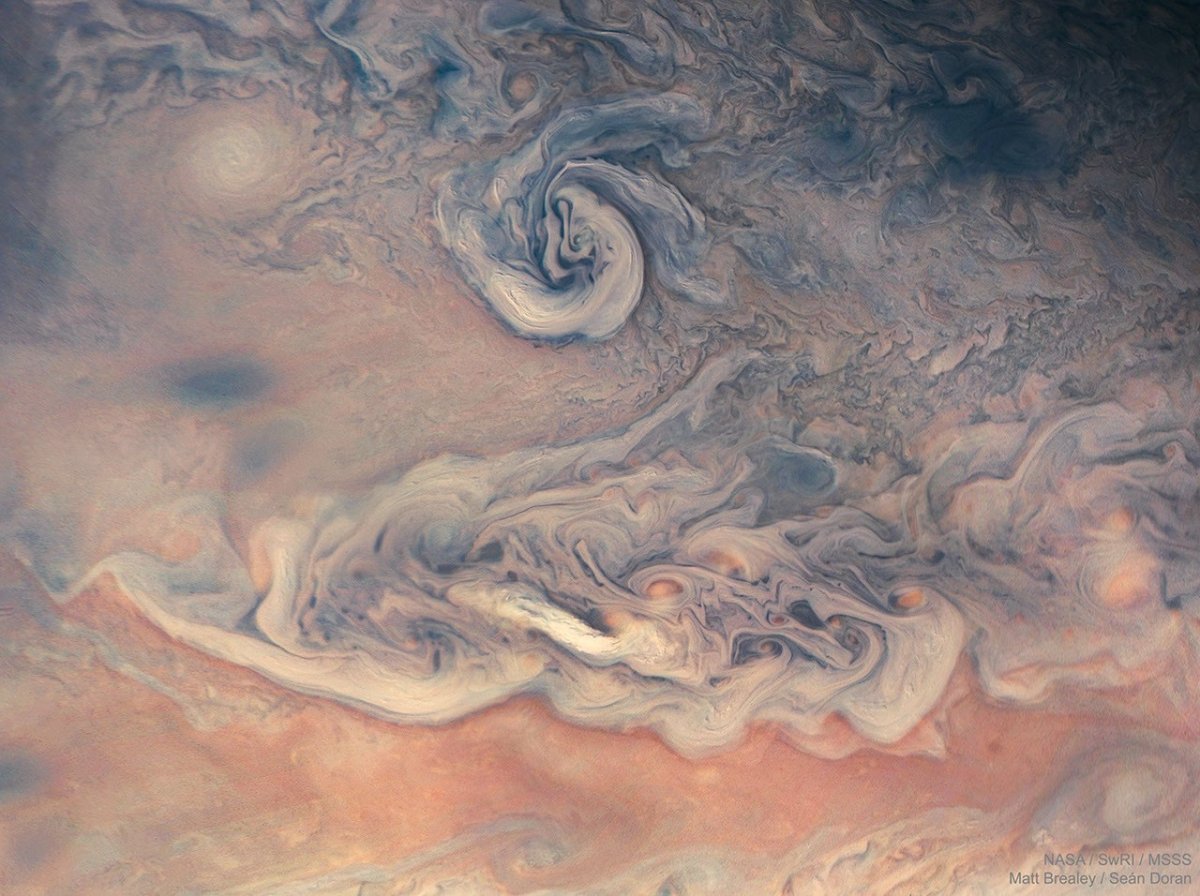
The swirling clouds and vibrant colors of Jupiter, the largest planet in our Solar System, continue to captivate astronomers and astrophotography enthusiasts worldwide. Recent images sent by NASA’s Juno spacecraft, which has been orbiting Jupiter since 2016, reveal astonishingly detailed depictions of the planet’s spectacular atmospheric dynamics like never before.
Scientific context
Jupiter is a gas giant composed primarily of hydrogen and helium, with traces of other chemical compounds present in its upper atmosphere that impart its distinct coloration. The variations in temperature, pressure, and chemical composition between different atmospheric layers create a highly dynamic environment, featuring powerful jet streams, giant storms, and cloud formations in a stunning range of hues. Iconic structures such as the planet’s alternating light and dark bands, alongside the Great Red Spot—a vast storm enduring for centuries—offer a glimpse into this complexity.
What Juno reveals
The Juno mission, launched by NASA in 2011 and arriving at Jupiter in 2016, carries a suite of sophisticated instruments to study the planet’s atmosphere, magnetic field, and internal structure. A recent image captured by JunoCam unveils incredible details of Jupiter’s cloud tops, showcasing swirling patterns in a palette ranging from white and yellow to various shades of red, orange, and ochre. These colors arise from chemical compounds such as sulfur- and phosphorus-containing molecules, which interact with solar radiation and chemical processes within Jupiter’s atmosphere.
Such images provide a direct view into the ongoing atmospheric dynamics, revealing turbulence and flow patterns far more intense and complex than any Earthly storm.
The importance of these studies
Juno’s observations deepen our understanding not only of Jupiter’s atmospheric mysteries but also shed light on the formation and evolution of the Solar System itself. Jupiter’s gravitational influence has played a pivotal role in shaping the orbits of other planets, and understanding its atmospheric composition and dynamics helps unravel our cosmic history. Furthermore, the analytical techniques developed for studying Jupiter’s colors and structures can be applied to investigate the atmospheres of giant exoplanets beyond our system, broadening the frontiers of astronomical research.
Inspiration for astrophotography enthusiasts
For amateur astronomers and astrophotographers, Juno’s images are a rich source of inspiration. While capturing such detailed photographs of Jupiter’s clouds in visible light demands advanced equipment and excellent observing conditions, NASA’s publicly released images offer beautiful material for artistic interpretation and study. Additionally, enthusiasts can learn to interpret the atmospheric colors and formations themselves, observing effects caused by Jupiter’s rapid rotation and turbulent weather patterns.
Conclusion
The swirling and colorful clouds of Jupiter, as unveiled by the Juno spacecraft, portray a dynamic and mysterious world. Continued exploration enhances our knowledge of gas giant planets’ formation and atmospheric physics, illuminating the awe-inspiring processes shaping one of our Solar System’s most fascinating worlds. Each image transmitted from Juno invites us to look beyond Earth and delve into Jupiter’s vibrant complexity.
Image credit: NASA
Source: NASA