
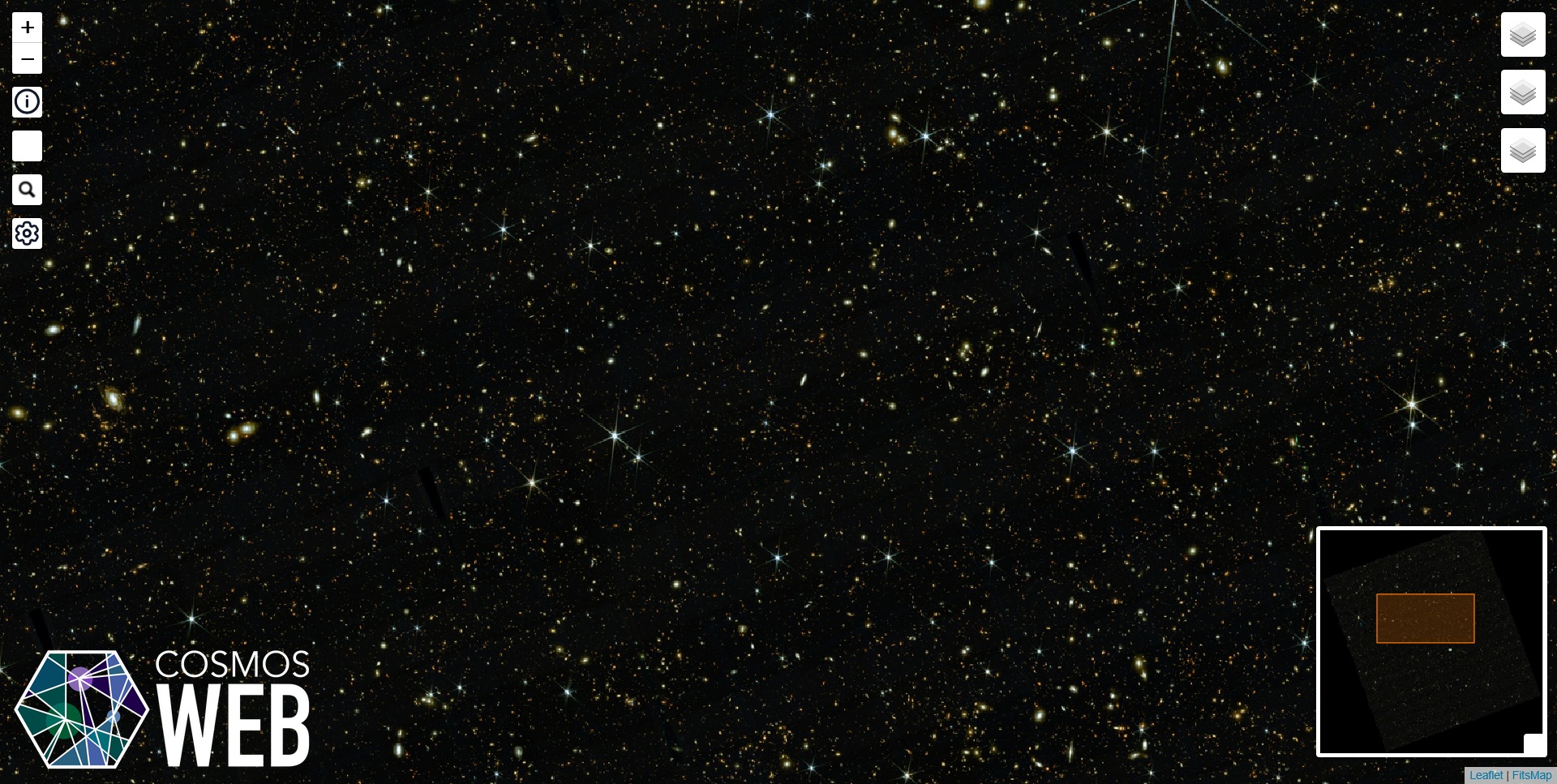
The universe, vast and enigmatic, is structured in an intricate cosmic web, where galaxies aren`t randomly scattered but woven into a vast interconnected network. This web comprises colossal filaments of dark matter and gas, which act as the scaffolding for billions of galaxies spanning across the visible universe. Recently, astronomers have produced the most detailed map of this cosmic web yet, thanks to the powerful observations from NASA`s James Webb Space Telescope (JWST). This achievement offers new insights into the early universe`s evolution.
Leading this research, scientists from the University of California, Riverside, leveraged JWST`s extraordinary capabilities to chart the cosmic web as it was when the universe was only one billion years old—a remarkably young cosmic epoch compared to the present estimated age of about 13.8 billion years. Their work has revealed intricate details about how galaxies were arranged and began coalescing into the vast cosmic structures we observe today.
What is the cosmic web? The cosmic web is an immense and complex distribution of dark matter and baryonic matter (normal matter like gas and stars) permeating the space between galaxies. It can be visualized as a three-dimensional cosmic map in which galaxies and clusters form nodes connected by thin filaments, separated by vast empty spaces called cosmic voids.
Before JWST`s advent, these structures were primarily mapped within the local universe, i.e., the more recent cosmic history. Understanding the details is pivotal for unraveling how dark matter influenced galaxy formation and how the universe has expanded and evolved following the Big Bang.
Significance of James Webb Space Telescope Launched in 2021, JWST is the most advanced and sensitive infrared space telescope ever built. Its infrared capabilities are crucial because light from the earliest, most distant galaxies shifts towards longer infrared wavelengths due to the redshift effect caused by the universe`s expansion. This stretching of light means that the JWST can detect galaxies far further back in time than ever before, allowing astronomers to explore the structure and composition of the cosmic web in its infancy.
JWST`s unparalleled sensitivity and resolution provide a clearer picture of the cosmic web`s formation, revealing the intricate processes that shaped the universe`s large-scale structure.
Methodology behind the research Using JWST`s instruments, the research team collected spectroscopic data and detailed observations of the COSMOS-Web field, a vast region dedicated to cosmic studies. These data were then analyzed to reconstruct a three-dimensional map showing the distribution of galaxies and the matter surrounding them with extraordinary precision.
The findings indicate that the cosmic web was actively forming when the universe was about one billion years old, offering clear evidence of how galaxies connected along filaments guided by dark matter`s gravitational pull. This suggests a dynamic and large-scale organized structure existed even at these early times.
Importance for astronomy enthusiasts and astrophotographers This discovery opens new vistas for those who cherish the cosmos, providing both visual and scientific material capable of inspiring new projects and images of the early universe. For astrophotographers, these detailed maps and imagery offer opportunities to create sophisticated visualizations and simulations of the universal structure grounded in profound scientific understanding.
Specifically, the detailed mapping of the cosmic web is crucial in bridging the gap between the primordial formation of galaxies and the large-scale cosmic structures now visible in our night sky. It serves as a key link connecting theoretical astrophysics and direct observation.
The future of cosmic exploration with JWST JWST`s role in studying such cosmic phenomena is only beginning, and upcoming observation campaigns promise to unveil even more about the universe`s evolution, including the enigmatic nature of dark matter and dark energy, which together constitute about 95% of the universe yet remain largely mysterious to science.
Source: Universe Today