

- name: Pinwheel Galaxy (M 101, NGC 5457)
- location: Ursa Major constellation
- RA: 14hr 03' 12"; DEC: 54º 20' 58"
- distance from Earth: 21 million light-years
- magnitude: 7.9
- apparent size: 28.8' x 26.9'
About the Pinwheel Galaxy (M 101)
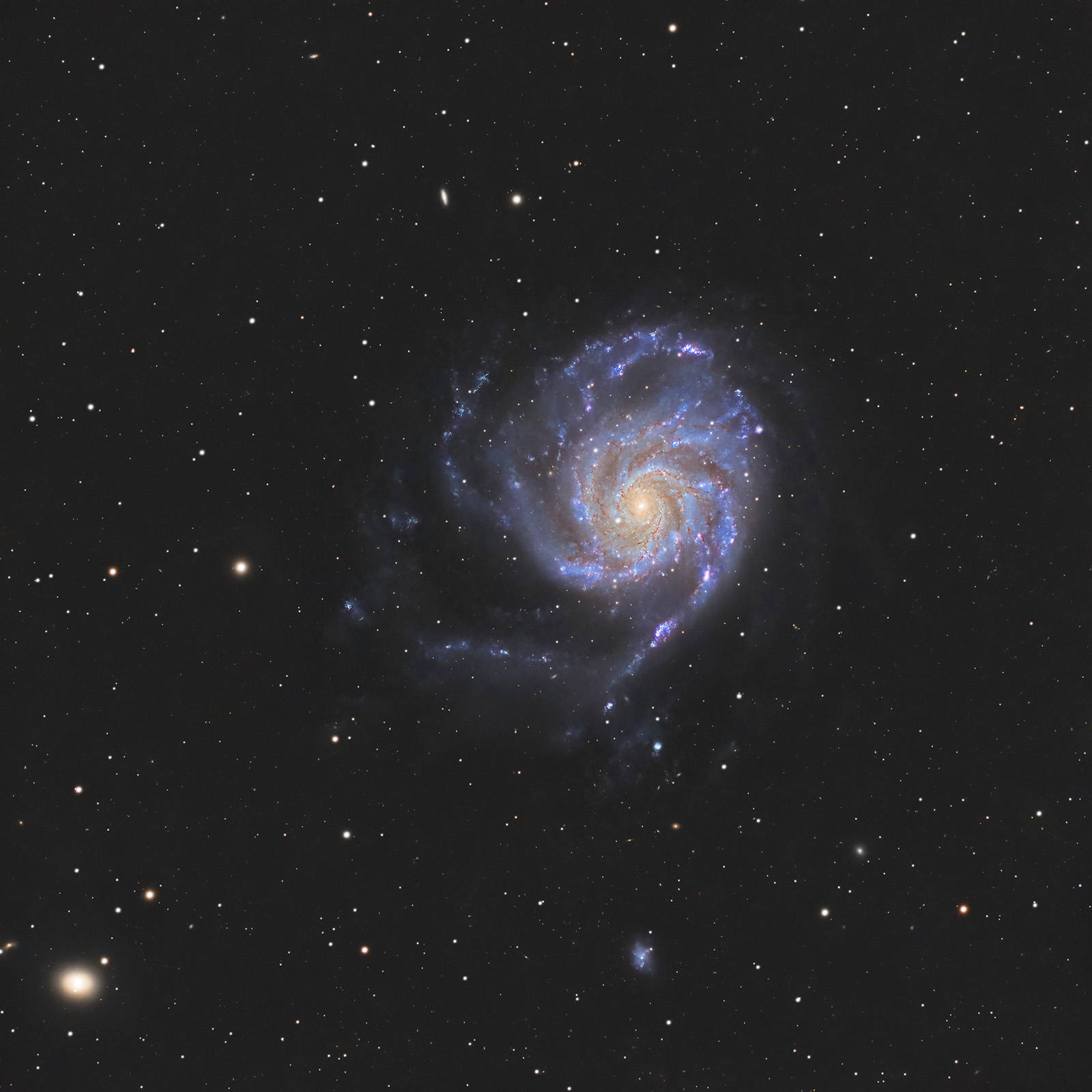
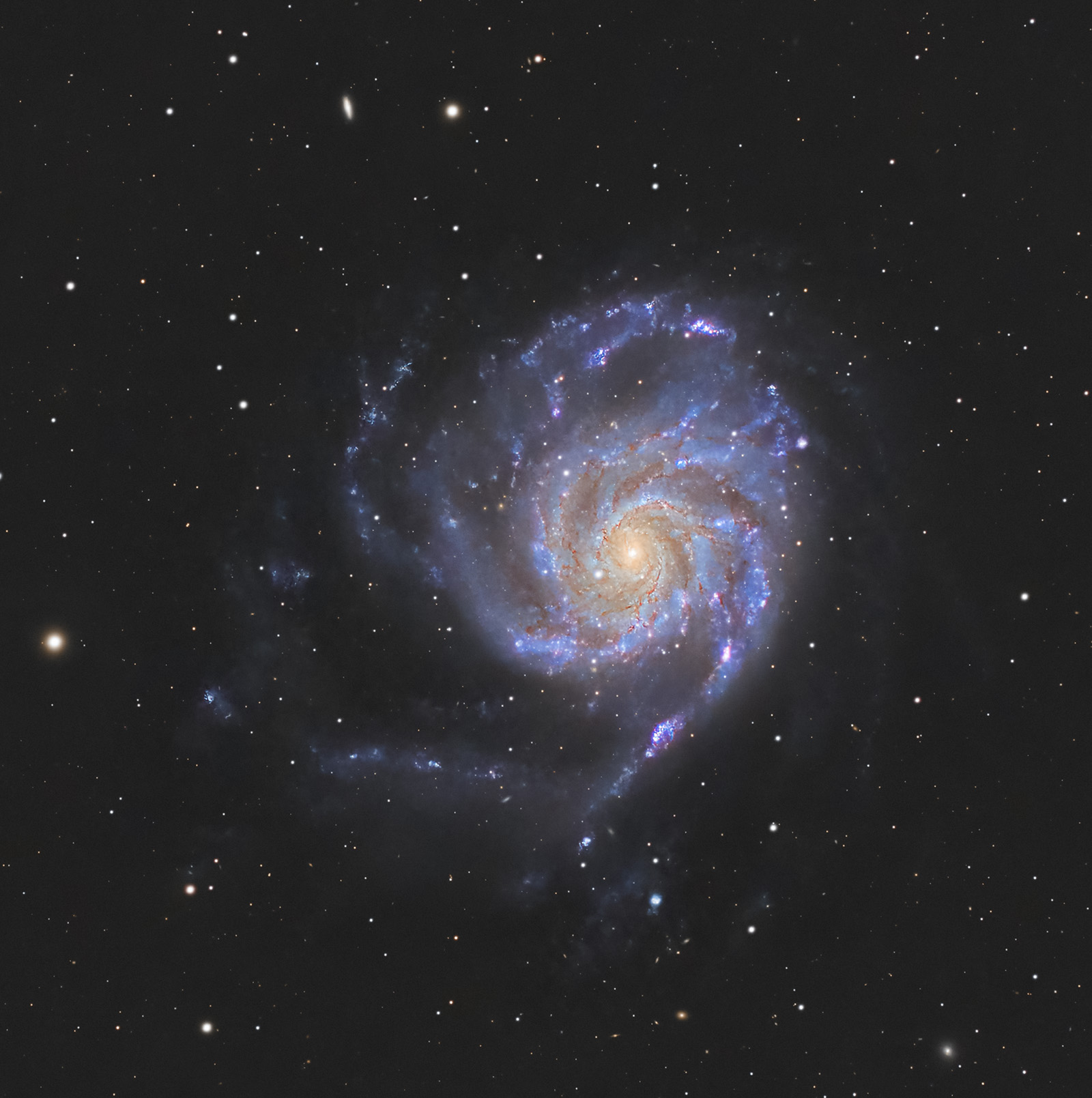
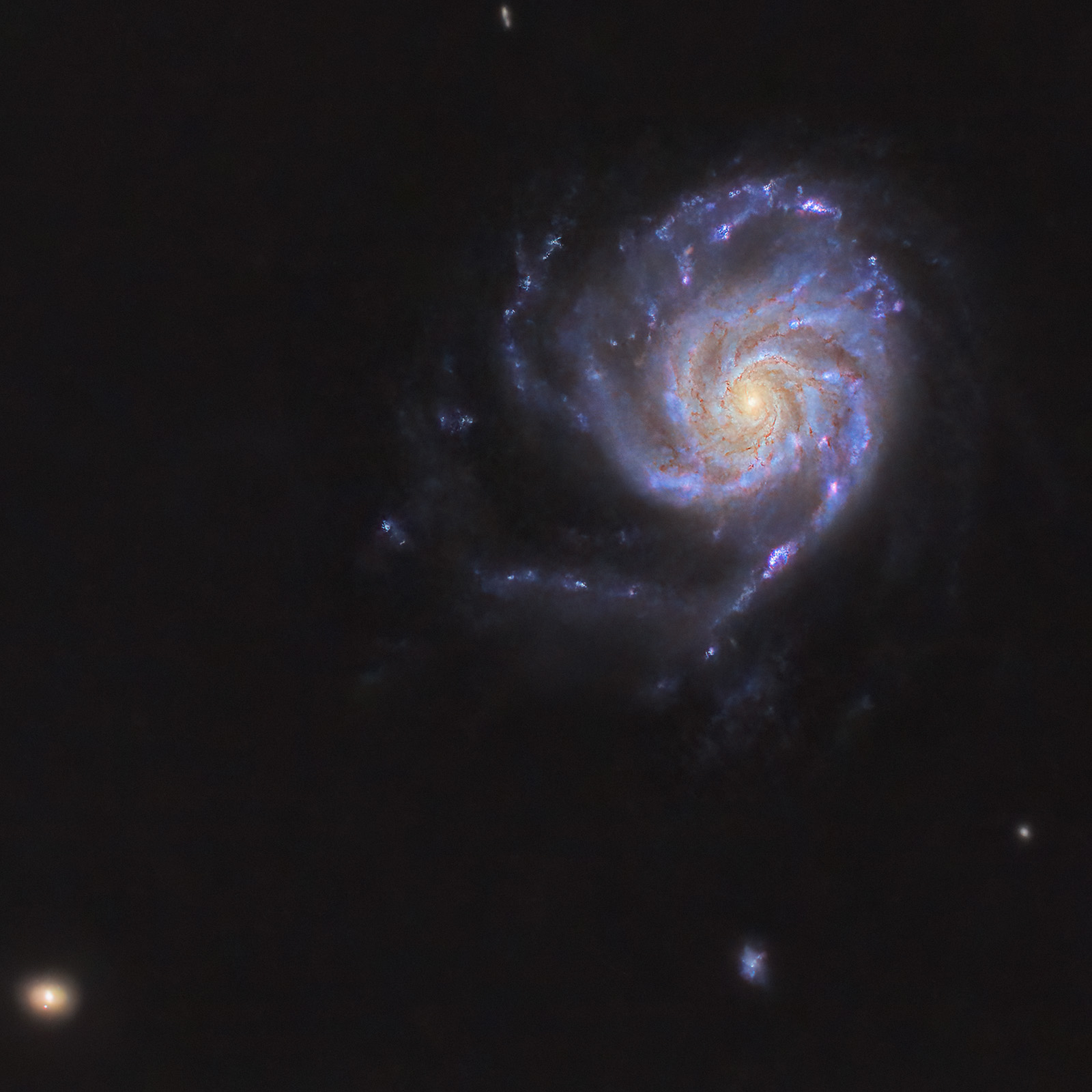
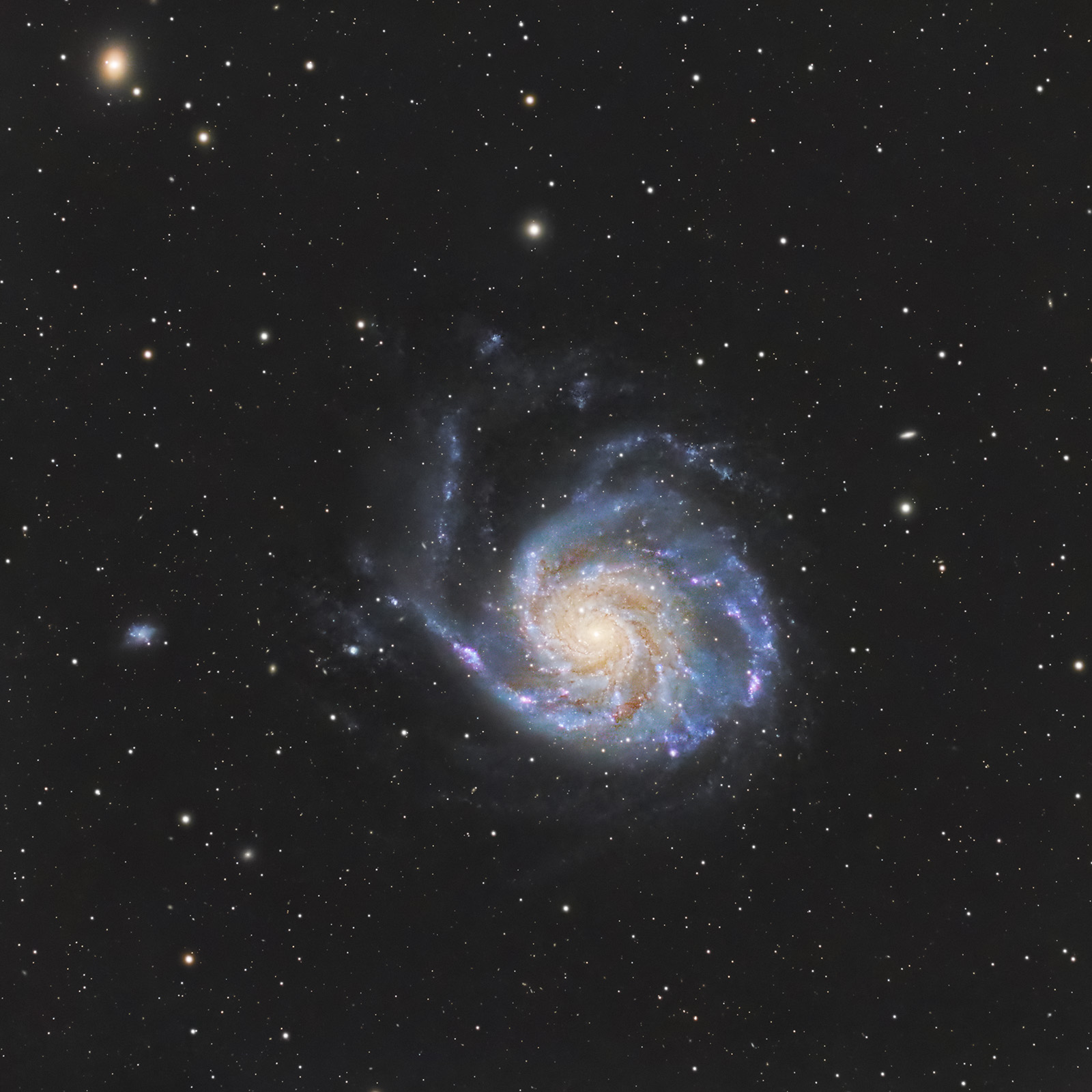
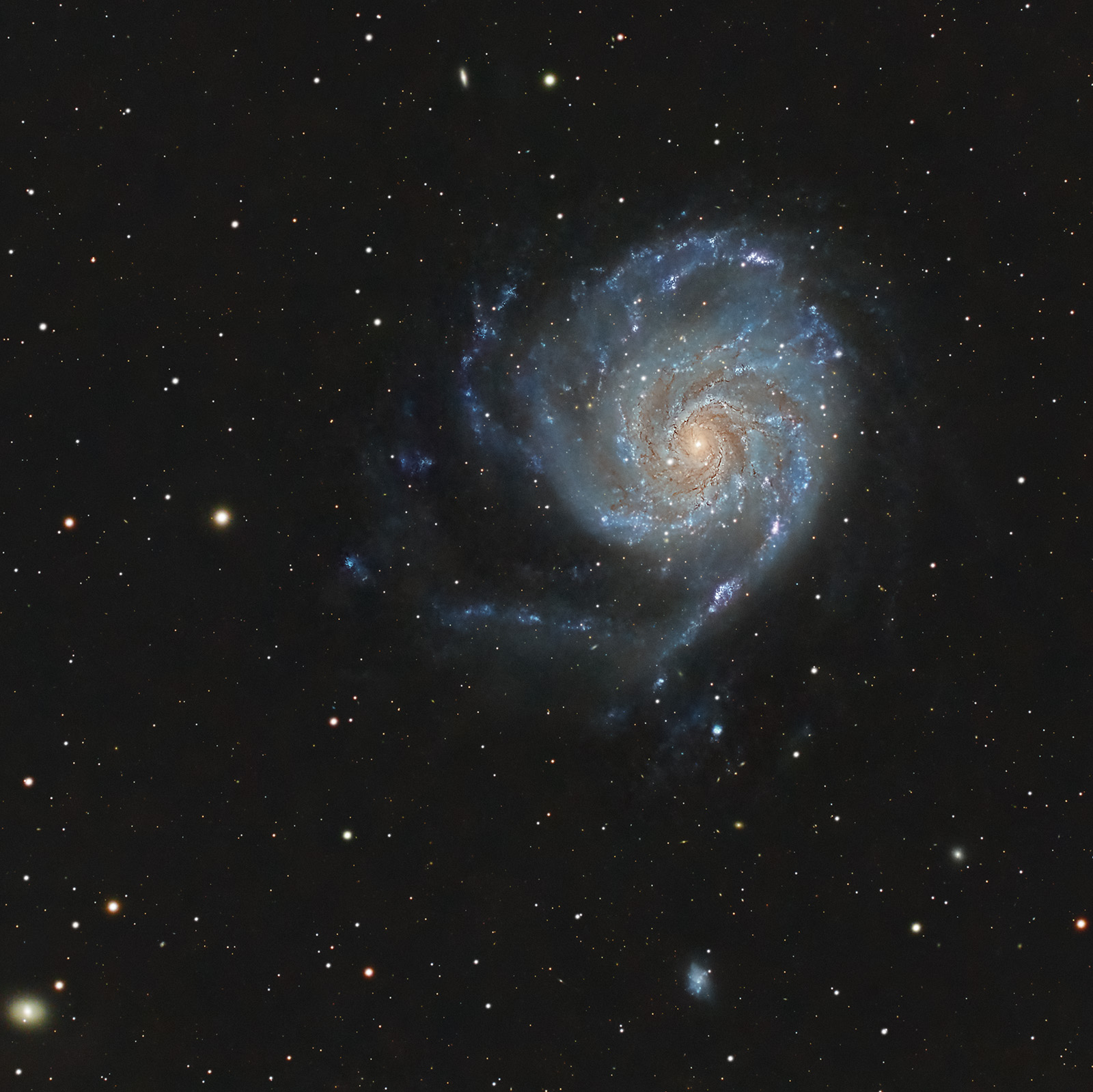
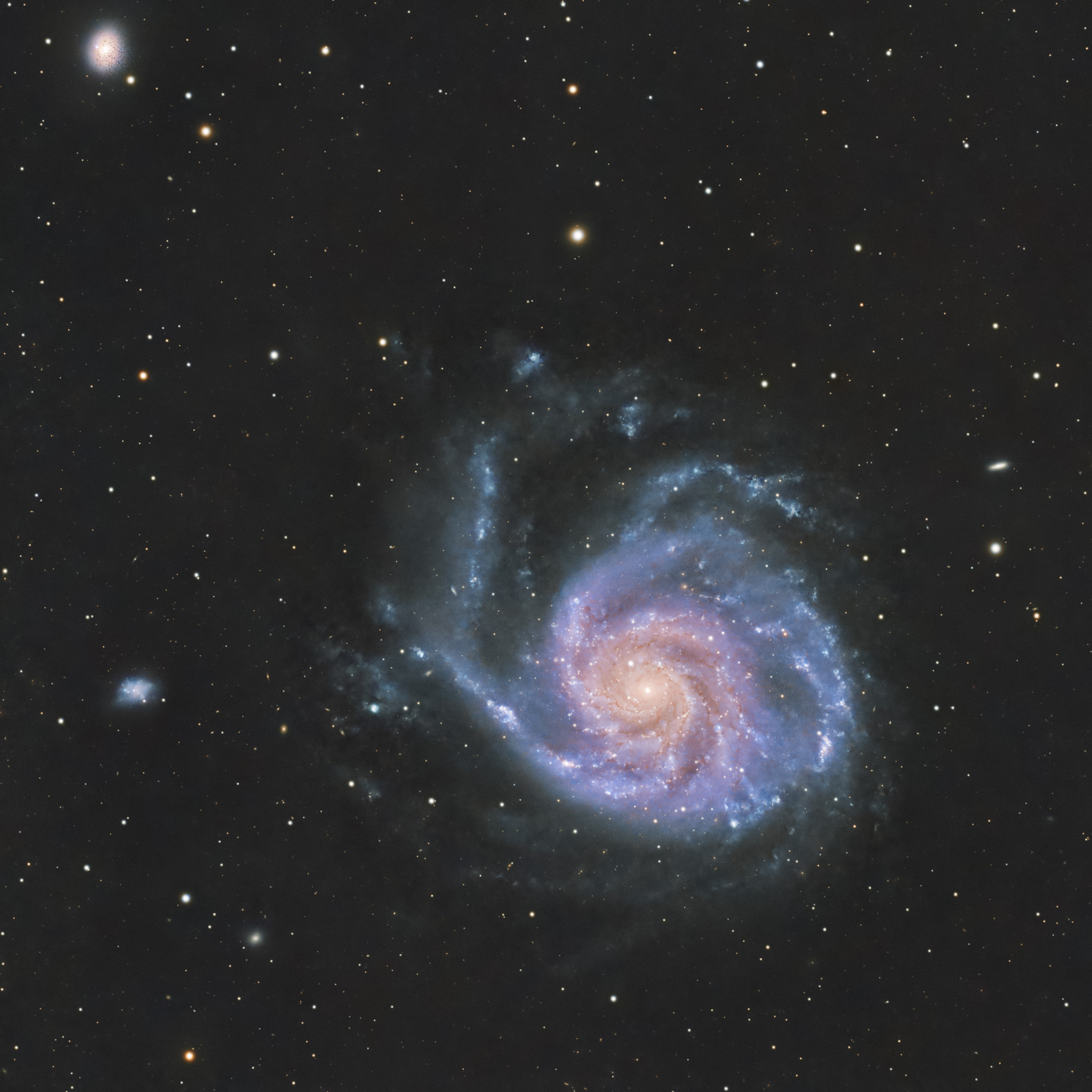
The Pinwheel Galaxy (M 101) is a spiral galaxy that was discovered by the French astronomer Pierre Méchain in 1781. Its large apparent size of 28.8' x 26.9' and its brightness make this galaxy one of the first targets dedicated to beginners who want to photograph galaxies, even with a normal DSLR/mirrorless camera (unmodified for astrophotography).
Image gallery - Pinwheel Galaxy (M 101)
How to find the Pinwheel Galaxy (M 101) in the sky
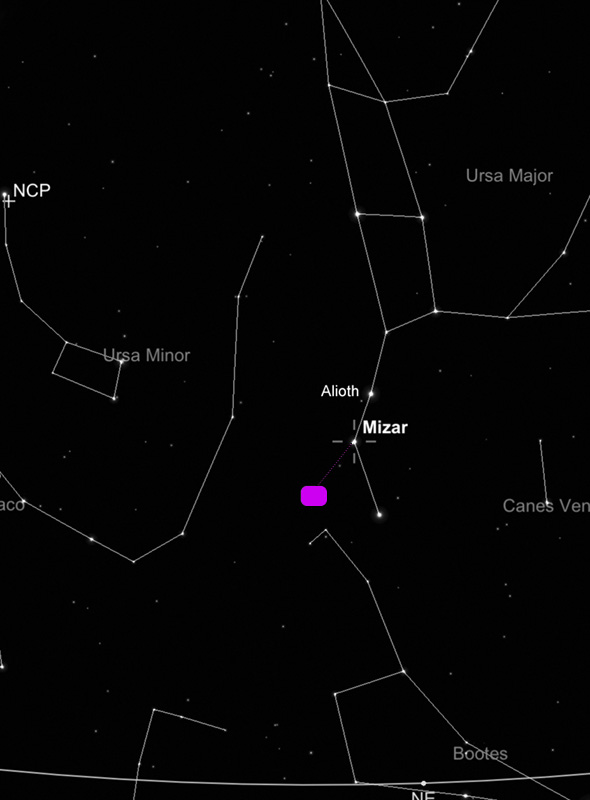
The Pinwheel Galaxy (M 101) can be identified quite easily in the night sky if we use as a reference the second and third stars from the handle of the Big Dipper.
By imaginatively extending, with a segment equal to the distance between the stars Alioth and Mizar, the axis that connects these two stars, we will identify the Pinwheel Galaxy (M 101) with a fairly good approximation.
Useful tips for photographing the Pinwheel Galaxy (M 101)
I photographed the Pinwheel Galaxy for the first time on August 6, 2021, with a Canon 7D. That summer marked the beginning of my astrophotography journey, but also of identifying such tiny targets invisible to the naked eye (or barely visible from areas with skies without light pollution).
The optimal period for photographing the Pinwheel Galaxy is from spring until late summer, however this interval can be extended if you have good visibility towards the North.
I must admit that this galaxy did not impress me at first, as did the Whirlpool Galaxy (M 51) or Andromeda Galaxy (M 31). However, I was pleasantly surprised by the details obtained in the spring of 2022 when I used an ASI 533 MC-PRO camera in an area near Bucharest (Bortle 6 sky)... thus, my interest in photographing it was revived.
Four years later, in April 2026, I resumed this project. This time I photographed for two nights (April 10 and 12) from Orlești (Vâlcea area, Bortle 4–5), accumulating 7 hours and 30 minutes.
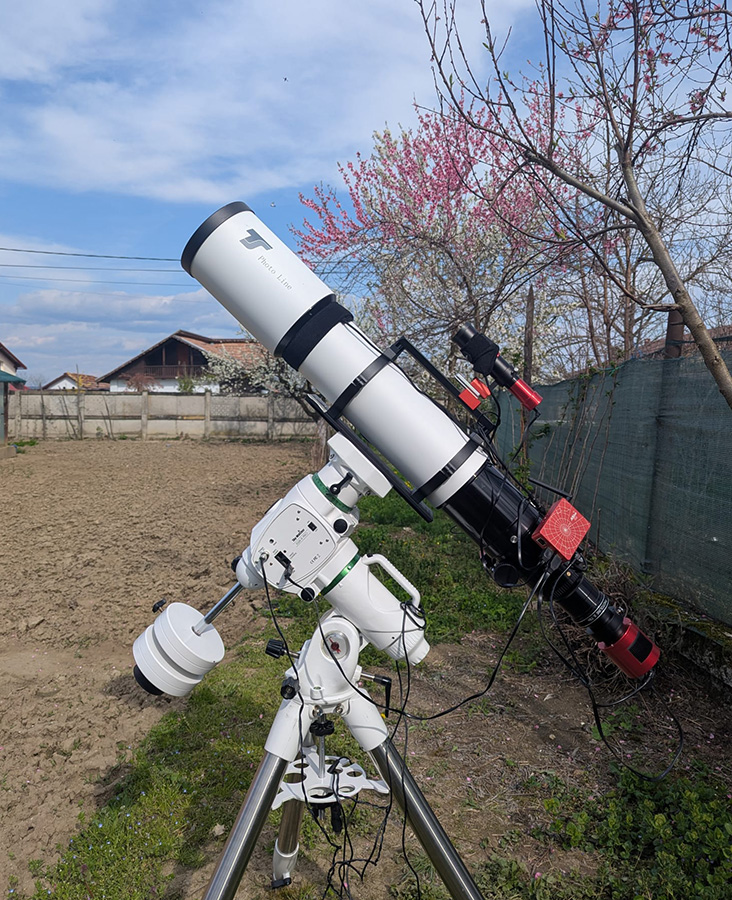
I used the new TS-Optics 130 mm apochromatic telescope, reduced to 734 mm and f/5.6, an ASI 533MC camera (gain 101, -10°C), a simple Baader UV/IR filter and ASIAIR+ for data acquisition and guiding. EQ6-R mount, plus two astro batteries and two heater straps.
Below is the list of all my attempts to photograph the Pinwheel Galaxy (M 101), up to the date of writing this article:
1. Pinwheel Galaxy (M 101) photographed with an unmodified DSLR and a SkyGuider Pro - August 6, 2021
Canon 7D (unmodified), 44 frames of 2 minutes each at ISO 3200, Sigma 150-600 Contemporary at 600mm, f/8.0, 7 DarkFrame frames. Image taken from the Vâlcea area, Bortle 4 sky. No guiding. Total integration time: 1 hour and 30 min.
iOptron Sky Guider Pro Star Tracker with iPolar
Processing in Starry Sky Stacker (image stacking software for Mac) and Photoshop.
The resulting image has mediocre quality, the master frame resulting after stacking all frames having quite a lot of noise. But it proves that it can be photographed using only a star-tracker, a telephoto lens and a DSLR (with rather old technology) together with a remote shutter release and a tripod.
Identifying the galaxy in the sky was not easy, but I used a useful trick when you have a zoom lens: first I photograph at minimum focal length (150 mm in my case) and center the object. Then, after it is centered as well as possible, I increase the focal length to 600 mm (or as needed) and refocus. It is much easier to identify and center an object at small focal lengths. At large focal lengths, a small change in declination or in the angle on the rotation axis can make the object disappear from the frame... and then everything has to be started over...
Not having a Go-To mount that automatically positions itself on a celestial object, many times I photographed the target even if it was not perfectly centered, especially if the focal length was large (over 400 mm). Otherwise I would have risked that through the small corrections I would have made, instead of correcting the centering, I would lose the object completely from the frame... which also happened to me many times.


2. Pinwheel Galaxy (M 101) photographed with an ASI 533 MC-PRO astronomical camera on April 20, 2022. Integration time: 3 hours and 30 minutes.
The image was taken from the Vâlcea area, Bortle 4 sky, guided through ASI AIR+. This time I tried to balance as well as I could both on the rotation axis (which is simple), and especially on declination (which is quite complicated).
Camera cooled to -20C, gain 101, 71 Light frames of 3 minutes each, 20 Flat frames and 100 Bias frames. I noticed that Dark frames are not really necessary if I use the ASI 533 MC-PRO camera, the noise being minimal.
Sigma 150-600 Contemporary lens at 600mm, f/8.0.
1.5" Optolong L-Pro filter.
iOptron Sky Guider Pro Star Tracker with iPolar. Polar alignment done on the laptop in the iOptron iPolar application.
The entire photography process is managed through ASIAIR+ and its mobile application on the tablet, which greatly simplifies the steps, especially those of identifying the target using PLATE SOLVING algorithms.
I do not even want to remember the frustrating moments from last year when I was trying to find and then center a cosmic object doing everything manually and visually starting from celestial landmarks (nearby stars). It is good, however, for a beginner to go through such moments in order to learn the sky as well as possible and then come to appreciate the new and innovative methods.
I realized that at large focal lengths (over 500 mm), with a minimalist mount (SkyGuider Pro), even the way the power cables are secured is important. A long power cable can not only influence tracking through simple oscillation in light wind gusts, but sometimes the cable can act like a spring, so that when the camera is closer to the ground, the cable acts like a spring pushing the mechanism upwards, and when the camera is up, the cable acts like a spring pulling the mechanism towards it. Therefore, it is important how many cables hang, how they are secured and how they are grouped. This is a problem for which I still do not have a final solution... With a "serious" mount, such "fine details" should not matter so much.
Processing in PixInsight and Photoshop.
The resulting image seemed acceptable to me for an integration time of 3 and a half hours. The final master frame contained much more useful signal and less noise compared to the version made with Canon 7D.


Therefore, the Pinwheel Galaxy (M 101) can be photographed even with a classic DSLR, unmodified for astrophotography. A longer integration time would be recommended. A focal length of 600 mm is acceptable, but I would prefer 750mm–1200mm, possibly a telescope with as large an aperture as possible.
A color astro camera, such as the ASI 533 MC-PRO, is good enough for such a broadband target. M 101 can also be photographed with a mono camera with L R G B filters.
Equipment used:
- Mount (star-tracker) iOptron Sky Guider Pro with iPolar (polar alignment using the laptop)
- ZWO ASI 533 MC-PRO camera or Canon 7D (unmodified)
- Sigma 150-600 f5.6-6.3 Contemporary lens at 600mm focal length
- 1.5" Optolong L-Pro filter
- ASIAIR+
- ASI 120 MM guiding camera
- Manfrotto CX PRO3 tripod
- Remote shutter release - for Canon 7D
- 2 dedicated batteries: Omegon Pro Powerbank 96k LiFePO4 307Wh 12V battery + Celestron Powertank Lithium Pro LiFePO4 159Wh
3. Pinwheel Galaxy (M 101) photographed through a Ts-Optics 130mm Apo-Refractor telescope (reduced to 734mm, f/5.6), ASI 533 MC-PRO astronomical camera, AsiAir+ on the nights of April 10 and 12, 2026. Orlești (Bortle 4–5). Integration time: 7 hours and 30 minutes.
Equipment used:
- SW EQ6-R Pro mount
- ZWO ASI 533 MC-PRO camera
- Ts-Optics 130 mm telescope, 910mm, f/7 (reduced to 734mm and f/5.6)
- 2" Baader UV/IR filter
- ASIAIR+
- ASI 120 MM guiding camera
- 2 dedicated batteries: Omegon Pro Powerbank 96k LiFePO4 307Wh 12V battery + Celestron Powertank Lithium Pro LiFePO4 159Wh
Processing images of the Pinwheel Galaxy (M 101)
The first step is loading the frames (Light, Flat, Bias etc.) into PixInsight Script >> Batch Processing >> WeightedBatchPrepocessing in order to stack the frames, after which the program will export a single final frame that we will work with. I prefer this simpler option, without too many settings, although there are many other more advanced stacking methods (including in PIXINSIGHT). There are numerous other software programs: DeepSkyStacker (the most used software for Windows), SIRIL (Windows, Linux and Mac) or Starry Sky Stacker (Mac).
Below several frames can be seen:
- an unprocessed frame (.RAW) taken with Canon 7D ... this is how a frame looks on the camera screen
- the master frame obtained in Starry Sky Stacker after stacking the 44 frames of 2 minutes each taken with Canon 7D
- the master frame obtained in PixInsight after stacking the 44 frames of 2 minutes each taken with Canon 7D
- an unprocessed frame (.FIT) photographed with ASI 533 MC-PRO ... this is how a frame looks on the screen of the mobile application connected to ASIAIR+
- the master frame obtained in PixInsight after stacking the 71 frames of 3 minutes each taken with ASI 533 MC-PRO


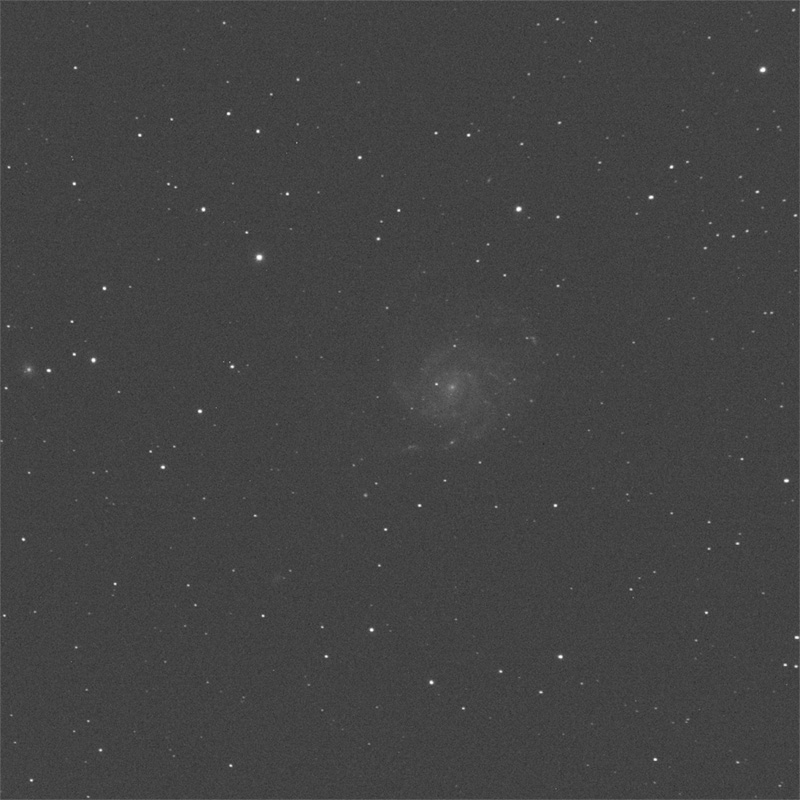

Then several processes are performed in PixInsight:
- The first step is removing the green background and correcting the gradient as much as possible: you can experiment with BackgroundNeutralization or AutomaticBackgroundExtractor; and in the case of a very complex gradient you can use DynamicBackgroundExtractor
- ColorCalibration
- SCNR
- noise reduction (EZ Denoise)
- splitting the image into 2: the starless image (all stars are removed from the photo) and the stars-only image (an image that contains only the stars) using STARNET2. Afterwards, the two images are processed separately, so that the adjustments made to nebulosity areas do not affect the stars.
The final color adjustments were done in Photoshop, then at the end I re-imported the modified images back into PixInsight and generated the final image by overlaying the stars-only image over the starless image.
In conclusion, the Pinwheel Galaxy (M 101) can be a subject both for beginner astrophotographers who only have a star-tracker, a standard camera and a telephoto lens, as well as for advanced astrophotographers who have a Go-To mount, a telescope with focal lengths over 600mm and a dedicated astro camera (color-OSC) or mono (in which case a set of R (red), G (green), B (blue) filters is used).