
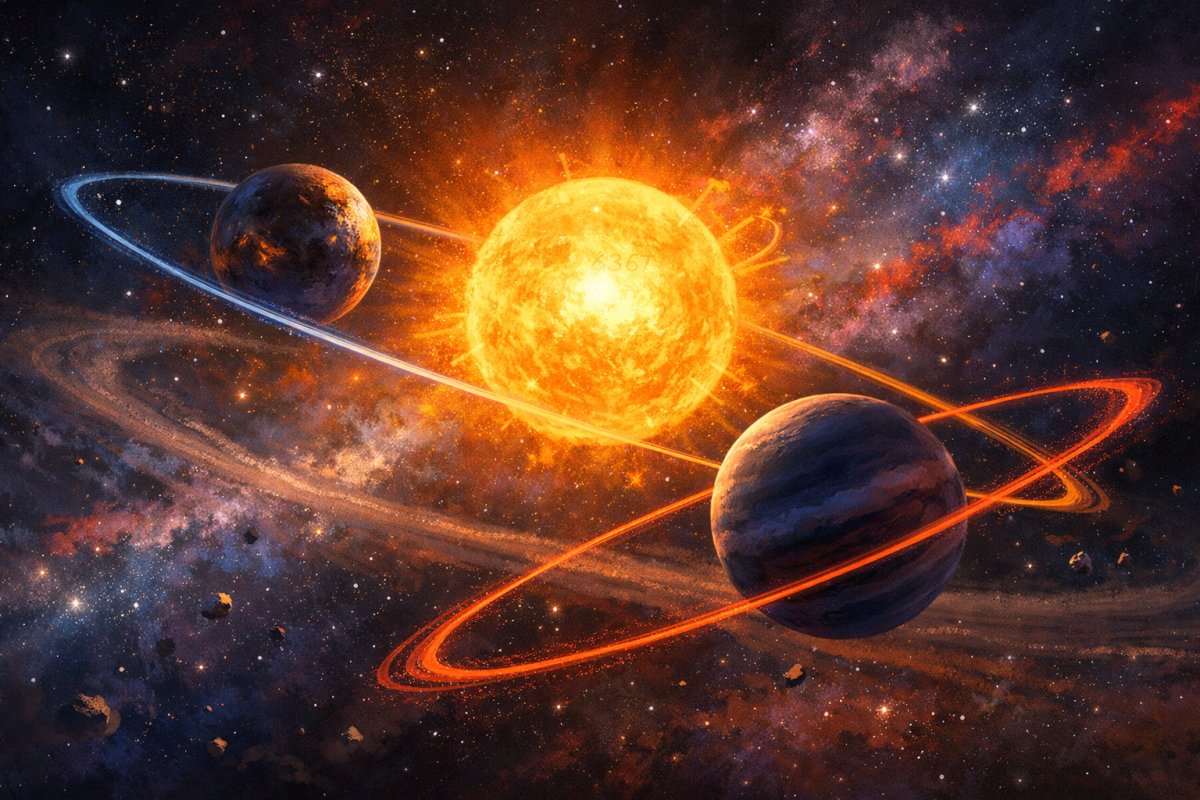
In recent years, exoplanetary systems have increasingly captured the attention of the astronomical community, not only because of their discovery but also due to unusual orbital configurations that challenge classical theories of planetary system formation. One such case is the HD 3167 system, which appeared to manifest a rare orbital geometry, with its transiting planets orbiting nearly perpendicularly to each other. However, recent studies suggest that the initial description was likely exaggerated and that the reality might be less dramatic but equally interesting for astronomy and astrophotography enthusiasts.
HD 3167 is a relatively nearby K-type star, which has allowed detailed observations using transit techniques and spectroscopy. The system is known for two of its transiting planets, named HD 3167 b and HD 3167 c, which initially seemed to have orbits almost orthogonal to one another. This configuration is extremely unusual because, generally, planets in a system form and migrate within a common orbital plane, reflecting the structure of the protoplanetary disk from which they emerged.
The scientific context of these studies begins with the understanding that orbital architecture is crucial for deciphering how planetary systems evolve over time. Highly inclined or perpendicular orbits can indicate strong external influences, such as gravitational interactions with massive bodies, disturbed trajectories, or even the presence of unseen planets or stars in complex positions within the system.
Researchers involved in recent efforts employed new techniques and additional data to verify the initial measurements. Using high-precision spectroscopic observations, including the Rossiter-McLaughlin velocity method, they reanalyzed the orbital angles of the planets. This method allows measurement of the projected orbital plane of a planet relative to the star’s rotational axis by observing the Doppler shift effect when the planet crosses the star’s face.
The updated results indicate that the angular difference between the planetary orbits is smaller than previously thought. Although there is a notable inclination, the planets are not exactly at 90 degrees with respect to each other but rather have a smaller tilt. This finding can be explained by a model of moderate migration or perturbation. This new interpretation changes the perspective on how these exoplanets formed and interacted around the star HD 3167.
This case highlights how dynamic and unpredictable exoplanetary systems can be and how important it is to have multiple methods and datasets to build the most accurate picture of their architecture. For astrophotography enthusiasts, such discoveries add an additional dimension: understanding orbital configuration not only enables capturing breathtaking images but also conducting quantified observations that help advance scientific knowledge.
In conclusion, the HD 3167 system remains a fascinating one, even if its planetary orbits are not as extremely perpendicular as initially believed. Research continues, and upcoming exoplanet-dedicated missions along with ever more powerful telescopes will certainly bring surprises and essential information for understanding the universe we live in.
Illustration generated with AI
Source: AAS Nova