
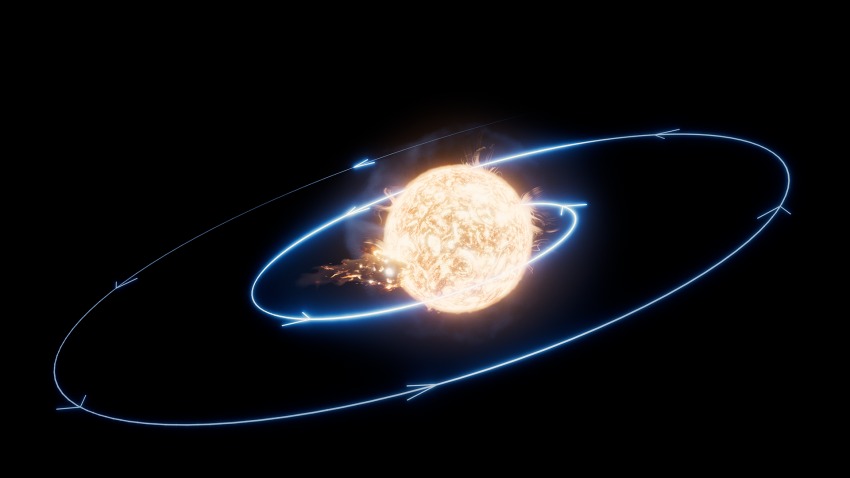
New research has unveiled an intriguing possibility about the early history of our solar system, proposing that the Sun might have consumed a large planet during its formative years. This hypothesis sheds light on certain unusual characteristics observed in the Sun`s composition, which have puzzled scientists for decades.
The broader context involves trying to solve puzzles related to a missing planetary body in the early solar nebula. Our Sun, a middle-aged G2V star, is mainly composed of hydrogen and helium. Yet, detailed spectroscopic studies reveal an unexpectedly high abundance of heavier elements in its outer layers, which standard models of solar formation cannot easily explain. This anomaly hints at some extraordinary event early in its development.
The new study, carried out by a team of astronomers using advanced stellar evolution modeling and numerical simulations, suggests that the Sun engulfed a sizeable planetary body during its protostellar phase. This planet, likely a gas giant in its infancy, failed to maintain a stable orbit and was eventually drawn into the star`s outer layers, altering its chemical makeup.
Direct observation of such an event is virtually impossible today, as it would have occurred over 4.5 billion years ago, and such processes are transient and difficult to capture. However, chemical signatures present in the solar atmosphere provide crucial clues, and comparative analysis with young stars in our galaxy supports this scenario.
Astrophysically, the accretion of planetary mass onto a young star can significantly influence its thermal and magnetic dynamics. The sudden infusion of heavy elements stirs convection and can leave lasting imprints on temperature and composition profiles within the star. Current sophisticated models can simulate these processes and reproduce features aligning with observed solar properties.
This new insight not only improves our understanding of the solar system`s birth but also informs general planetary system formation theories. The phenomenon of stars swallowing planets is not purely speculative — observations in other stellar systems have hinted at such interactions. Our Sun may be among these, and this study places it at the heart of the phenomenon with concrete data.
Moreover, these findings carry implications for astronomy and astrophotography enthusiasts alike. A better grasp of our star`s history refines models and observational strategies used to detect and characterize exoplanets around distant stars, including hints about their survival or destruction in early evolutionary stages.
In conclusion, this research presents a compelling narrative about the Sun`s turbulent youth, overcoming the prior assumptions of a quietly evolving star. The proposed ingestion of a large planet explains many of the solar composition`s unexpected traits and inspires novel theories regarding star and planet formation and evolution across the cosmos.
For astronomy aficionados and astrophotographers, understanding these complex processes enriches appreciation for the vast universe we inhabit and fuels passion for exploring and capturing its wonders.
Source: Universe Today