
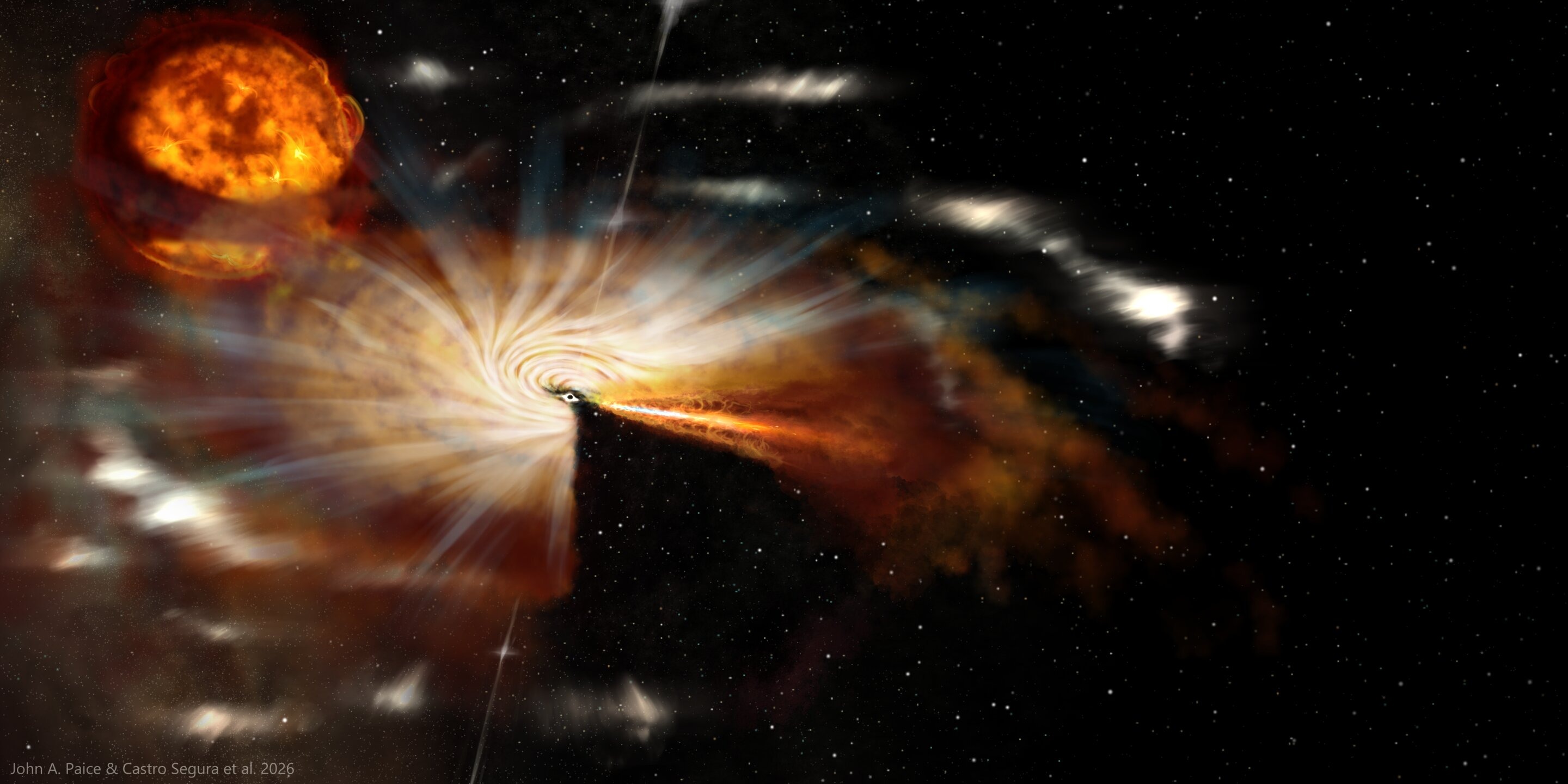
Black holes are frequently depicted as cosmic gluttons, swallowing anything that dares to come too close. However, groundbreaking observations led by Dr. Noel Castro Segura, a postdoctoral researcher at Warwick University, suggest this portrayal drastically oversimplifies the true nature of how black holes feed.
This new study focuses on a recent, dramatic black hole outburst — a sudden surge in brightness caused by rapid accumulation of surrounding matter. Classic models have traditionally assumed that black holes quickly and efficiently consume all infalling material. Contrary to this, observations reveal a far more chaotic and prolonged feeding process. Rather than instantaneously absorbing everything, the black hole appears to experience a kind of cosmic indigestion: much of the matter lingers in turbulent, unstable conditions around its event horizon, leading to unpredictable, long-lasting activity.
The scientific context underlying this research revolves around accretion processes — how matter spirals inward under the influence of intense gravitational pull and ultimately crosses the event horizon. As the gas heats up and ionizes, it emits strong electromagnetic signals, allowing astronomers to track these phenomena with advanced telescopes and instruments. By closely monitoring this recent outburst, Dr. Castro Segura and colleagues gathered compelling data that challenge the simplistic image of black holes as perfect, swift consumers.
Moreover, these observations shed light on energy transfer mechanisms that influence the immediate cosmic environment extensively. The lingering material around the black hole forms complex flows of gas and plasma, altering local astrophysical conditions and even impacting nearby galaxies over significantly longer time scales than previously assumed.
For astronomy enthusiasts and astrophotographers, this discovery opens an exciting window into the dynamic, unruly environments surrounding stellar-mass or supermassive black holes. The irregular rhythms of black hole feeding create unique observational opportunities, especially for those equipped with sensitive detection tools across various wavelengths. Understanding these cycles not only enriches our astrophysical models but also helps answer profound questions about the role black holes play in shaping large-scale cosmic structures.
Subcer.ro will continue to report on developments stemming from this remarkable investigation, which is reshaping our perception of the universe and posing new challenges to existing theoretical frameworks. It seems these enigmatic cosmic giants do not simply ingest matter in neat gulps but rather assimilate it in erratic feeding bouts, leaving a lasting impact well beyond the initial frenzy.
Source: Phys.org Astronomy