
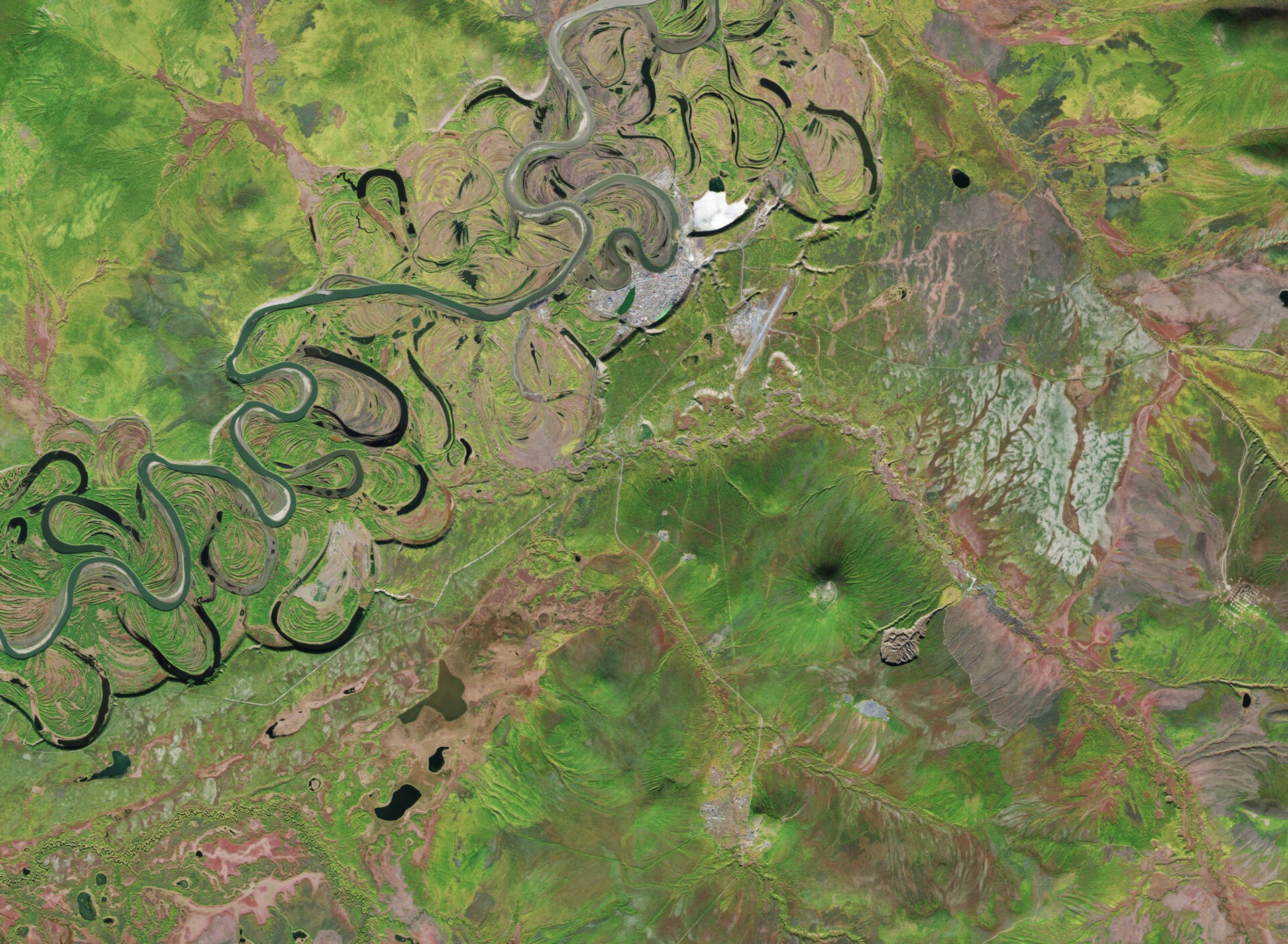
In recent decades, the effects of climate change have become increasingly visible, especially in the Earth`s polar and subpolar regions. One of the most striking examples of these environmental transformations is the Batagaika crater in Siberia, which stands as the world`s largest permafrost crater. A recent image captured by the European Space Agency`s (ESA) Copernicus Sentinel-2 satellite offers a clear and fascinating perspective on this unique geomorphological feature.
The Batagaika crater is known as a `mega-slump`, a massive landslide caused by the thawing of permafrost. Permafrost is defined as ground or rock that remains frozen for at least two consecutive years. In Arctic regions, large areas are covered by permafrost, and its thawing due to rising global average temperatures results in terrain instability, forming craters, cracks, and other irregular landforms.
Batagaika, sometimes called the `Siberian crater` or the `giant crater`, began forming in the 1960s. Initially a small depression, the thawing permafrost gradually enlarged it into the vast crater visible today. Currently, it measures over one kilometer in width and is estimated to be around 100 meters deep. Natural thawing continues to expand this geological formation.
The scientific importance of studying Batagaika stems from the fact that permafrost stores vast amounts of carbon in the form of frozen organic matter. When permafrost thaws, it releases gases such as carbon dioxide and methane — greenhouse gases that significantly contribute to global warming, methane being notably more potent. Therefore, Batagaika is not just a geological curiosity but a critical indicator of the ongoing climate crisis.
High-resolution satellite imagery, like that from Sentinel-2, is crucial for monitoring such remote and challenging areas, helping scientists track changes and understand thawing processes in detail. This ongoing data collection enables researchers to deepen their comprehension of long-term climate change impacts and predict potential ecological and environmental consequences both locally and globally.
Besides its scientific relevance, Batagaika represents a formidable challenge for nearby Siberian communities. These populations must adapt rapidly to the changing landscapes and cope with the risks associated with land subsidence, ecosystem alterations, and other environmental hazards triggered by permafrost thaw.
In summary, the Batagaika crater serves as a vivid reminder of the severe impact of climate change on our planet. Continued monitoring and research on this formation are vital to understanding permafrost dynamics better and developing strategies to mitigate the effects of global warming.
Source: ESA