
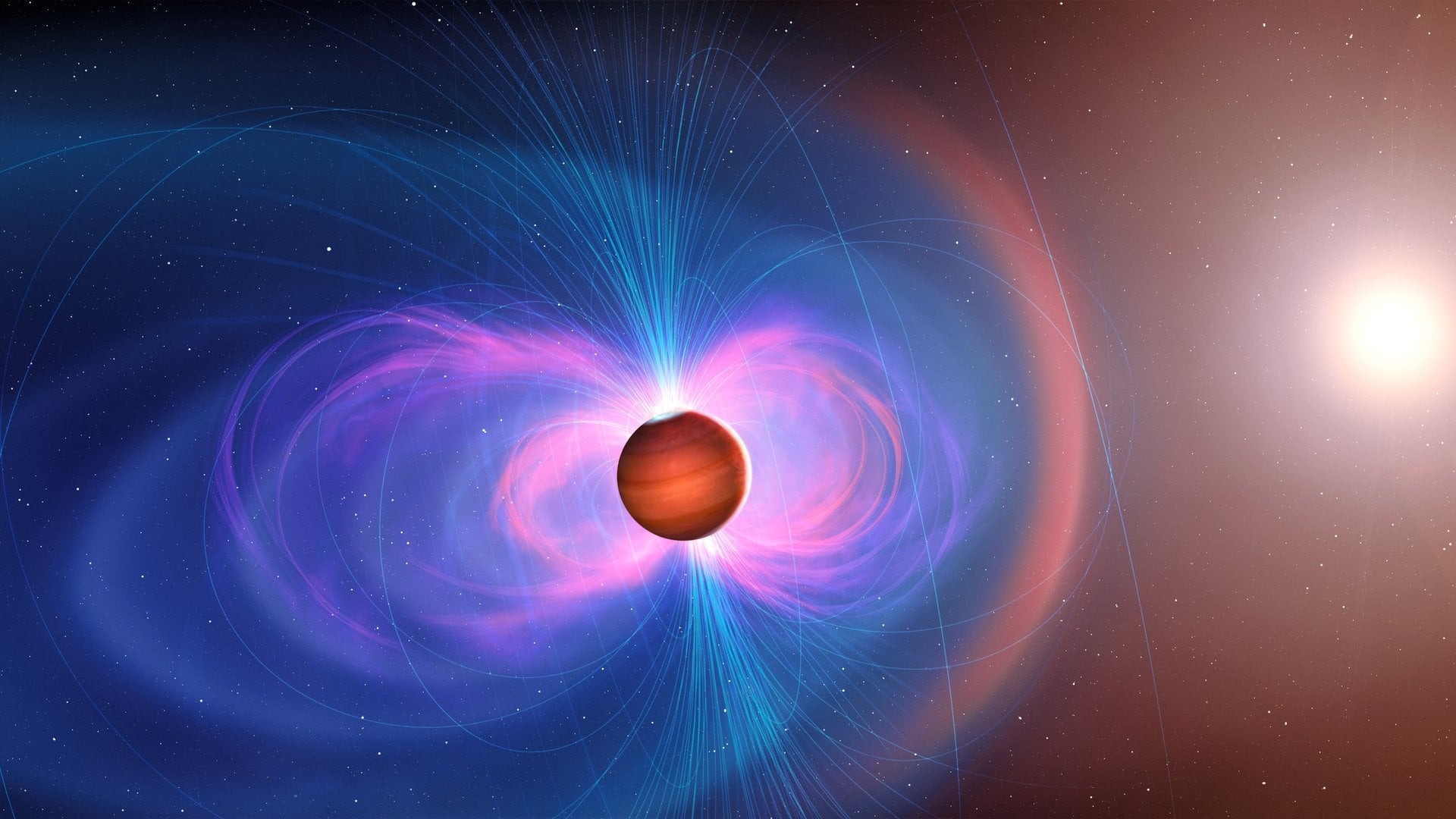
In recent years, the study of exoplanets has made spectacular progress, providing us with increasingly detailed insights into worlds beyond our Solar System. While current technologies allow us to determine atmospheric compositions and sometimes even weather conditions on these distant bodies, an important aspect of exoplanets remained uncertain: the existence and nature of their magnetic fields. Scientists have now taken a major step forward, discovering compelling evidence that some exoplanets possess strong magnetic fields significantly influencing the weather patterns we observe.
The recent study, conducted by astronomers examining atmospheric wind speeds on distant exoplanets, revealed that these planets do not only exhibit weather systems dominated by hydrodynamic phenomena, as is largely the case on Earth, but also display magnetically driven weather phenomena. This discovery provides some of the most robust evidence to date for the existence of magnetic fields on these alien worlds.
On Earth, weather is mainly governed by hydrodynamic processes – air circulation, pressure differences, and temperature gradients all contribute to the formation of winds, clouds, and storms. However, on certain exoplanets, magnetism plays a crucial role, with visible effects on atmospheric flows. This has major implications not only for understanding the climates of planets in other star systems but also for how magnetic fields can protect atmospheres and potentially influence the habitability of these worlds.
The research teams utilized advanced methods to measure wind speeds and detect indirect signs of magnetic fields. Techniques such as high-precision spectroscopy and monitoring the influence of magnetic fields on ionized atmospheric particles, which affect wind behavior, were key to their analysis. Based on the data gathered, the researchers could distinguish between meteorological patterns generated purely by hydrodynamic forces and those influenced by strong magnetic fields.
One of the main findings is the presence of atmospheric currents significantly altered by magnetic forces, creating unique weather phenomena not observable on planets without substantial magnetic fields. These magnetic effects on weather could manifest as extensive electrical storms, winds accelerated from specific regions, and rapid variations in atmospheric activity, all drastically changing the planetary meteorological landscape.
Furthermore, the presence of magnetic fields has a decisive impact on atmospheric retention. On Earth, the magnetic field shields the planet from solar wind and cosmic radiation, thereby limiting atmospheric loss. For exoplanets, such protection could be crucial in maintaining conditions suitable for liquid water and, by extension, potential life forms. As such, this discovery provides important clues in the search for life beyond the Solar System.
In conclusion, through observing and analyzing exoplanetary weather patterns, scientists have been able to add a new piece to the puzzle of understanding the physics of these extraterrestrial worlds. Confirming the existence of magnetic fields on exoplanets not only brings us closer to a comprehensive picture of these bodies but also opens avenues for further research related to atmosphere, climate, and extraterrestrial habitability. This finding represents a notable achievement in astrophysics and astrobiology, and astronomy and astrophotography enthusiasts can look with growing interest toward these distant systems that still harbor many fascinating mysteries.
Source: Universe Today