
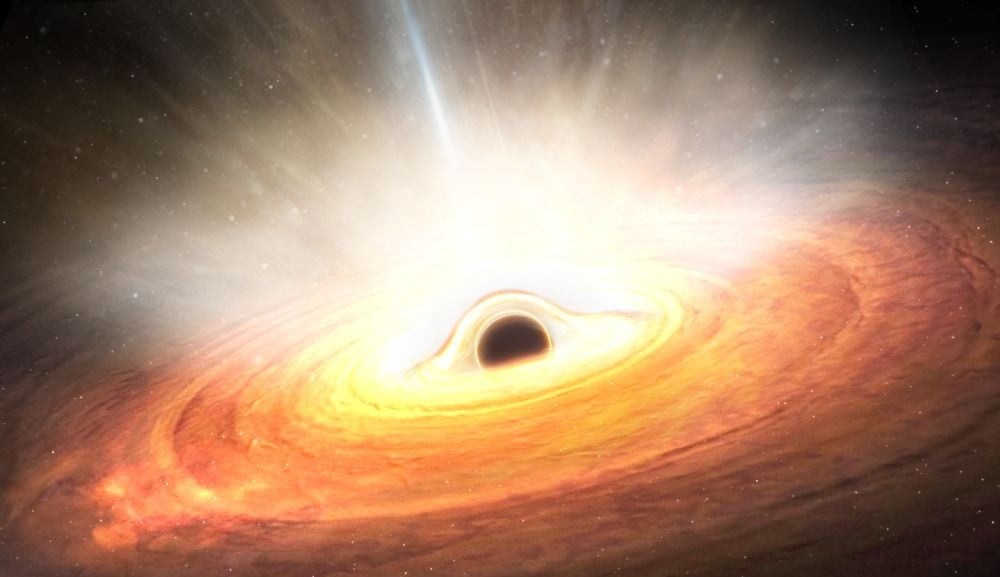
For over fifty years, astronomers have pursued a compelling and elusive phenomenon linked to the heart of our galaxy – the wind emitted by the supermassive black hole at the Milky Way`s center. A recent international research group has confirmed, for the first time, the presence of this galactic wind, unveiling images and analysis that reveal a distinct cone-shaped, nearly empty region pointing directly at the black hole.
What is a black hole wind and why does it matter?
In astrophysics, active black holes are considered energetic sources of radiation and moving matter. Theoretical models predict that any actively accreting supermassive black hole must produce a stream of particles – a wind or jet – manifesting as a powerful flow of matter accelerating outward from the galactic core. This phenomenon is crucial in galaxy evolution, as it can regulate star formation and the distribution of gas within the galactic environment.
However, detecting such a wind around Sagittarius A*, the supermassive black hole at the center of the Milky Way, has been notoriously challenging. Diverse disturbances and radiation sources complicate direct observations, and until now, evidence remained indirect and inconclusive.
The discovery – a cone-shaped empty region near the black hole
By leveraging advanced imaging technologies and data analysis, astronomers have pinpointed a unique cone-shaped area that appears to channel the powerful outflow of Sagittarius A*S wind. This region seems exclusively shaped by the energetic activity of the black hole, as no other known astronomical process could produce such a characteristic void and distinct form.
The images show that this active wind is clearing matter within its sphere of influence, crafting this evacuated cone extending outward from the galaxy`s center. This observation aligns perfectly with theoretical predictions and strengthens current understanding of how the black hole interacts with its surroundings.
Implications for astrophysics and astrophotography
This breakthrough carries broad implications. Scientifically, it confirms a fundamental model of supermassive black hole dynamics and provides a key to interpreting galaxy structure and evolution. Moreover, for astronomy enthusiasts and astrophotographers, it opens exciting new avenues for studying and capturing previously invisible phenomena.
Understanding how the central black hole affects its surroundings could elucidate mysteries related to radiation flows and gas movements near the galactic nucleus – a fascinating topic for both amateurs and professionals.
Context and future prospects
The discovery owes itself to the integration of multi-wavelength observations and state-of-the-art instruments, including space-based and ground-based telescopes equipped with cutting-edge technology. Ongoing monitoring of this wind will deepen insight into black hole dynamics and enhance comprehension of its influence on the Milky Way.
After decades of speculation and indirect study, astronomers have finally lifted the veil on one of the most enigmatic components of our galaxy, offering a priceless glimpse into the cosmic mechanisms that govern the universe.
Source: Universe Today