
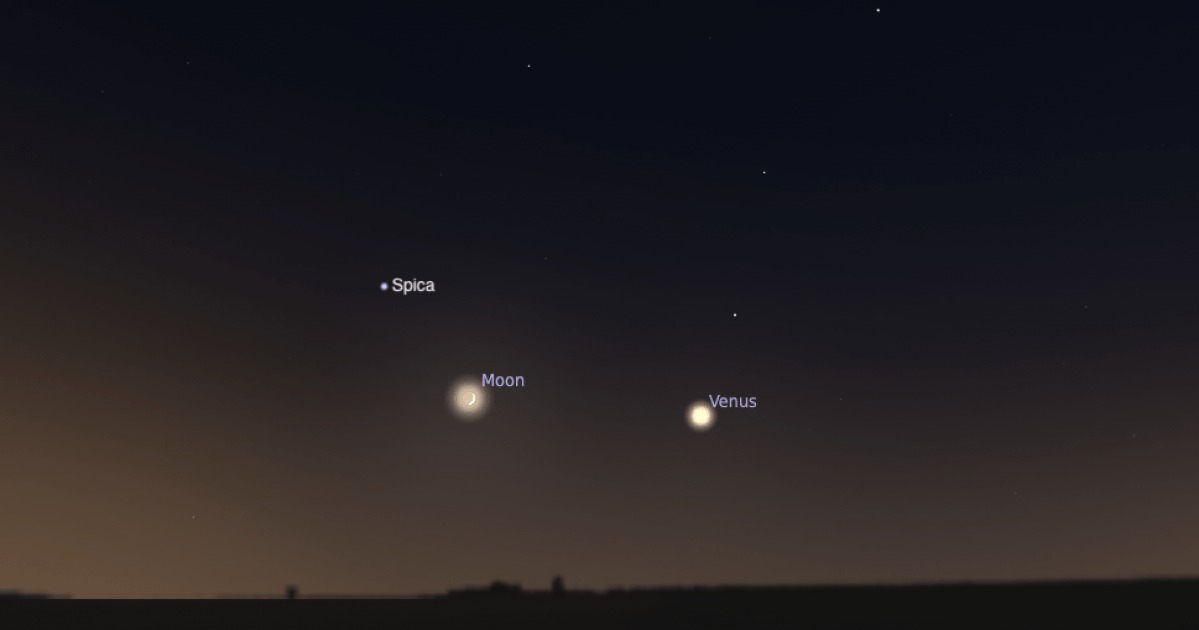
On the evening of August 16, 2026, skywatchers, astronomy enthusiasts, and astrophotographers will find a celestial spectacle impossible to miss in the western horizon after sunset. The Moon and the luminous planet Venus will appear close together in a striking conjunction, providing a fantastic opportunity for observation and capture through cameras and telescopes alike.
The Moon, Earth`s natural satellite, has fascinated humankind for millennia with its changing phases and dramatic presence in the sky. On this particular evening, it will hang near Venus, one of the brightest planets visible from Earth. Venus, often called the Evening Star, is the second planet from the Sun and the brightest after the Moon itself. Its brilliance comes from a thick atmosphere composed mainly of carbon dioxide clouds that reflect sunlight efficiently, making it shine intensely even during twilight hours.
Adding to this cosmic display, the bright star Spica, located in the constellation Virgo, will also be visible nearby. Spica is the most luminous star in Virgo and has served as a reference point for astronomers and navigators throughout history. The close apparent proximity of the Moon, Venus, and Spica creates a picturesque scene that is rewarding both for visual observers and for those who aim their cameras at the sky.
From a scientific perspective, this event is a wonderful example of a conjunction — a term used in astronomy to describe the apparent alignment of two or more celestial bodies when viewed from Earth. Although the Moon and Venus are at vastly different distances from our planet, their paths across the sky intersect from our line of sight, creating the illusion that they are near each other. In reality, Venus orbits the Sun while the Moon orbits Earth, so their actual spatial separation is enormous.
The best time to view this conjunction is soon after sunset, when the sky begins to darken but retains enough light to place the surrounding stars and planets in context. During this twilight period, Venus is particularly dazzling due to its proximity to Earth and its reflective cloud cover. The Moon, with its surface features illuminated by the Sun, will provide interesting details to those using binoculars or small telescopes, allowing observers to see craters and maria on its surface.
Events such as these are not only visually captivating but also connect us deeply with the cosmic rhythms of our neighborhood in space. Observing the Moon’s phases and the motions of planets like Venus has helped humankind develop calendars, track time, and construct early models of the solar system. Each glance upward serves as a reminder of our place in the vast universe and inspires continued curiosity and exploration.
August also offers other noteworthy astronomical happenings, such as meteor showers and further planetary alignments. Keeping track of these provides a continuous stream of adventures for those passionate about the night sky. For newcomers and veterans alike, astronomy apps and websites offer excellent guides to planning observations, ensuring that no exciting event is missed.
In summary, the evening of August 16, 2026 promises a beautiful visual treat as the Moon, Venus, and star Spica cluster near one another against the deepening twilight of the western sky. Whether you are a casual stargazer or an avid astrophotographer, this conjunction is an event worth witnessing and capturing. Set up your telescope, ready your camera, and prepare to immerse yourself in the magnificent dance of the heavens.
Clear skies and happy observing!
Source: astronomy.com