
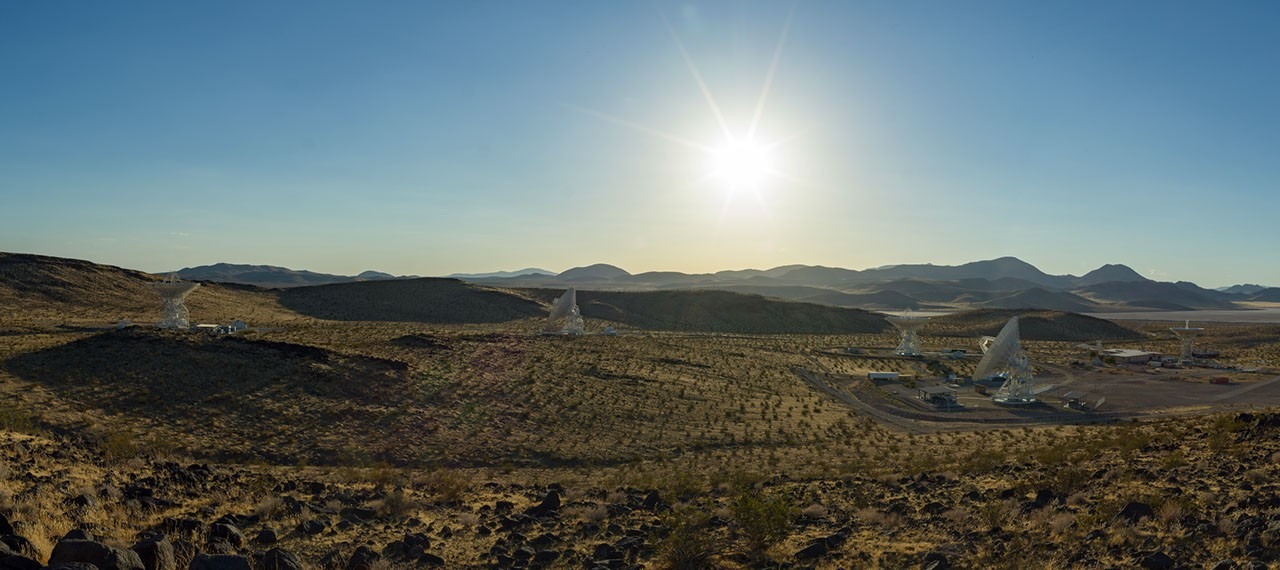
Under the vibrant summer sun of California`s Mojave Desert, five massive 34-meter antennas stand tall within NASA`s Deep Space Network (DSN) Goldstone complex near Barstow. Captured in a stunning panorama in August 2026, this image offers astronomy enthusiasts and space technology aficionados a glimpse into one of the most crucial communication hubs that supports humanity`s exploration of the cosmos beyond Earth`s orbit.
The Deep Space Network is a global system of large radio antennas positioned strategically around the world to maintain continuous communication with spacecraft exploring distant realms of our solar system and beyond. With sites located in Goldstone, California; Madrid, Spain; and Canberra, Australia, the DSN facilitates signal relay no matter the spacecraft`s position relative to Earth. The Goldstone complex specifically hosts several antenna dishes, including those with a diameter of 34 meters, designed to track, receive, and transmit signals over vast interplanetary distances.
These 34-meter antennas provide a perfect balance between the enormous 70-meter dishes and smaller arrays. They operate primarily in high-frequency bands such as the X-band and Ka-band, enabling efficient data transmission even at hundreds of millions of kilometers from Earth. The antennas are remarkably sensitive, capable of detecting faint radio waves sent by spacecraft operating in deep space. Successfully capturing these weak signals is critical to acquiring scientific data and maintaining control of remote probes.
The Goldstone complex is named after the Goldstone Valley in the Mojave Desert and forms a part of NASA`s Jet Propulsion Laboratory (JPL) national infrastructure. It plays an integral role in robotic missions exploring Mars, asteroids, comets, and the outer planets. The DSN`s worldwide antenna layout ensures round-the-clock communication—when a spacecraft is not visible from one site, another site takes over tracking responsibilities seamlessly.
This summer-lit photograph emphasizes the metallic framework and electromagnetically optimized design of each antenna. Every dish consists of a precisely shaped parabolic reflector that collects and focuses radio waves to a receiver at the focal point. Though visually similar, each antenna can be specifically configured and directed to different spacecraft, tracking objects moving rapidly against the background of space.
The importance of these antennas grows as space agencies prepare increasingly ambitious missions to the Moon, Mars, and beyond. Reliable, high-bandwidth communication channels allow scientists and engineers to receive vital telemetry, control commands, and scientific measurements. Goldstone and its DSN counterparts serve as the backbone infrastructure sustaining these connections across unimaginable cosmic distances.
For amateur astronomers and astrophotographers, the Goldstone antennas offer a captivating example of how advanced technology supports deep space exploration. Observing phenomena or learning about long-distance space communication is enhanced by understanding the role of these giant radio dishes. They stand as monuments not only to human curiosity but also to engineering mastery pushing the frontier of our knowledge.
In summary, NASA`s panoramic image invites us into the complex world of interplanetary communication technology, where each antenna plays a vital role in expanding our horizons across the stars. Gazing upon these impressive structures reminds us of the collaborative efforts and technological ingenuity required to bridge the vast gulf between Earth and the daring missions venturing into the cosmic unknown.
Source: NASA