
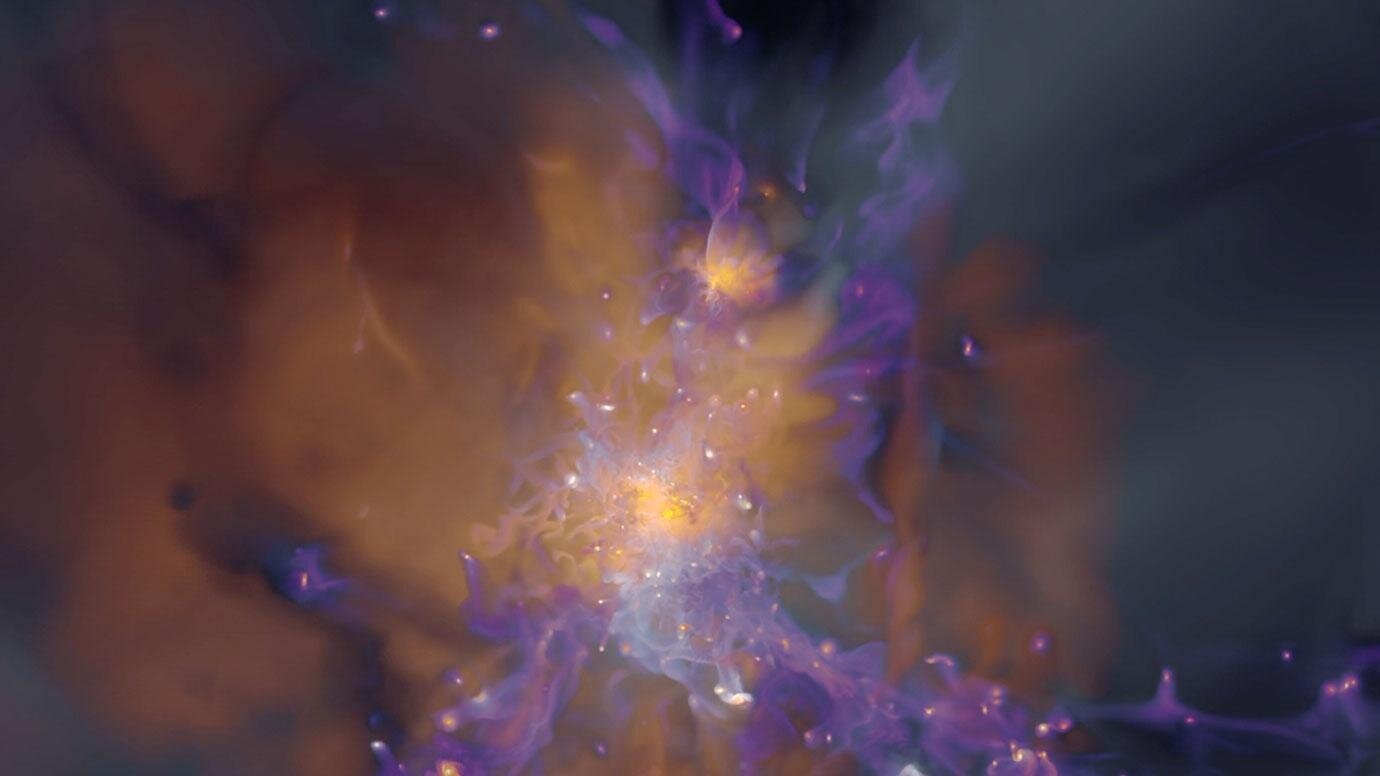
The early universe looked dramatically different from the starry night sky we observe today. According to recent advanced simulations, the region that would eventually become our Milky Way was once home to thousands of smaller galaxies. These simulations provide compelling evidence that our galaxy did not form as a single entity but was assembled through the gradual merger of a multitude of smaller galactic structures, each with diverse characteristics ranging from vigorous star formation to being dominated by gas or remnants of dead stars and black holes.
This new research offers a profound insight into the complex processes behind the birth and evolution of our galaxy. It highlights the fragmented nature of cosmic structure in the earliest epochs following the Big Bang and demonstrates how smaller proto-galaxies coalesced to form the massive, spiral galaxy that is the Milky Way.
The scientific context of galaxy formation
Galaxies are massive cosmic systems composed of stars, gas, dust, and dark matter, and they serve as the fundamental building blocks of the universe. After the Big Bang, the universe underwent a rapid expansion and cooling phase that allowed the first stars and galaxies to begin forming within a few hundred million years. However, the Milky Way`s current location was originally occupied by countless smaller galaxies often referred to as dwarf galaxies or proto-galaxies.
Each of these early galaxies had varying attributes: some were stellar nurseries forming new stars at a high rate, others contained predominantly cold gas, and some were populated mainly by aging stars and black holes. This diversity played a crucial role in the formation of the Milky Way, as these galaxies merged over billions of years, building up the complex galactic structure that we see today.
Simulations reshaping our view of the Milky Way
The research is based on detailed computer simulations that model galaxy formation on cosmic time scales and vast spatial scales. These findings illustrate how thousands of smaller galaxies gathered and merged in the region destined to become our own galaxy. The simulations emphasize the critical role of dark matter and intergalactic gas in shaping the location and structure of the Milky Way.
For astronomy and astrophotography enthusiasts, these discoveries invite a new appreciation of the night sky, encouraging observers to think about the Milky Way as a dynamic historical record of cosmic evolution, rather than a static backdrop of stars. It underscores the notion that the stellar populations we observe today stem from a far more turbulent cosmic past.
Implications for astrophotography and observation
Understanding the formation processes of the Milky Way has important implications for those capturing images of our galaxy or studying the spatial distribution of stars and nebulae. Knowing that our region formed through the merging of thousands of small galaxies allows astronomers to identify and interpret features such as stellar streams, residual star clusters, or remnants of galaxies assimilated into the Milky Way, adding layers of depth and history to astrophotography work.
This perspective enriches our appreciation for the stars we capture through telescopes or cameras, each with a story tied to the grand narrative of the cosmos. This novel study essentially maps the cosmic ancestry of our galaxy’s stars.
In conclusion, the Milky Way should be understood not as a single primordial galactic entity but rather as the outcome of a slow and complex amalgamation of numerous smaller galaxies. Exploring and studying these formative processes brings us closer to comprehending our universal origins and encourages ongoing exploration with modern scientific tools and curiosity.
Source: Phys.org Astronomy