
Introduction
Galactic collisions are among the most spectacular and violent events in the cosmos, creating breathtaking scenes that captivate astronomers and astrophotography enthusiasts alike. At the heart of these colossal encounters lie supermassive black holes (SMBHs), cosmic giants with masses millions to billions of times that of our Sun. These entities engage in a chaotic orbital dance that eventually leads to their merger into a single remnant.
One of the most fascinating phenomena in this process is the possibility that these SMBHs might receive a powerful `kick`—a recoil—that propels them out of their galaxy`s center. This phenomenon holds significant implications for galaxy evolution and black hole dynamics.
Scientific background
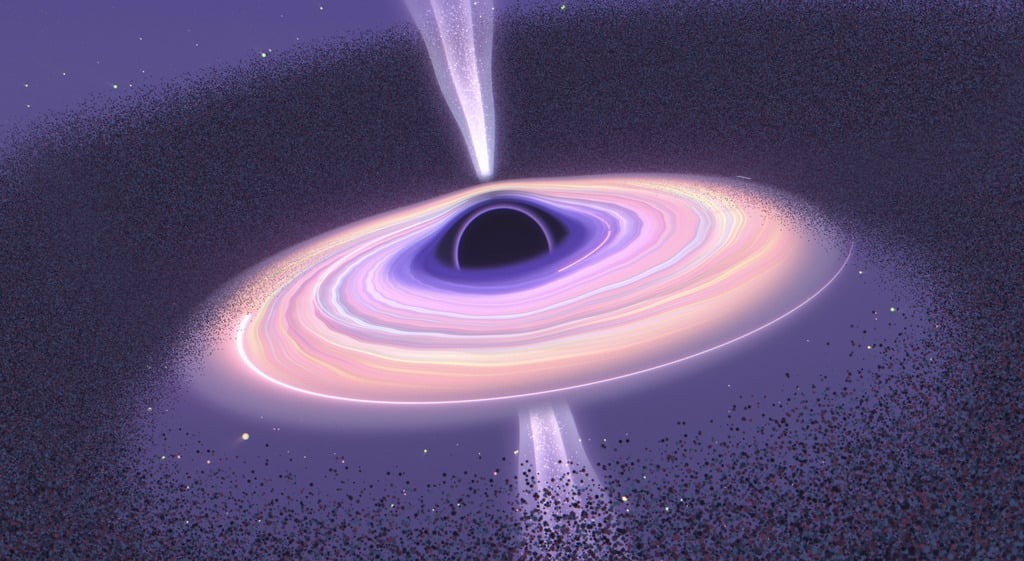
A supermassive black hole is a region of spacetime exhibiting gravitational acceleration so strong that nothing—not even light—can escape it. These behemoths reside at the centers of most galaxies. When two galaxies collide, their respective SMBHs begin a complex evolutionary process: they orbit one another, emit gravitational waves as they spiral closer, and eventually merge into a single, larger black hole.
This merging process emits powerful gravitational waves and, under particular conditions, can impart a recoil velocity sufficient to dislodge the merged SMBH from the galactic nucleus. Detecting these `recoiling` black holes has been a significant observational challenge because they often remain hidden or subtly influence their surroundings.
A novel approach
Recently, an international team of astronomers published a groundbreaking paper on arXiv introducing innovative statistical methods to hunt for these elusive fast-moving giants. Using extensive datasets from quasar and active galactic nucleus observations—where the intense radiation emitted by accreting material lights up the black hole`s surroundings—the researchers identified unusual spectral signatures indicating unusual velocities.
These spectral anomalies correspond to SMBHs that are not stationary but moving rapidly, presumably as the result of recoil after a merger event.
Implications of the discovery
Confirming the existence of recoiling SMBHs significantly impacts our understanding of galaxy formation and evolution. Such off-center black holes can disrupt the distribution of gas and stars, modulate the accretion rate, and thus influence how galaxies grow and evolve over cosmic time.
Moreover, these findings reinforce general relativity predictions and contribute to the burgeoning field of gravitational wave astrophysics. The discovery opens new pathways for future investigations using gravitational wave detectors like LIGO and Virgo, combined with multi-wavelength electromagnetic observations.
Looking ahead
As technology advances and astronomical observatories, both space and ground-based, reach unprecedented sensitivity, astronomers will better capture these dynamic black holes and fully understand their consequences.
This era is incredibly exciting for astronomy and astrophotography enthusiasts, as every new discovery adds depth to our cosmic puzzle. Understanding these extraordinary phenomena enriches the experience of sky-watching and deep-sky imaging, unveiling the universe`s ever-changing nature.
This study reminds us that the universe is full of surprises and that even its most massive objects can be propelled through space, forever altering the face of a galaxy.
Original study link: universetoday.com
Source: Universe Today