
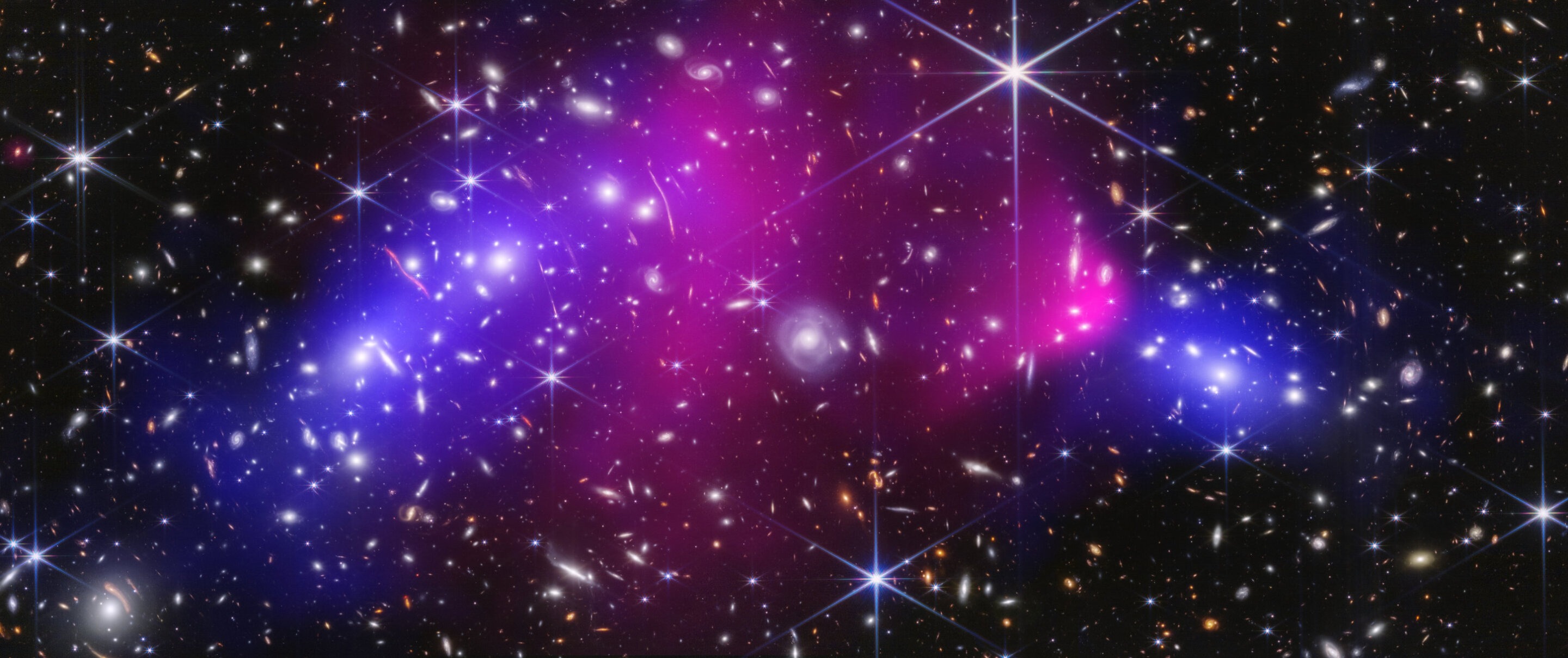
In the captivating world of astronomy and astrophotography, one of the most iconic cosmic structures — the Bullet Cluster — has long been regarded as compelling evidence for the existence of dark matter. This invisible substance, thought to exert gravitational influence over galaxies and galaxy clusters but not emitting any detectable light, remains one of the most intriguing scientific mysteries. However, recent observations and analyses by an international team of researchers present a fascinating alternative explanation that does not necessarily require the large quantities of dark matter previously assumed.
The Bullet Cluster is composed of two galaxy clusters that collided at an extraordinary speed. Earlier observations, including X-ray data and gravitational lensing effects, have revealed a dissociation between visible matter — primarily the hot intergalactic gas — and the total mass inferred from gravitational effects. This discrepancy has been interpreted as evidence of dark matter, since only this unseen form of matter could explain the mismatch between the detectable matter via radiation and the gravitational influences observed.
The researchers utilized the latest data from the James Webb Space Telescope (JWST), which provides much deeper and more detailed images of the cluster. After in-depth analysis of these data, the team suggests that the observations can also be explained within an alternative framework known as Modified Newtonian Dynamics (MOND). MOND proposes modifying the laws of gravity at cosmological scales, rather than invoking dark matter. According to MOND, gravitational forces behave differently at very large scales compared to the expectations based on Newtonian and Einsteinian gravity.
This study emphasizes that while dark matter may still exist, its quantity within the Bullet Cluster might be significantly smaller than previously thought. Therefore, the observed phenomena could result from a combination of visible matter and modified gravitational effects. If correct, this hypothesis could fundamentally alter our understanding of the Universe`s composition and the dynamics of galaxies and galaxy clusters.
The debate around dark matter is among the greatest mysteries in modern astronomy. Over decades, indirect evidence has led scientists to consider dark matter a dominant component of the Universe, accounting for about 27% of its total energy budget. Yet, direct detection of dark matter particles remains elusive, with their presence inferred only through gravitational effects on visible matter.
Alternative theories like MOND have been proposed to explain anomalies observed in galaxy rotation curves and certain cosmic phenomena. However, these theories have faced criticism because they struggle to match all cosmological observations with the same precision as the classical dark matter model. Thus, this new research, leveraging fresh JWST data, is revolutionary by providing new arguments to reinterpret Bullet Cluster observations.
This ongoing debate also holds significant implications for astrophotography. Capturing clearer and more comprehensive images of luminous clusters across various wavelengths is crucial for detecting subtle phenomena that may confirm or refute these theories. While the James Webb telescope offers an unprecedented perspective, the passion for capturing fine cosmic details remains a driving force for amateurs and professionals alike.
As the scientific community continues to analyze data and create increasingly sophisticated models, it is clear that the Universe still harbors many secrets. Research on this colossal cluster proves that science is an ever-evolving journey of discovery, where each observation has the potential to overturn entire paradigms. For astronomy enthusiasts, this new MOND-compatible hypothesis brings renewed excitement and an invitation to explore, opening pathways to possible revolutions in cosmic understanding.
In conclusion, the MOND-compatible explanation of Bullet Cluster observations, supported by JWST results, does not definitively reject the existence of dark matter but rather encourages us to reconsider its amount and role in the cosmos. For astronomers, astrophotographers, and science lovers, the future promises new discoveries and revelations that bring us closer to the true mysteries of the Universe.
Source: Phys.org Astronomy