
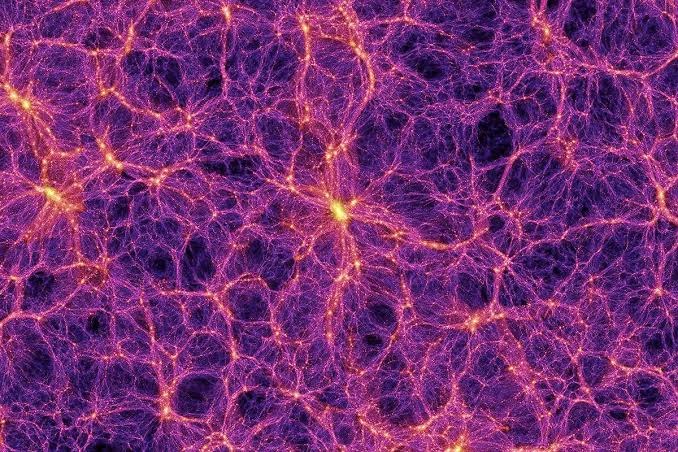
Our vast and mysterious universe is predominantly composed of enormous regions that astronomers call voids or cosmic voids. These immense cosmic expanses are characterized by extremely low matter density and occupy the majority of the observable universe`s volume. While these voids might appear to be devoid of any cosmic life, a new study using the CAVITY survey reveals that they are not entirely empty. Interestingly, small groups of galaxies manage to survive and even form loose associations within these seemingly barren environments.
Using a technique known as the "friends of friends" approach, which identifies galaxy clusters based on their spatial proximity and gravitational ties, researchers have mapped how galaxies cluster together in these vast cosmic voids. Although most galaxies in these voids live solitary lives—with isolation being the norm—when groups do form, they tend to be small, loosely bound, and curiously independent of just how empty their surroundings actually are.
This discovery sheds new light on galaxy dynamics and evolution in parts of space that are unusually sparse, raising a compelling question: what factors lead some galaxies to seek companionship while most remain isolated in cosmic solitude? Understanding these processes can provide valuable insights into the mechanisms governing matter distribution and large-scale structure formation in the universe.
The scientific context behind this topic begins with the understanding that the universe`s matter distribution is not uniform on small scales, but instead forms a complex structure known as the cosmic web. This cosmic web consists of filaments of galaxies and dark matter interconnected by vast, empty voids where matter density is remarkably low. Until now, these cosmic voids were thought to be nearly sterile, but data from the CAVITY survey illustrates that galaxies do exist here, sometimes in small groups.
The "friends of friends" algorithm employed in this study is a widely used astrophysical method for detecting galaxy groups by linking galaxies that are close enough to be gravitationally associated. Applying this technique to cosmic void data reveals that the cores of these void groups are weak and their gravitational connections are more flexible than those found in the dense clusters of galaxies at the cosmic web`s nodes.
These findings open exciting new perspectives for astronomy and astrophotography enthusiasts alike, encouraging them to view cosmic voids not as empty, cold wastelands, but as environments where the universe harbors hidden, small galactic communities. With advancing observational capabilities and increasingly powerful telescopes, future research is poised to uncover even more intriguing structures within these cosmic deserts.
In conclusion, this study on galaxy groups within the universe`s voids demonstrates that even in the emptiest regions of space, galactic life is not completely absent. It invites us to contemplate the universe`s complexity and ask how matter evolves in some of the most unexpected places—questions that fascinate anyone who follows the mysteries of the cosmos.
Source: Universe Today