
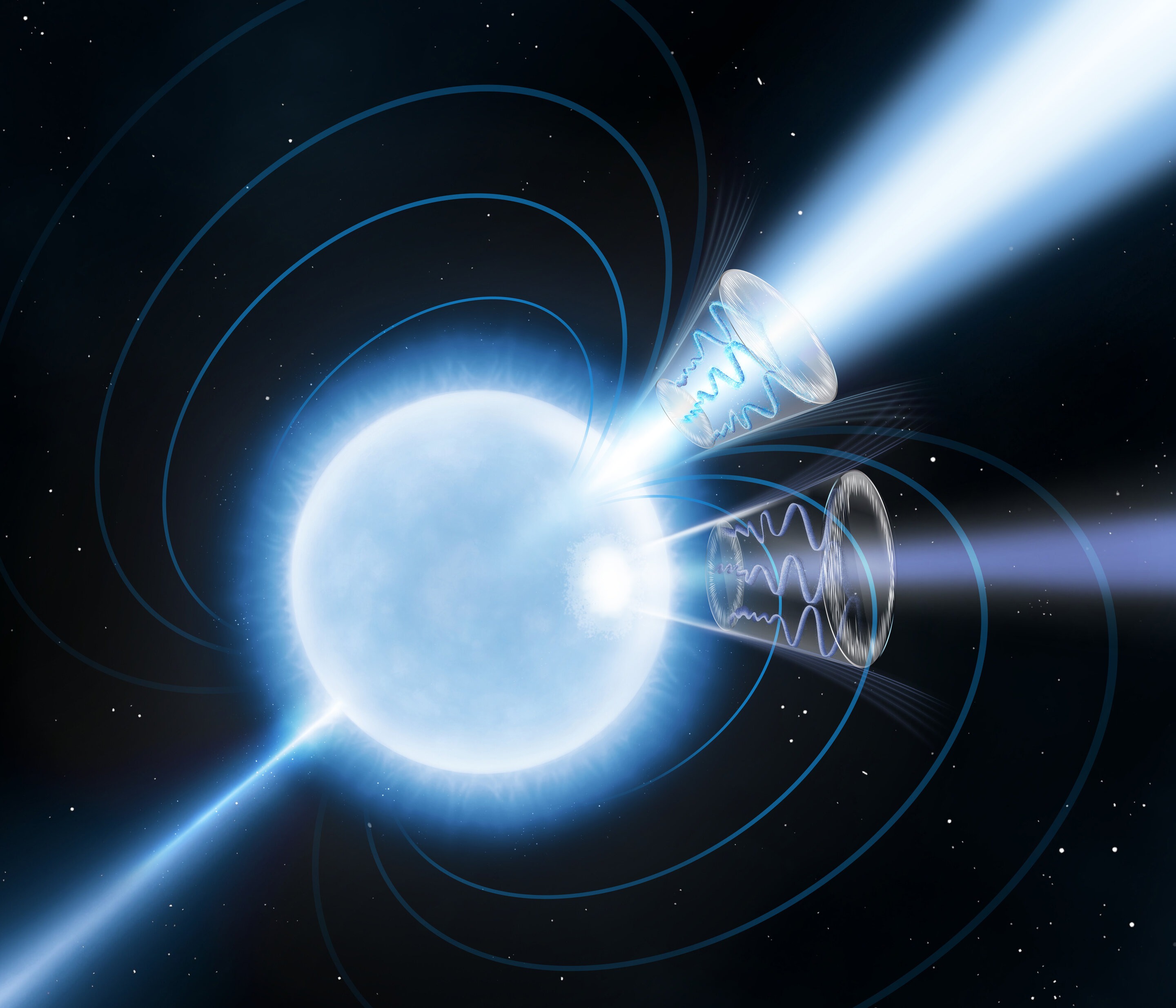
In the expansive realm of astrophysics, where the universe continually astounds us with extraordinary phenomena, a recent breakthrough related to an ultra-magnetic star has captivated the scientific community. This rare celestial object may hold the key to understanding a fundamental quantum phenomenon long theorized — vacuum birefringence — first predicted nearly 90 years ago.
But what exactly is vacuum birefringence, and why does it matter? In simple terms, vacuum birefringence is a peculiar property of seemingly empty space, which according to quantum theory, is never truly empty. Back in the 1930s, Werner Heisenberg, one of the founding figures of quantum mechanics, proposed that a vacuum is filled with virtual particles — transient entities that fleetingly pop in and out of existence.
These ephemeral particles influence how light propagates through space, causing the vacuum to behave as an anisotropic optical medium. This means that light polarized in different directions travels at slightly different speeds. Vacuum birefringence is this subtle effect, which, until recently, had remained purely theoretical due to the extraordinarily strong magnetic fields required to observe it directly.
Recently, astronomers turned their attention to an ultra-magnetic star known as a magnetar, boasting one of the strongest magnetic fields ever observed in the known universe. Such colossal magnetic fields provide the ideal environment to amplify quantum effects on light, allowing us to catch a glimpse of these elusive phenomena in practice.
The studied magnetar creates the perfect natural laboratory for investigating vacuum birefringence. Light emitted from this star traverses regions where intense magnetic fields interact with the virtual particles in the vacuum, shifting the polarization characteristics of electromagnetic waves. Using cutting-edge observational methods and state-of-the-art polarimetry instruments, scientists have now detected this rare and subtle effect for the first time.
Confirming this hypothesis not only substantiates Heisenberg`s nearly century-old theoretical prediction but also opens a new window into understanding fundamental light-matter interactions under extreme cosmic conditions. For astronomy enthusiasts and astrophotographers alike, this discovery implies that images and data collected from cosmic objects with intense magnetic fields might soon reveal far deeper insights into the governing mechanics of our universe.
Beyond its theoretical importance, this observation holds practical implications. Understanding vacuum birefringence could significantly influence the development of future optical communication technologies or space exploration tools, where precise control over light propagation media is critical. New knowledge about how light behaves in the presence of tremendous magnetic fields could revolutionize modern optics and materials physics.
Looking ahead, studying ultra-magnetic stars like this rare magnetar condenses a unique set of conditions that enable us to test foundational physics theories within a natural laboratory. This is compelling evidence that the universe, with all its diversity and complexity, remains an expansive experimental arena where science continuously evolves. Astrophotography enthusiasts can anticipate unique opportunities to capture images that reflect impressive quantum phenomena using modern telescopes or upcoming space-based instruments.
In conclusion, the confirmation of vacuum birefringence via observations of an ultra-magnetic star represents a landmark achievement in modern physics and offers concrete evidence that quantum theory extends naturally to cosmic scales. This discovery reaffirms the close ties between astronomy and theoretical physics, two branches of knowledge that together help decode the mysterious mechanisms underlying our universe.
Source: Phys.org Astronomy