
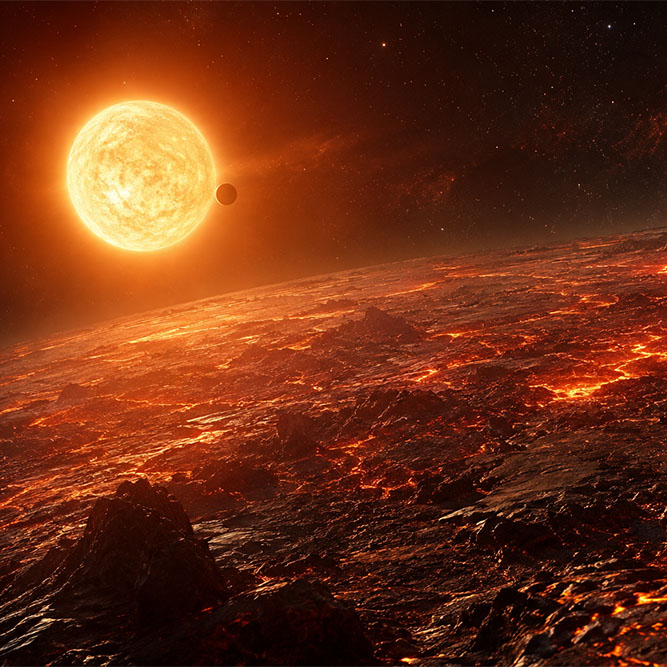
The James Webb Space Telescope has given astronomers the most detailed view yet of the surface of a planet located outside the Solar System, revealing a dark, scorching world almost completely devoid of atmosphere.
Astronomers using the James Webb Space Telescope managed to directly study the surface of the exoplanet LHS 3844 b, located approximately 49 light-years away from Earth. The discovery represents an important step for modern astronomy, as until now most studies of exoplanets focused primarily on their atmospheres rather than on their actual surfaces.
LHS 3844 b is a “super-Earth,” with a diameter approximately 30% larger than our own planet. However, the similarities with Earth end there. The planet orbits extremely close to its host star and is tidally locked, meaning the same side always faces the star — similar to the way the Moon always shows the same face to Earth.
On the illuminated side, temperatures exceed approximately 700°C, hot enough to melt many types of rock. In contrast, the side permanently shrouded in darkness is much colder. The enormous temperature difference between the two hemispheres helped researchers reach an important conclusion: the planet does not appear to possess a significant atmosphere capable of transporting heat from one side to the other.
Data obtained by Webb suggest that the planet’s surface is composed of very dark volcanic rocks similar to basalt. Astronomers compare its appearance to that of the planet Mercury in our Solar System — a scorched, sterile world lacking the protection of an atmosphere.
For the scientific community, these observations are extremely important. This is the first time the Webb telescope has managed to provide direct clues about the geology of a rocky exoplanet. Such research helps astronomers better understand how diverse the worlds in our galaxy can be and how rare a truly Earth-like planet might actually be.
The discovery is also relevant for the future of astrophotography and cosmic exploration. Although these exoplanets cannot yet be photographed directly in detail with current instruments, the technologies developed for Webb and for future giant telescopes such as the Extremely Large Telescope will allow increasingly precise studies of the surfaces and atmospheres of planets located tens or even hundreds of light-years away.
In the coming years, astronomers hope to identify exoplanets that not only possess atmospheres, but also favorable conditions for liquid water and, potentially, life.
Sources:
JWST Captures an Airless World: The Clearest “Map” Yet of an Exoplanet’s Surface
-
264