
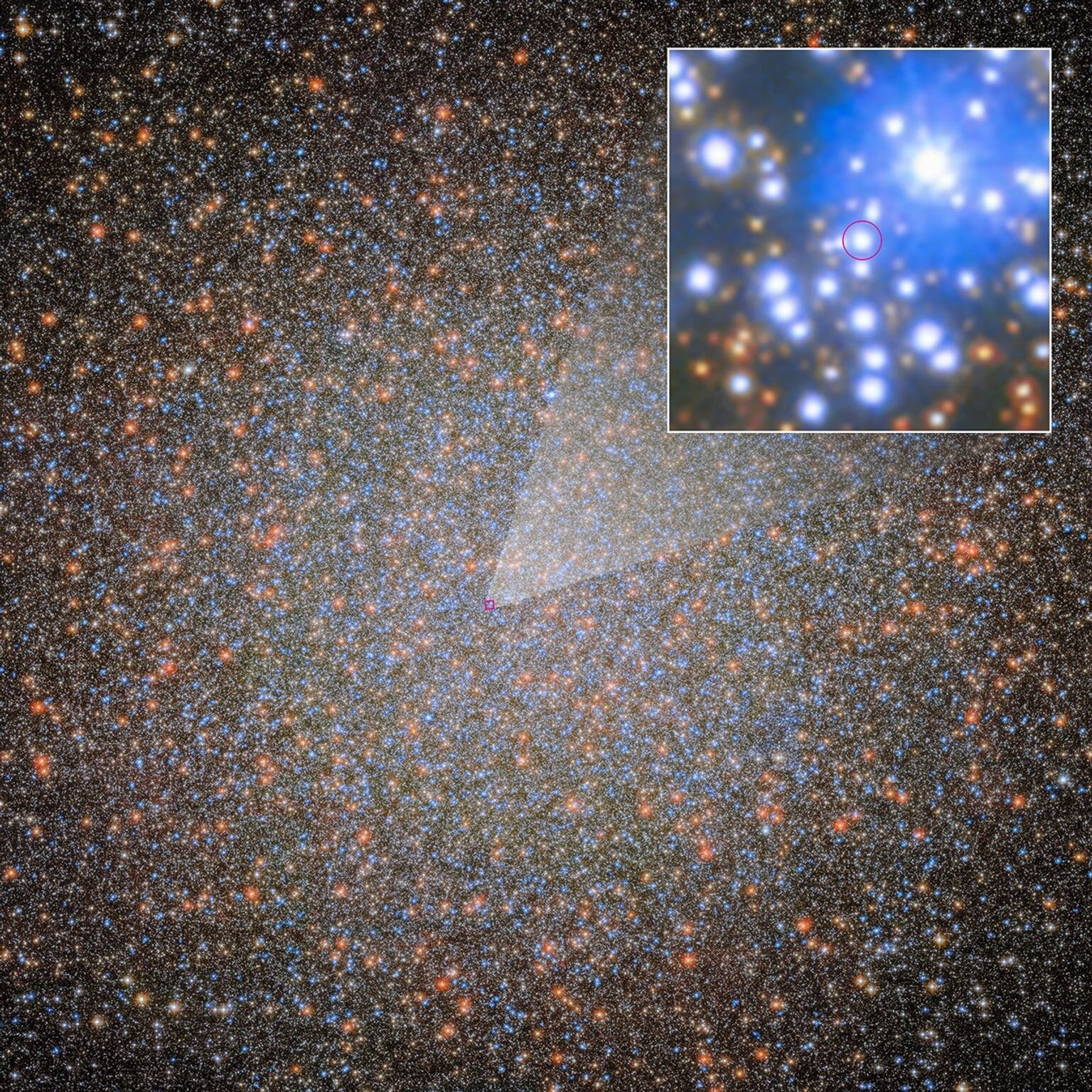
Recent discoveries made with NASA`s Hubble Space Telescope have shed light on one of the most enigmatic celestial objects: the globular star cluster Omega Centauri. This massive and dense stellar conglomeration has posed significant challenges to astronomers for decades, as theoretical predictions suggested it should contain numerous stellar-mass black holes, yet observational evidence was scarce.
Omega Centauri, located approximately 17,000 light-years from Earth, is a giant globular cluster composed of millions of stars gravitationally bound within a relatively compact region. Theoretical models have long predicted that in such densely populated environments, massive stars that ended their lives as supernovae should have left behind a substantial population of black holes — compact remnants formed from gravitational collapse.
Detecting these black holes, however, has proven difficult. Since black holes do not emit light themselves, astronomers rely on indirect methods such as monitoring the gravitational influence on nearby stars or detecting high-energy emissions like X-rays generated by accreting matter. Until now, none of the expected stellar-mass black holes had been unequivocally identified in Omega Centauri, casting doubt on existing formation models in dense stellar environments.
By analyzing archival data from the Hubble Space Telescope, combined with complementary observations from the recently launched James Webb Space Telescope, scientists have now successfully located one such black hole within the cluster. This marks the first confirmed stellar-mass black hole in Omega Centauri, providing key evidence that supports theoretical predictions of a hidden population.
The findings, published in the esteemed journal The Astrophysical Journal Letters, detail the complex techniques used by an international team led by NASA astronomers. These include precise measurements of stellar motions within the cluster, revealing subtle disturbances indicative of an unseen massive companion influencing local gravitational dynamics.
Identifying even a single black hole in Omega Centauri is a crucial breakthrough in understanding the cluster`s hidden constituents. This discovery holds promise to refine models of black hole formation and distribution in dense stellar systems where gravitational interactions are highly intricate and dynamic.
Beyond its scientific importance, this discovery ignites enthusiasm among astronomy and astrophotography enthusiasts who follow the universe`s deepest mysteries and its darkest phenomena. Moreover, advancing technology and the unparalleled observational capabilities of the James Webb telescope open exciting prospects for future discoveries and more detailed studies of black holes.` existence and formation processes.
Scientific context
Stellar-mass black holes form from the gravitational collapse of massive stars at the end of their life cycles, often accompanied by supernova explosions. These objects are so dense that nothing, not even light, can escape their event horizons, hence their name. In environments like Omega Centauri, where star densities are extremely high, interactions among stars can significantly influence both the formation and evolution of these black holes.
Detecting black holes typically involves analyzing nearby stars` motions as they orbit an invisible massive object, or observing emissions from accreting material heated to extreme temperatures. Such measurements are technically demanding and complex, especially in crowded and dynamic clusters like Omega Centauri, which explains why confirming a black hole there has been challenging.
In conclusion, this groundbreaking discovery represents a major advance in astrophysics, offering new insights into the processes governing black hole formation and evolution in our cosmic neighborhood, as well as the fascinating dynamical interplay within globular clusters.
Source: Phys.org Astronomy