
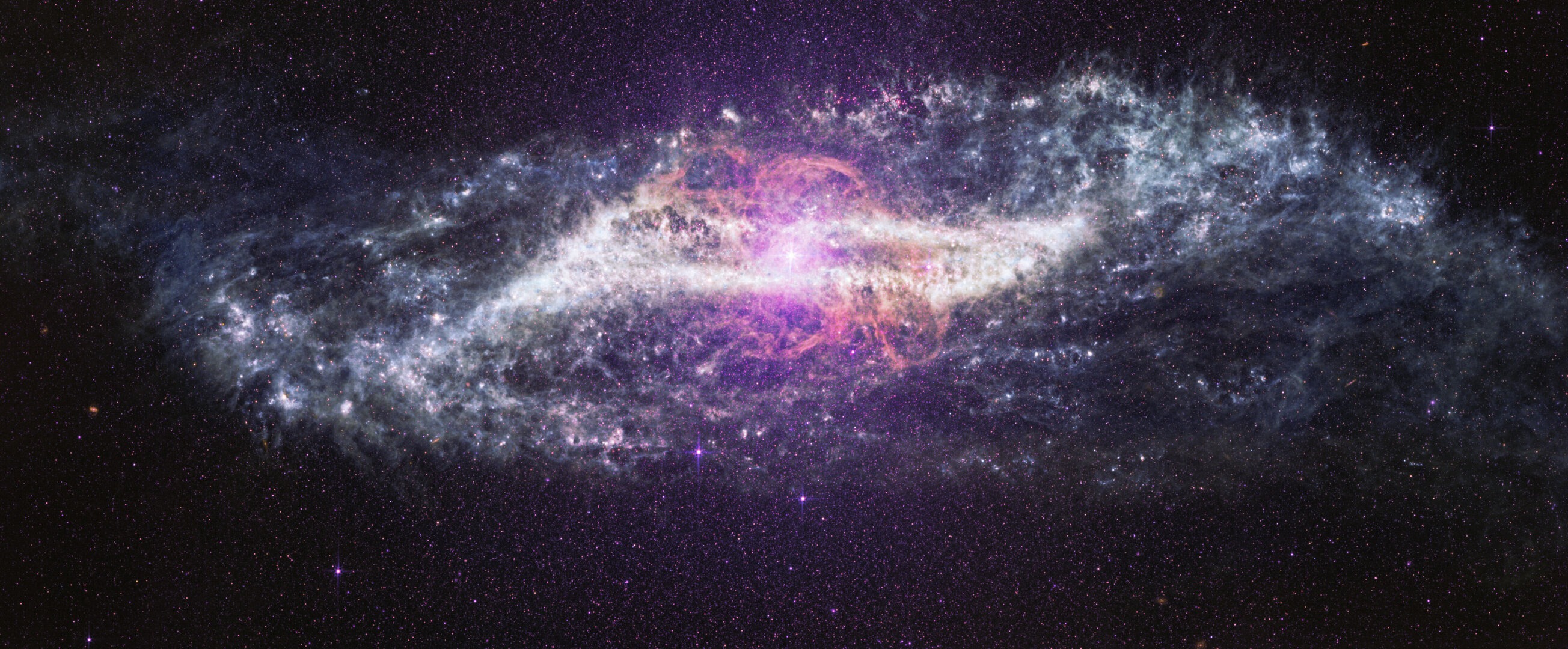
On the occasion of its fourth anniversary since the beginning of its scientific operations, the NASA/ESA/CSA James Webb Space Telescope has provided stunning new images of the Centaurus A galaxy, revealing a universe far richer and more complex than previously seen. These remarkable images were captured using Webb`s unique ability to observe in near- and mid-infrared wavelengths, allowing a detailed look into the galaxy`s core, which is usually hidden behind thick lanes of cosmic dust in visible light.
A universe hidden beneath layers of dust
Centaurus A, located approximately 12 million light years away from Earth, is one of the closest active galaxies and a frequent subject of astronomical research. In the visible spectrum, the central region appears obscured by dark dust lanes, making it challenging to observe its detailed structure. However, the James Webb telescope, with its advanced technology, can penetrate these dense dust clouds, revealing millions of individual stars as well as the dynamic phenomena occurring within the galaxy.
These images represent a real revolution for astronomers and astrophotography enthusiasts alike, offering a completely new perspective on how the galaxy is organized and evolves. Furthermore, they provide insight into the stellar fields, star-forming regions, and energetic activity in the galactic nucleus.
Webb`s performance exceeds expectations
James Webb is considered the most powerful space telescope ever built, and these images mark four years of remarkable performance and scientific operations. Its capability to observe in the infrared spectrum allows it to study cosmic objects that are extremely distant or obscured by dust, enabling discoveries that were impossible before.
The observations of Centaurus A not only provide a visual spectacle, but also advance understanding of the formation and evolution of active galaxies, as well as the interaction between interstellar matter, stars, and gas under extreme conditions. This is essential for building more accurate models of the Universe and for future astrophysical breakthroughs.
Implications for astronomers and enthusiasts
The new set of images holds immense value for astrophotographers and amateur astronomers, encouraging visual exploration and study of the Centaurus A galaxy in a novel way. The extraordinary visibility of countless individual stars allows enthusiasts to expand their horizons and better grasp the dynamic nature of the cosmos.
As James Webb continues operating and gathering data, even more fascinating discoveries are anticipated, poised to reshape our understanding of the surrounding Universe. Four years of success is only the beginning of a scientific journey that promises to answer great cosmic questions and inspire future generations.
For further details and stunning images, visit the official ESA website, which provides extensive resources for those eager to learn more about this spectacular blend of science and cosmic art.
Source: ESA