
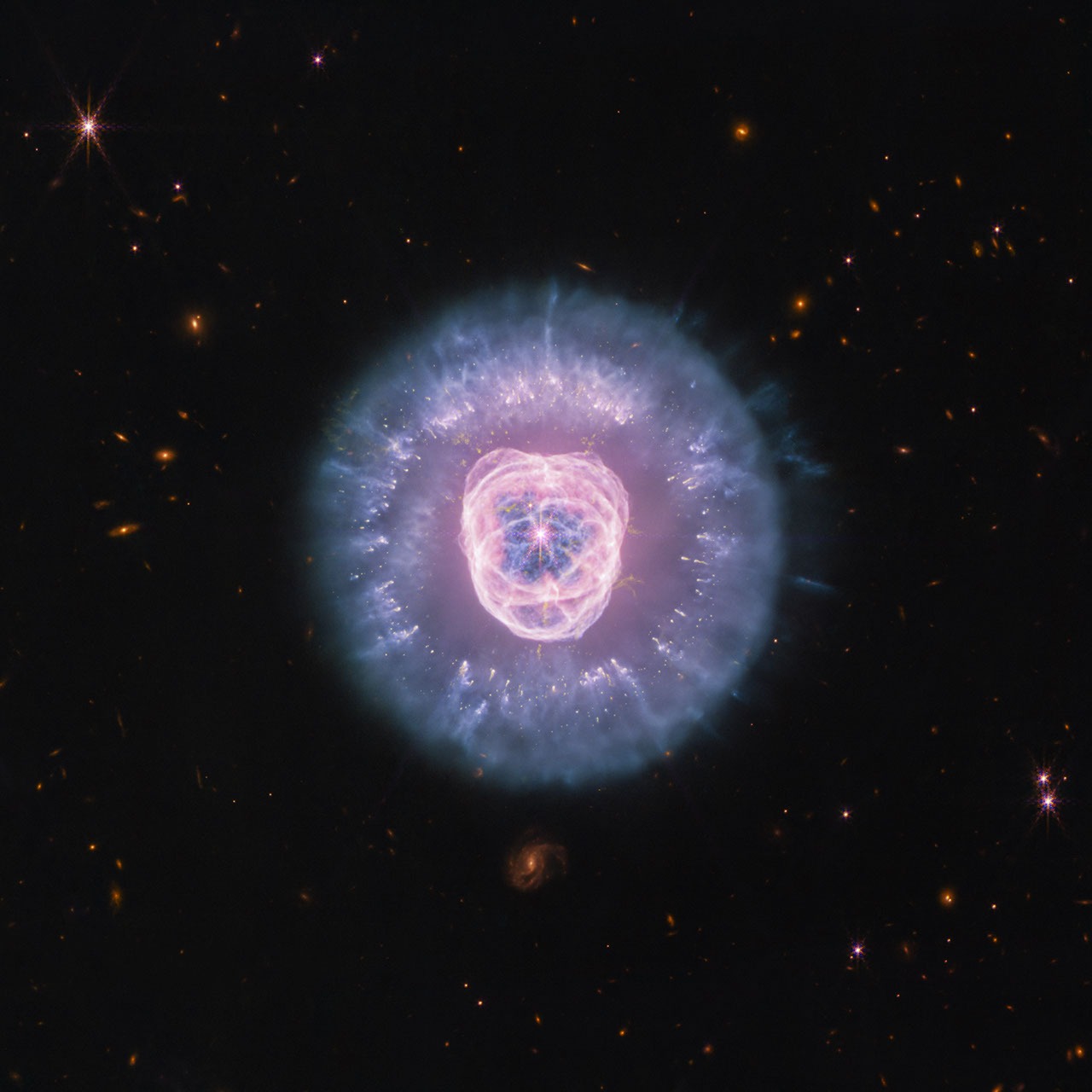
In a significant leap forward for deep space exploration, NASA`s James Webb Space Telescope (JWST) has captured breathtaking new images of the NGC 2392 nebula, widely known as the Lion Nebula. This visual breakthrough sheds unparalleled light on the structure and composition of a planetary nebula, enhancing our understanding of the final stages of life for Sun-like stars.
Scientific background: Planetary nebulae are clouds of gas and cosmic dust expelled by aging stars during their late evolutionary phases as they exhaust their nuclear fuel. Located some 4,200 light-years away in the constellation Gemini, NGC 2392 serves as a classic example of how a star similar to the Sun sheds its outer layers, creating a glowing and colorful celestial spectacle. These formations offer vital clues about the dynamics of gas and the interactions between stellar radiation and the surrounding medium.
What sets James Webb apart from its predecessor, the Hubble Space Telescope, is its ability to observe the universe in the infrared spectrum. This capacity allows it to penetrate cosmic dust that previously obscured many of the nebula`s finer details. In the JWST images, the Lion Nebula reveals complex structures and diverse regions of ionized gas and carbon molecules, indicating that the nebula`s chemical and physical processes are far more intricate than once believed.
The significance of the new images: These observations provide astronomers with a clearer view of how low-mass stars end their lives, enriching the interstellar medium with heavy elements essential for the formation of new stars and planets. The JWST images highlight a bright ‘face’ in the nebula`s center, representing the star`s remnant core that continues to emit intense radiation, ionizing the surrounding gas and causing it to glow.
Furthermore, this data contributes to our understanding of the cosmic matter cycle by revealing how atoms excited by radiation from the central star produce various luminous emissions. These can be analyzed to identify the nebula’s chemical composition. The James Webb Telescope also reveals multiple layers of gas and dust, irregular in shape and rich in detail, illustrating how stellar winds and radiation sculpt the circumstellar environment.
These observations are not only a technological feat but also a source of inspiration for amateur astronomers and astrophotographers. The fine details captured by JWST invite a deeper exploration of cosmic phenomena, offering spectacular images designed to pique curiosity and support public education in space sciences.
In summary, the newly obtained images of the Lion Nebula open a window into the complex processes marking the end of a star`s life cycle, transforming how we see these fascinating cosmic objects. James Webb remains an indispensable tool for astronomy, advancing our knowledge of the cosmos and uncovering crucial details about the birth, life, and death of stars.
Source: NASA