
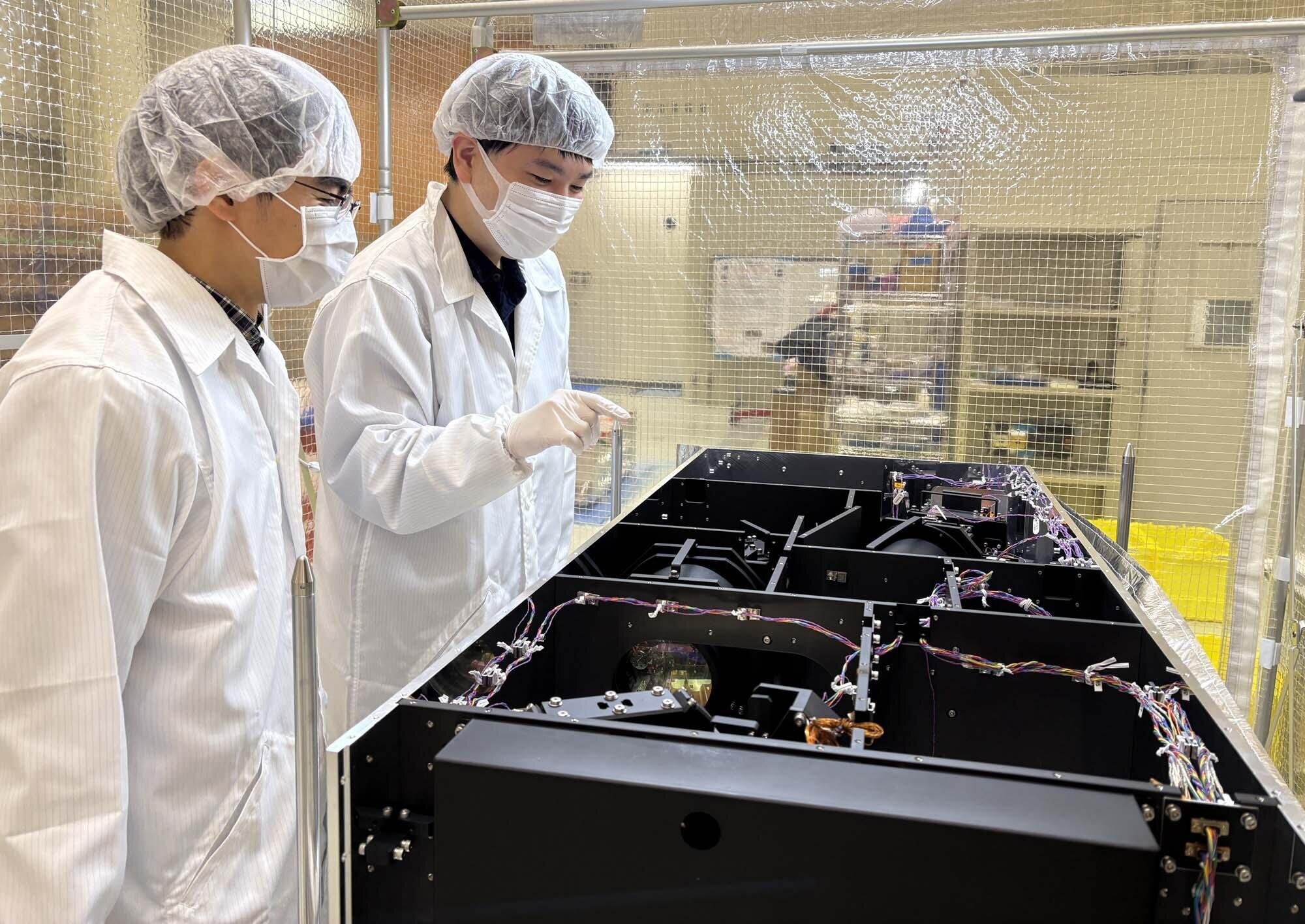
This summer, the Subaru Telescope, perched atop the Mauna Kea volcano in Hawaii, will debut a groundbreaking new instrument for modern astronomy: the NINJA near-infrared spectrograph. These first on-sky engineering observations represent a critical step for testing the spectrograph`s performance under real observational conditions.
NINJA is specifically designed to study cosmic phenomena that evolve rapidly, meaning that swift response times are essential. Typical examples include gravitational-wave sources whose electromagnetic counterparts may appear and fade within hours or days. In this context, rapid availability and precision of instruments become vital to capture these fleeting events.
Time-domain astronomy is an increasingly important branch in this century, as the universe is full of dynamic phenomena: stellar explosions, comet breakups, gamma-ray bursts, and notably, the electromagnetic counterparts to gravitational waves. The latter offer a valuable window into the true mechanisms of black hole or neutron star mergers, and to fully understand them, multi-wavelength observations including infrared are necessary.
NINJA, an acronym reflecting its speed and precision, fills a crucial technological gap. The spectrograph operates in the near-infrared wavelength range, a domain essential because light from distant cosmic events is often reddened—shifted toward the infrared due to cosmic expansion or dust absorption. This makes a high-performance infrared spectrograph indispensable for detecting and analyzing these faint and transient signals.
Another advantage of NINJA is its quick response capability: it can react rapidly to alerts from detectors and observatories such as the gravitational-wave detectors LIGO and Virgo or space telescopes. This brief reaction time allows observations to begin shortly after event identification, increasing the chances of gathering valuable scientific data before the object fades.
The Subaru Telescope, home to NINJA, is among the world`s most advanced for infrared sky observations, thanks to its large 8.2-meter mirror and the excellent viewing conditions atop Mauna Kea. Adding cutting-edge technology like NINJA will further enhance the observatory`s power, enabling major discoveries in stellar astrophysics, cosmology, and fundamental physics.
The instrument was developed as part of an international collaborative effort combining expertise in optical engineering, electronics, and space science. The responsible team will analyze data obtained during engineering runs to calibrate the spectrograph and optimize processes for collecting and interpreting signals. Only after this stage will NINJA be fully integrated into regular scientific programs.
In conclusion, the arrival of NINJA at Subaru marks an important step in exploring the universe through a temporal and dynamic lens. Rapid and detailed capture of infrared signals from ephemeral cosmic events will contribute immensely to our understanding of violent cosmic phenomena and the fundamental nature of the universe.
For astronomy and astrophotography enthusiasts, the development and results of this new instrument will be watched with great interest. For the global astronomical community, NINJA promises to become a trusted ally in capturing the most spectacular and fleeting moments of the cosmos.
Source: Phys.org Astronomy