
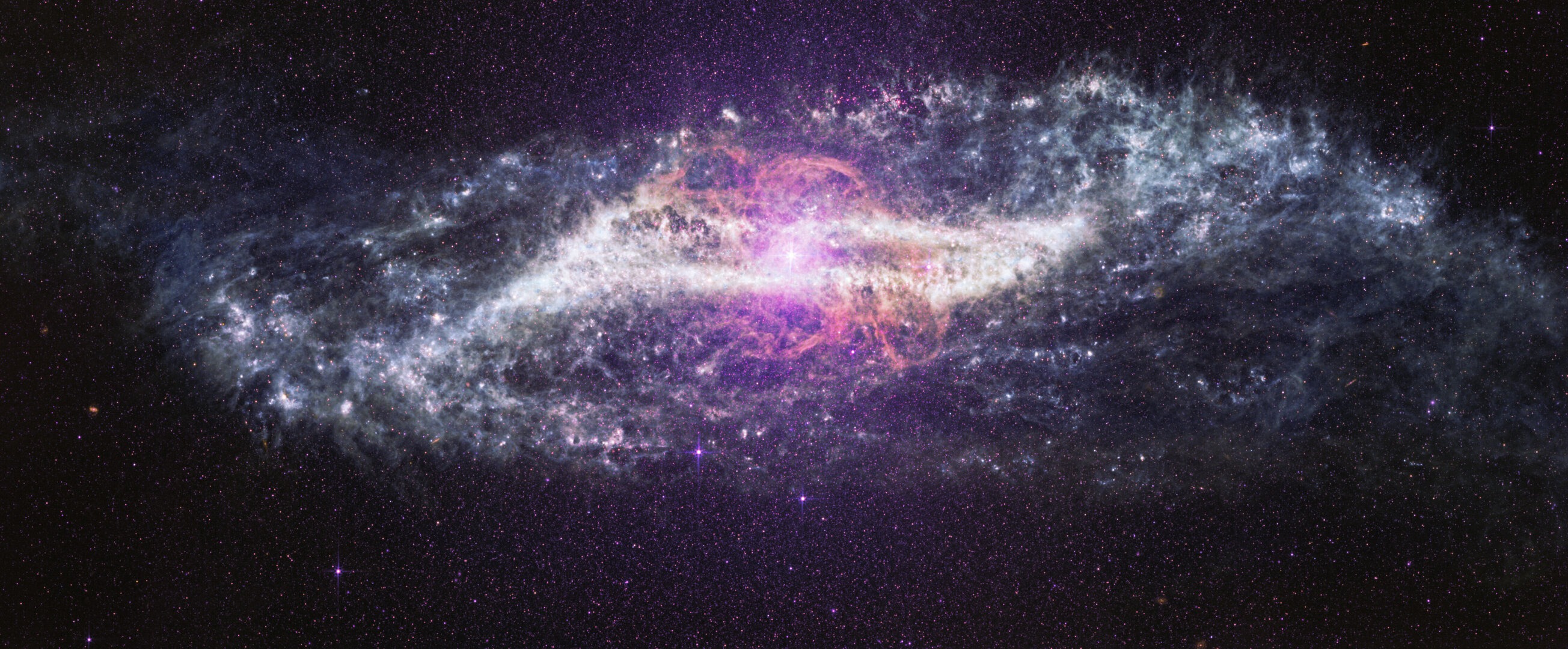
The James Webb Space Telescope (JWST), a groundbreaking collaboration between NASA, ESA, and CSA, has been revolutionizing our understanding of the cosmos since its science mission began four years ago. To celebrate this anniversary, new images showcasing the galaxy Centaurus A, reveal an astonishing number of stars and intricate structures that were hidden from view in visible light.
Centaurus A is among the closest galaxies to our Milky Way and is well-known for its powerful radio emissions. However, from traditional optical observations, its dense dust lanes obscure much of its core, limiting detailed study. Thanks to the Webb telescope’s revolutionary sensitivity, operating in the near- and mid-infrared spectrum, it penetrates these dust clouds, unveiling a densely populated star field and revealing a dynamic and complex galaxy.
The recent images obtained with Webb’s Mid-Infrared Instrument (MIRI) expose a vibrant tapestry of individual stars crowded within Centaurus A, a testament to the telescope’s unmatched capability to peer through obscuring cosmic dust. These observations display dusty gas pillars that appear to be shaping the ongoing star formation within the galaxy, providing invaluable insight into the physical processes that govern stellar birth and evolution in such environments.
Scientifically, these findings represent a breakthrough in studying stellar life cycles in dense galaxy cores. Centaurus A serves as a natural laboratory, enabling astronomers to better understand phenomena that not only occur nearby but are essential in more distant galaxies where detailed observation is more challenging.
For astronomy enthusiasts and astrophotographers alike, the unveiling of these detailed images offers both aesthetic beauty and profound scientific significance. The deep infrared views open new doors for exploration, highlighting how much there remains to discover about our cosmic neighborhood.
Celebrating four years of robust scientific achievement, JWST continues to observe Centaurus A along with countless other cosmic targets, promising a fruitful era of discovery. These images not only validate the telescope’s advanced technological status but also provide us with an unprecedented window into the universe’s hidden realms.
In summary, the fourth science anniversary of the James Webb Telescope has been marked by spectacular imagery that affirms its indispensable role in modern astrophysics and astrophotography. The revelation of millions of stars in Centaurus A reminds us that the universe is more rich and mysterious than ever imagined, continuously inviting us to unravel its secrets.
Source: ESA