
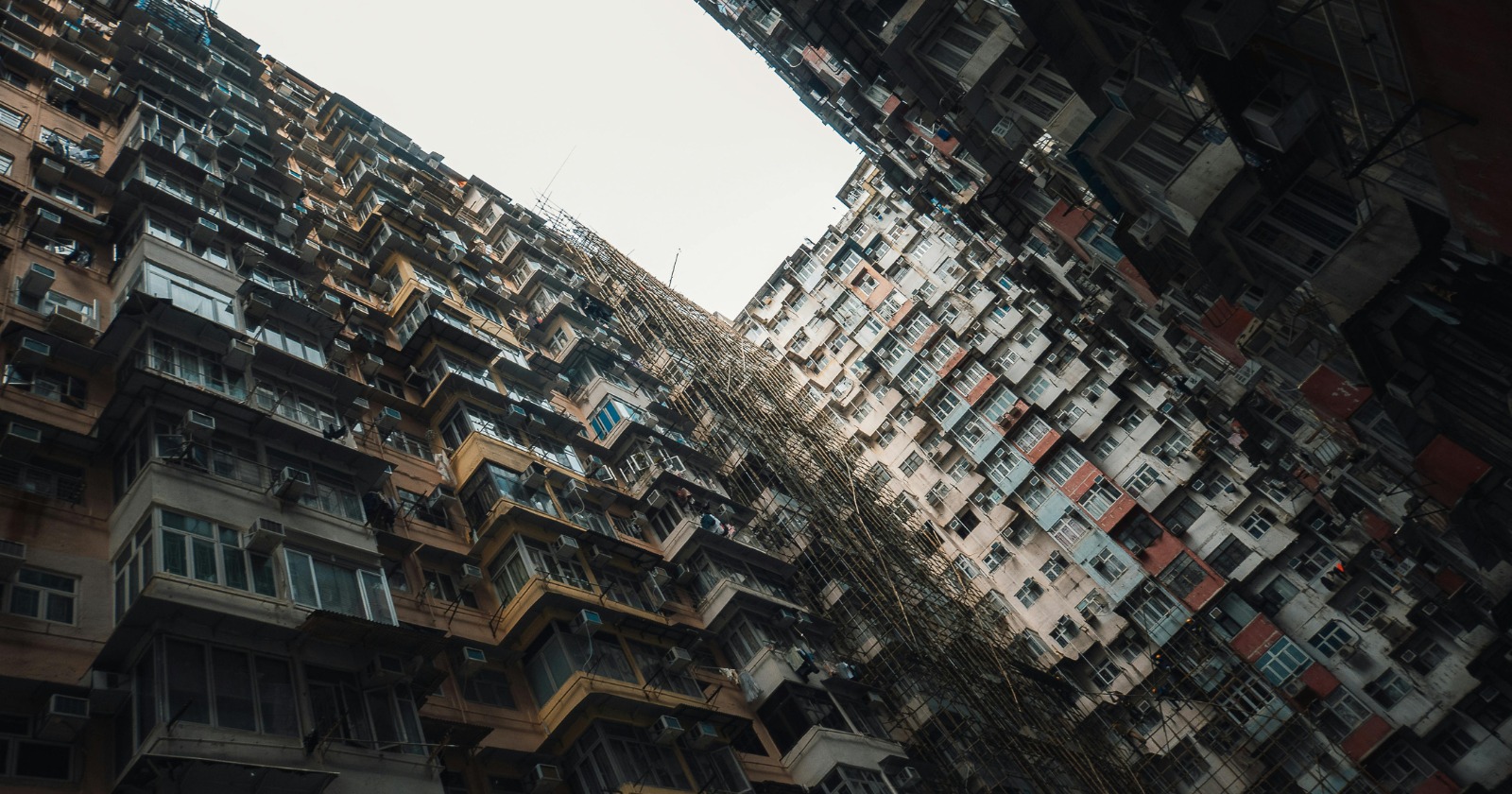
In the heart of Hong Kong, there once stood a truly unique urban phenomenon: Kowloon Walled City. This confined area, encompassing just six and a half acres (about 2.6 hectares), was the densest human settlement ever recorded on Earth. Within this small urban bubble, over 33,000 people lived — a population comparable to that of a small town, all stacked in more than 350 towers built in a wild, organic fashion without a single official architect or urban planner.
The massive block was an almost impenetrable maze, a tightly packed network of corridors and stairs seemingly stretching toward the sky, covering every available inch of space. Due to the extreme density of the constructions, natural light never reached the lowest floors, creating permanent darkness in many of the inner corners of this overcrowded neighborhood.
Scientific and urban context
Kowloon Walled City represents a fascinating case for urban planners, sociologists, and astronomy enthusiasts alike, as its extremely dense structure directly affects natural lighting conditions and the local environment. The settlement functioned in an almost organic manner — built and expanded by its inhabitants without official supervision. Consequently, the winding alleys and bulky buildings emerged around immediate social needs, without rational spatial planning, resulting in one of the most congested urban environments in the world.
Beyond just density, the improvised architecture impacted lighting and the local climate, affecting resident comfort and access to fresh air and sunlight. Studies of such extreme urban environments allow a better understanding of human construction possibilities and limitations in high-density areas, a critical topic for contemporary urban development and ecological projects.
Size and traversal time
Interestingly, the entire district could be crossed in under three minutes if its alleys ran in straight lines. In reality, however, things were quite different. The paths and corridors were crooked, twisting, and often only wide enough for a single person to pass at a time. This lack of planning extended the time needed to traverse the area and turned Kowloon Walled City into a true urban labyrinth.
At its peak, the structure consisted of interconnected buildings forming a very dense vertical complex rather than a sprawling horizontal region. This way of living practically eliminated the notion of personal space, a colossal challenge for sociologists, urban planners, and a point of fascination for astrophotographers, as the city represented an urban `fractal` influencing sky visibility and light quality.
Why is it significant for astronomy and astrophotography enthusiasts?
Kowloon Walled City is an example of extreme urban density that created almost inhumane conditions for its residents, especially concerning natural light access. This directly correlates with challenges faced by astronomy and astrophotography enthusiasts, as lack of natural lighting and sky obstruction are major problems in densely populated urban areas.
From an astrophotography perspective, expanding modern cities generate significant light pollution that dims the visibility of stars and planets. Kowloon represents an extreme case where buildings not only block natural light but also cast deep shadows and darkness, which in some spots might have paradoxically provided conditions favorable for certain types of astronomical observations, although comfort and access were severely compromised.
Moreover, studying such environments allows a deeper understanding of the simultaneous impact of density and architectural design on both natural and artificial environments, a highly relevant subject in modern urbanism, urban ecology, and the study of night skies affected by city lighting.
Demolition and legacy of Kowloon Walled City
In 1993, Hong Kong authorities decided to demolish this urban conglomerate to restore order and provide decent living conditions. The demolition took two years, and in place of the old neighborhood now rests a park that commemorates this unique area. Kowloon Walled City remains a symbol of extreme urban density, an unintentional social and architectural experiment, and a valuable subject of study for many researchers.
Today, stories and models inspired by Kowloon influence both artists and scientists alike, especially those who love the sky. It stands as a lesson about how environmental and human factors can overwhelmingly shape how we live and perceive the spaces we inhabit.
Source: Space Daily