
a remarkable discovery of two massive hydrogen clouds with no visible stars
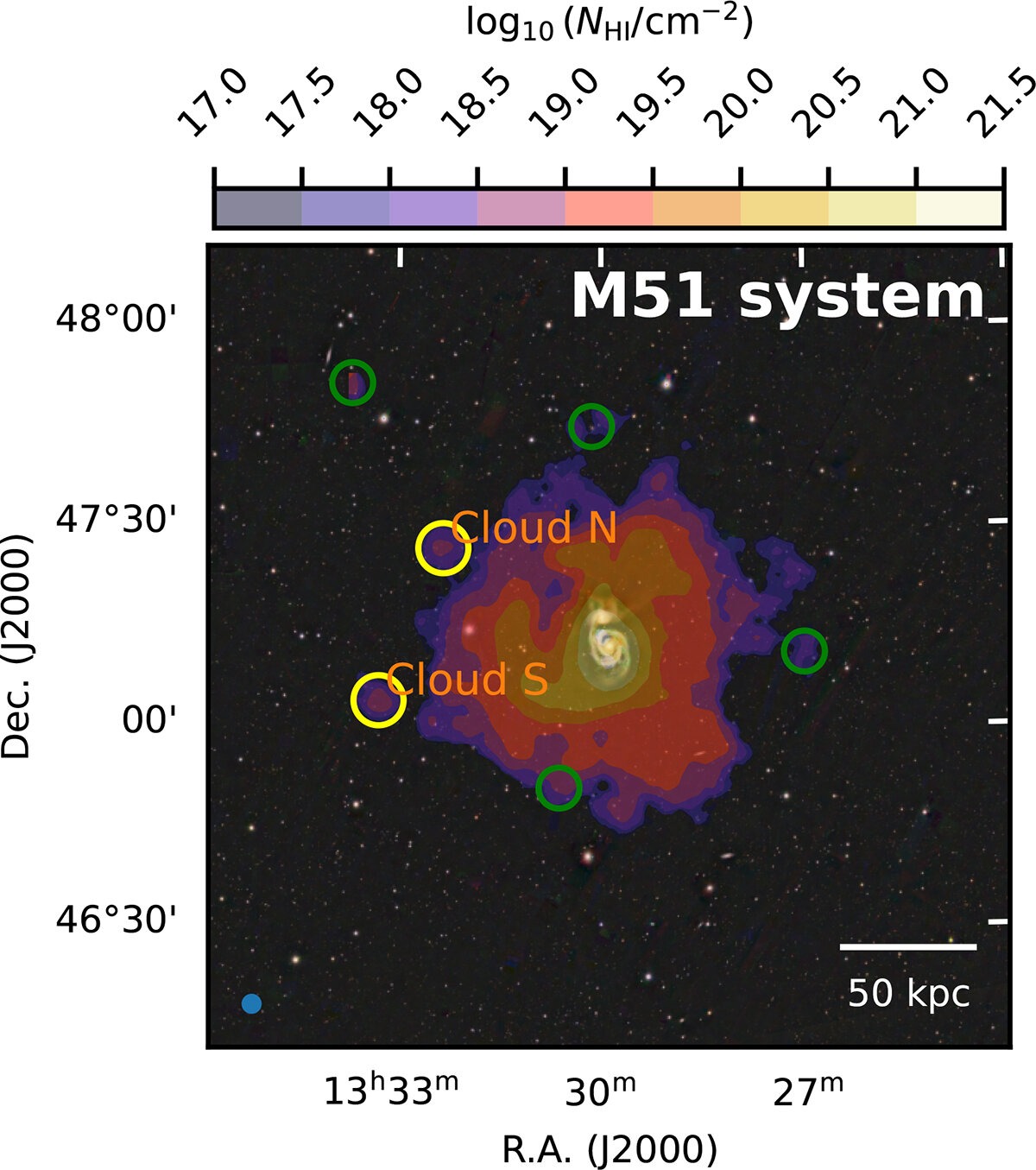
Within the vast and often enigmatic realm of astronomy, researchers have recently made an extraordinary finding using China`s Five-hundred-meter Aperture Spherical Telescope, commonly known as FAST. Situated near the famous Whirlpool galaxy (M51), scientists have identified two enormous clouds composed primarily of hydrogen that surprisingly appear to contain almost no visible stars.
Each of these clouds holds approximately 3 million times the mass of our Sun in hydrogen alone. The discovery was made possible by the incredible sensitivity of FAST, the world`s largest single-dish radio telescope, which detects the radio waves emitted by neutral hydrogen atoms (HI) in space. Despite this significant hydrogen content, subsequent optical observations using traditional telescopes, which capture visible light, have failed to detect any corresponding stellar structures or luminous sources typically associated with galaxies or star-forming regions. This puzzling absence invites fascinating questions about the nature and origins of these cosmic entities.
scientific context
Neutral hydrogen clouds are a common subject in radio astronomy because hydrogen is the most abundant element in the Universe. These clouds serve as critical tracers for understanding galaxy formation and evolution. The Whirlpool galaxy, located roughly 23 million light-years away in the constellation Canes Venatici, is known for its prominent spiral arms and dense populations of young stars and nebulae. Yet, this is the first time such massive hydrogen clouds have been detected near M51 without an optical counterpart, meaning no corresponding light-emitting stars or clusters can be seen.
The discovery, documented in a recent paper published in the prestigious Astronomy & Astrophysics journal on August 4, raises several hypotheses. One possibility is that these clouds represent so-called `dark galaxies` — galactic objects rich in gas but without enough star formation to become optically visible. Alternatively, they could be gas clouds gravitationally interacting with the nearby giant galaxy, possibly leftover debris from galactic encounters that have dispersed hydrogen gas without triggering star formation.
relevance for astrophotography and astronomy enthusiasts
For astrophotographers and amateur astronomers alike, this discovery highlights a fascinating facet of the cosmos not accessible via direct visible-light observations. Because these clouds emit almost no optical light, they remain invisible to traditional photographic techniques and require specialized tools such as radio telescopes to be detected. This underscores the complex, multi-wavelength nature of the Universe, revealing hidden structures waiting to be explored beyond the spectrum of visible light.
Moreover, combining data across different wavelengths — including radio, optical, and infrared — is vital for a complete understanding of cosmic phenomena. This particular discovery opens new avenues in studying galaxy formation processes and the distribution of intergalactic gas around massive galaxies.
future perspectives
The presence of vast hydrogen reservoirs with no current star formation activity suggests intriguing possibilities for the study of galaxy evolution. Future investigations, potentially using infrared and higher-resolution radio observations, may provide deeper insight into whether these hydrogen clouds will eventually ignite star formation and evolve into typical galaxies or if they will remain as inert gas reservoirs.
FAST has once again demonstrated its pivotal role in unveiling the hidden Universe, and further discoveries like this could dramatically reshape our understanding of galactic interactions and cosmic evolution. For astronomy lovers and astrophotography fans, this serves as an open invitation to explore beyond visible light and delve into the profound nature of the cosmos.
Source: Phys.org Astronomy