
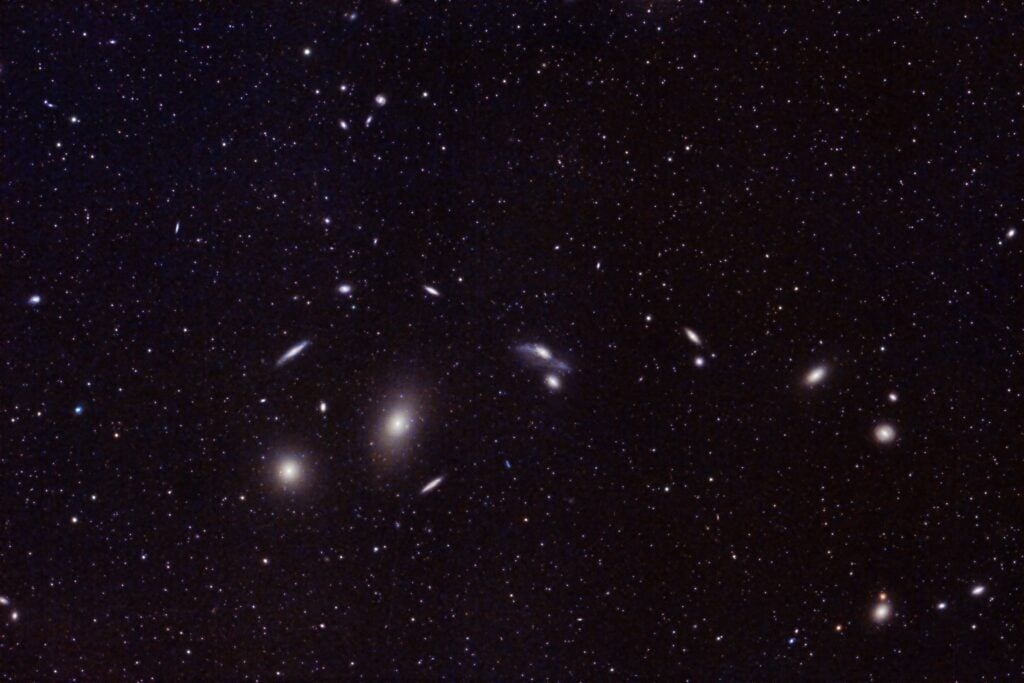
In a remarkable discovery highlighting both the strengths and limitations of traditional astronomical search techniques, a team of researchers identified 47 candidate dwarf galaxies in a deep space region using visual inspection of ultra-deep mosaics obtained with the VLT Survey Telescope (VST). This finding is particularly striking given that only four such galaxies had previously been cataloged in the exact same patch of sky, emphasizing just how many objects can evade automated surveys and digital algorithms.
What are dwarf galaxies and why do they matter?
Dwarf galaxies are much smaller and fainter collections of stars and matter compared to the massive spiral or elliptical galaxies that dominate our observable universe. Despite their subtlety and difficulty in detection, these galaxies play a fundamental role in our understanding of cosmic evolution. Primarily, they are regarded as the building blocks of universal structure and provide essential clues about how dark matter and baryonic matter aggregated under gravity.
Beyond their theoretical importance, detecting and cataloging dwarf galaxies helps astronomers create a fuller picture of the visible and invisible matter content of the universe, including dark matter, while illustrating large-scale cosmic structure. They also offer insights into galaxy formation patterns, galactic interactions, and the chemical enrichment of the cosmos.
The discovery method and its challenges
Visual inspection involves carefully and thoroughly examining telescope images to identify specific features—in this case, dwarf galaxies—that automated methods might overlook. The ultra-deep VST mosaics provide extremely sensitive images capable of revealing very faint or distant objects.
An intriguing paradox exists in this approach: although human visual inspection might seem outdated or inefficient in the age of artificial intelligence and automated processing, it delivers the unique advantage of detecting subtle and often unexpected details missed by algorithms. However, this method is time-consuming and potentially subjective, influenced by the observer`s experience, mental state, and viewing conditions.
The significance of the new discovery
Compared to the previously cataloged four objects, the 47 new candidate dwarf galaxies drastically expand the known population in the region studied. This suggests the universe may harbor far more such faint galaxies than previously estimated and raises questions about the effectiveness of automated observational methods.
This discovery holds substantial implications for future cosmological studies, especially those aiming to map large-scale structure. The newfound dwarf galaxies may affect data interpretation related to dark matter distribution and require adjustments to current models of galactic evolution.
Outlook and future work
The research team intends to follow up their findings by confirming the candidates with additional observations using complementary telescopes and instruments, including spectroscopy to verify the distances and compositions of these dwarf galaxies. This step is critical to elevate candidates to scientifically confirmed objects.
Moreover, the results suggest a hybrid approach combining automated algorithms and human visual inspection could be the most effective way to discover and classify subtle cosmic objects. Future astronomical missions and large-scale surveys may benefit from such integrative methodologies to maximize their detection capabilities.
Therefore, the discovery of these dwarf galaxies not only adds an exciting new chapter to our astronomical knowledge but also prompts a reevaluation of observation strategies, paving the way for future findings that will expand our understanding of the cosmos.
Source: Space Daily