
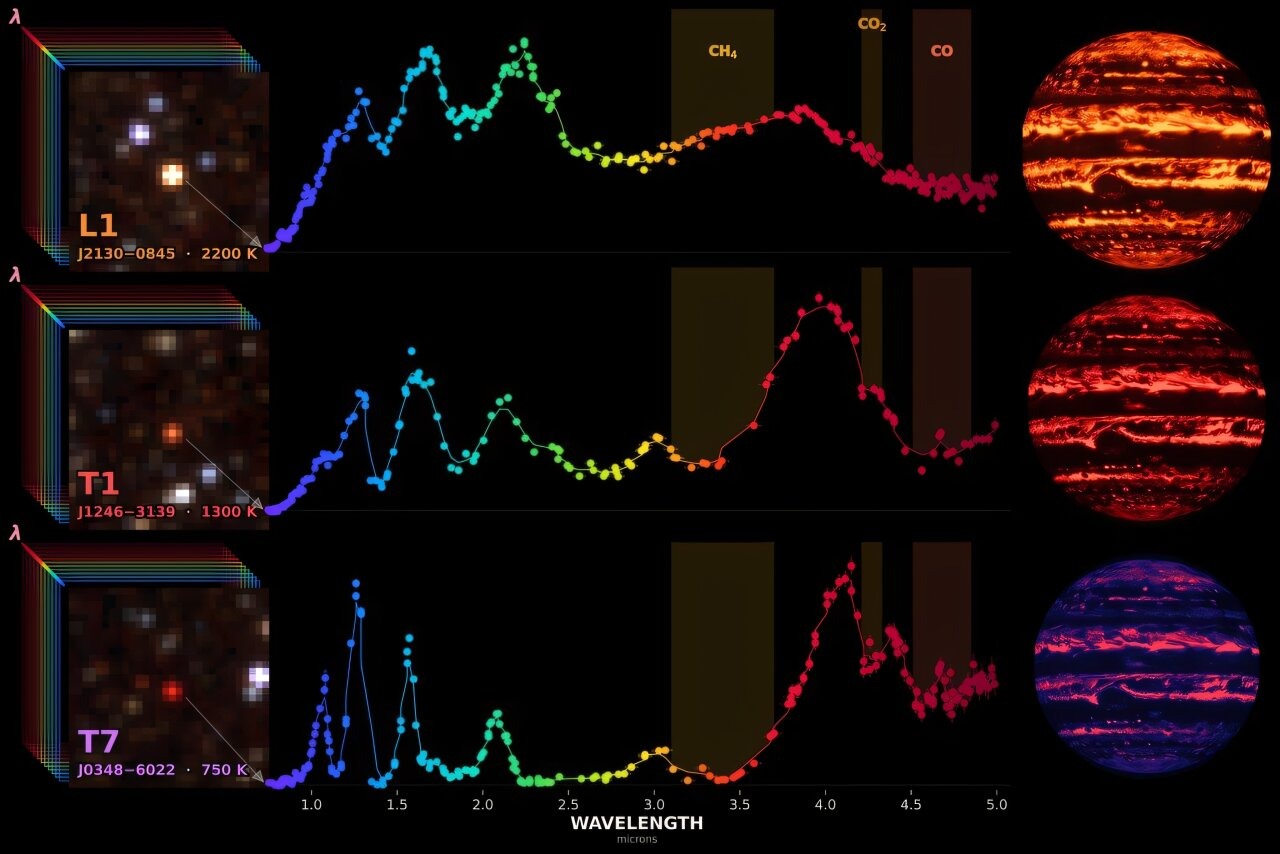
NASA`s SPHEREx (Spectro-Photometer for the History of the universe, Epoch of Reionization, and ices Explorer) space telescope is illuminating a fascinating class of cosmic objects known as brown dwarfs. These celestial bodies, positioned at the boundary between stars and exoplanets, have been recently studied using the advanced technologies aboard the SPHEREx telescope. Findings published in the renowned journal The Astrophysical Journal reveal that brown dwarfs possess complex atmospheres containing key molecules such as water and methane, similar to those of the giant planets in our own solar system.
Understanding brown dwarfs and their significance
Brown dwarfs are substellar objects that are too massive to be classified as planets yet lack sufficient mass to sustain steady hydrogen fusion at their cores, which is the hallmark of true stars. They serve as a bridge in the cosmic landscape that connects stars with massive exoplanets, providing astronomers with a unique laboratory to study chemical and physical processes in this intermediate category.
Masses of brown dwarfs typically range between approximately 13 and 80 times that of Jupiter. Their internal temperatures do not reach the threshold for sustained hydrogen fusion, so they emit much less light and energy compared to fully-fledged stars, making them intriguing objects for scientific study.
The technology behind SPHEREx
SPHEREx is an innovative space telescope equipped with a specialized spectro-photometer that can scan the sky in the near-infrared spectrum. It can analyze light from hundreds of thousands of celestial objects, enabling scientists to precisely identify the chemical composition of brown dwarf atmospheres by detecting molecules like water (H2O) and methane (CH4).
Observing in the infrared spectrum is crucial because it allows SPHEREx to pierce through the dense cloud layers that obscure many brown dwarfs. These cloud layers have historically impeded detailed analysis of their atmospheric makeup. The telescope`s unprecedented capabilities thus open a new window into this mysterious group of objects.
Revolutionary discoveries about brown dwarf atmospheres
Data analysis from SPHEREx has demonstrated that brown dwarf atmospheres are chemically rich and dynamically active. The presence of water and methane molecules signals atmospheric conditions that are remarkably similar to those observed in giant planets such as Jupiter and Saturn.
Such findings have profound implications for understanding how substellar objects form and evolve, helping to bridge the gap between stellar and planetary sciences. Moreover, they enrich our perspective on the diversity and variability of atmospheres found throughout the universe.
The broader scientific context
In astronomy, the classification of cosmic bodies is often complex, and brown dwarfs have long posed a challenge. Combining characteristics of both stars and planets, they occupy a gray area that complicates our understanding. Studying them allows scientists to explore how chemical and physical processes change when transitioning from stellar to planetary environments.
Additionally, insights into brown dwarf atmospheres help refine theoretical models of planetary system formation and evolution, offering clues about the nature of exoplanets with similar characteristics.
Importance for astronomy enthusiasts and astrophotographers
For astronomy fans and astrophotographers, SPHEREx`s new observational era is exciting and motivating. Observing brown dwarfs becomes more accessible, and knowledge about their atmospheric composition provides essential scientific context for the images and data collected with both ground-based and space telescopes.
This research also offers a rare glimpse into objects that do not emit strong visible light, making them difficult to detect and study. SPHEREx, through its innovative infrared observations, fills this gap in knowledge and opens new avenues for both professional astronomers and amateurs alike.
Looking ahead
As SPHEREx continues its cosmic journey, we can expect further discoveries that will push the frontiers of our understanding of the substellar and atmospheric universe. This telescope marks a significant step forward in exploring a still relatively unknown domain, promising exciting revelations in the near future.
In summary, SPHEREx`s data on brown dwarfs unveil a surprising chemical diversity that deepens our understanding of the universe`s complexity and beauty. For the astronomy community, it is an invitation to continue exploring and unraveling the mysteries that surround us.
Source: Phys.org Astronomy