
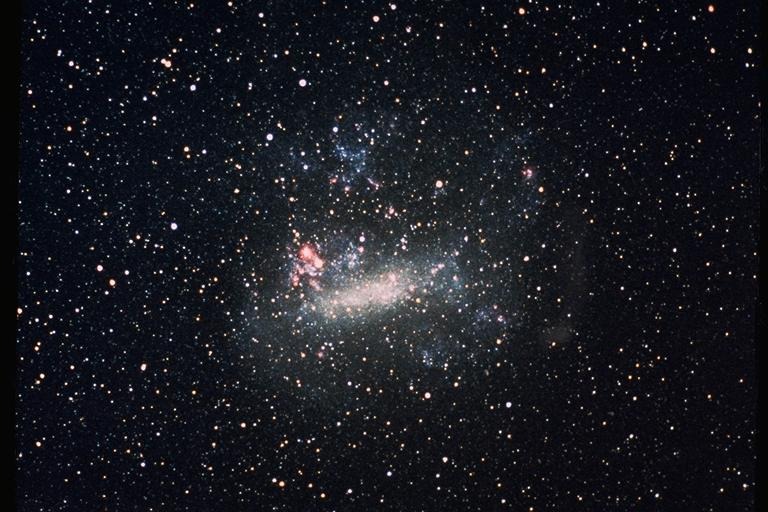
Astronomy sometimes surprises us with events that bring us closer to understanding the universe. One such remarkable phenomenon was observed in December 2019, when astronomers detected a sudden and brief brightening of a star located in the Large Magellanic Cloud (LMC), a dwarf satellite galaxy of the Milky Way, approximately 163,000 light-years away.
This gravitational microlensing event is a rare but fascinating cosmic occurrence. It happens when a compact object — such as a neutron star, a small black hole, or another dense mass — passes between us and a distant light source, bending spacetime and thus temporarily focusing the light from the background star.
These events provide an indirect way to detect dark objects that otherwise cannot be observed directly, such as black holes that emit no light or planets that reflect very little. In the December 2019 case, the compact object responsible was named Phoebe.
Phoebe has an estimated mass roughly three times that of our Moon. This makes it far too small to be a stellar black hole, which forms from the collapse of massive stars. Instead, its mass and properties align with the intriguing hypothesis that it could be a primordial black hole, formed in the moments just after the Big Bang — before the first stars and galaxies came into existence.
The concept of primordial black holes is fascinating yet still debated in the scientific community. These objects could represent an important component of dark matter in the universe or at least a unique class of compact objects with a fundamentally different origin than standard stellar black holes.
The microlensing observation was made possible thanks to continuous sky monitoring by specialized astronomical surveys designed to detect these extremely brief and subtle phenomena. The star`s brightness increased significantly for only about one hour, indicating that Phoebe is small and passed by at a very high relative velocity.
Such discoveries provide new insights into the study of dark matter and the composition of the early universe. If objects like Phoebe really are primordial black holes, they could offer clues about conditions in the universe before galaxy formation and about the nature of the matter that shapes our cosmos.
As observation technologies and analysis methods evolve, astronomers will be able to detect more of these events, refining our picture of the mysterious population of compact objects lurking in space.
In conclusion, the December 2019 observation was not just a simple flash of light on a distant sky, but a gateway to the mysteries of the primordial universe — a hint that the cosmic reality holds many surprises waiting to be uncovered by those who gaze at the heavens with curiosity and passion.
Source: Universe Today