
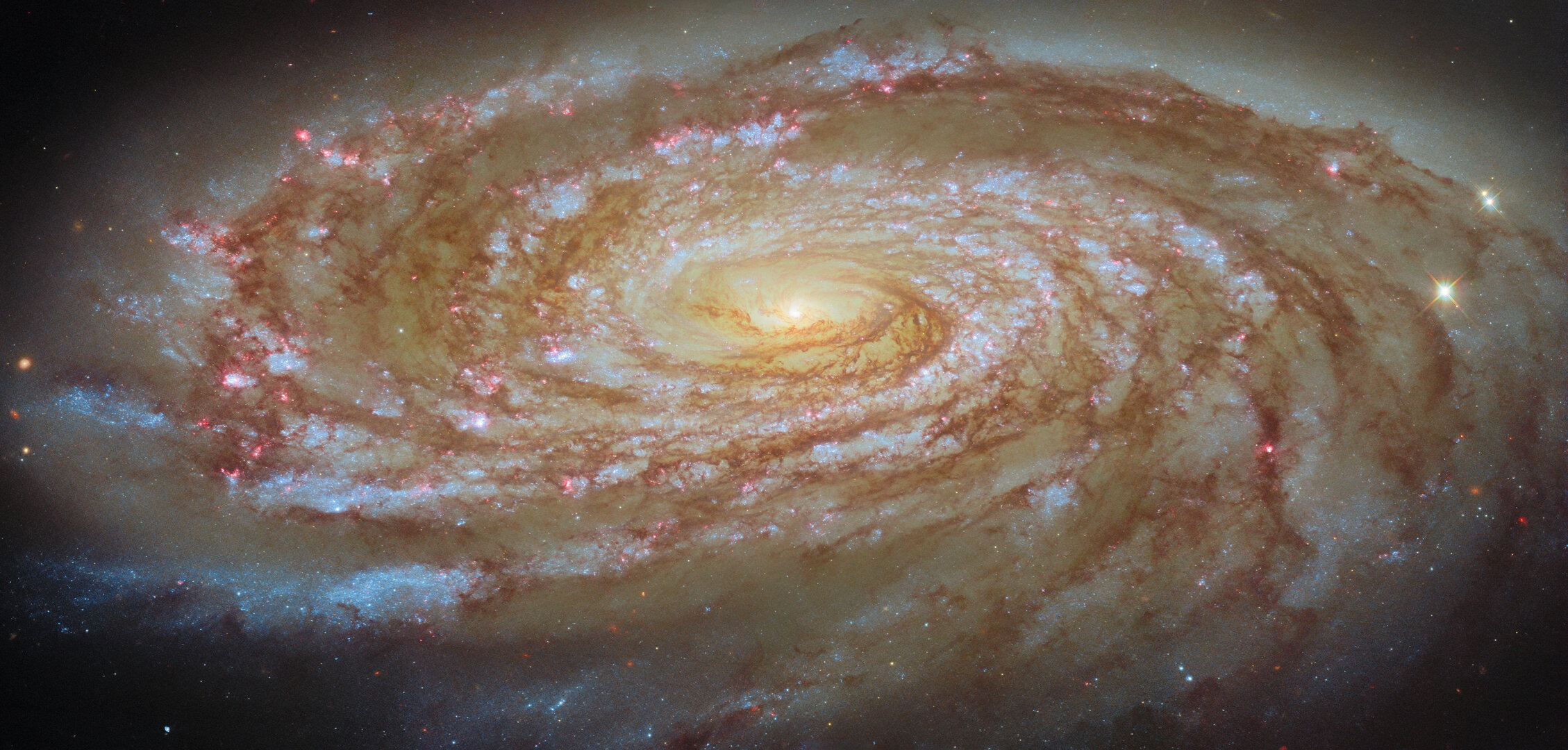
In the vastness of the Universe, galaxies rarely exist in isolation; they often gather in enormous groups known as galaxy clusters. Recently, the European Space Agency (ESA) released a stunning image inviting us to embark on a journey to the centre of a galaxy cluster, a region where gravity and cosmic interactions shape space at colossal scales.
A galaxy cluster is a massive collection of galaxies, hot plasma, and dark matter, all bound together by a common gravitational force. These structures are among the largest and heaviest in the Universe and are crucial for understanding how matter and energy behave on cosmic scales. In this imaginary journey, we delve into these profound and fascinating aspects using ESA`s data.
What is a galaxy cluster?
A galaxy cluster contains hundreds or even thousands of galaxies, each made up of billions of stars. But the cluster is more than just the sum of its galaxies: between them lies an extremely hot, ionized gas emitting X-ray radiation, as well as a large amount of dark matter – invisible yet essential for the cluster`s overall gravity.
Dark matter is a key concept in modern astrophysics. While it cannot be directly detected by telescopes, its gravity influences the motion of galaxies within the cluster and the way light bends as it passes through these regions. Studying galaxy clusters offers crucial clues about the distribution of dark matter and the evolution of the Universe on large scales.
The journey to the cluster`s centre
The ESA image allows us to visualize a deep path, showing how matter density increases towards the centre. The cluster`s centre is an extremely dynamic place where galaxies collide and interact, and the hot gas is compressed and intensified by strong gravity. This centre often hosts a large galaxy, commonly known as the dominant central galaxy, which plays a major role in how the cluster evolves over time.
These central regions are also spectacular sources of radiation – the huge energy released through galaxy mergers and new star formation is captured by space telescopes at various wavelengths. Exploring cluster centres helps astronomers understand not only the dynamics of individual galaxies but also the physical processes dominating vast cosmic scales.
ESA`s importance in observations
ESA plays a crucial role in studying galaxy clusters through its advanced instruments mounted on satellites and space telescopes. The images and data it collects contribute to fundamental research in cosmology and astrophysics, supporting the global scientific community.
For example, ESA observatories capture X-ray radiation emitted by the cluster`s hot gas, helping determine the total mass and map dark matter. This information is essential for constructing coherent models of Universe structure and how it formed after the Big Bang.
What can astronomy and astrophotography enthusiasts learn?
For astronomy and astrophotography enthusiasts, understanding galaxy clusters adds depth to viewing the night sky. These clusters are fascinating yet challenging targets to capture with amateur equipment, due to their immense distance and low brightness. However, by learning the scientific context and involved phenomena, each photograph or observation becomes more valuable and engaging.
Exploring clusters brings us closer to the mysteries of the Universe, from the formation of cosmic structures to dark matter dominating mass distribution. Moreover, the ESA image inspires us to continue searching and documenting these cosmic territories, fueling curiosity and scientific spirit.
In conclusion, the journey to the centre of a galaxy cluster is a voyage of science and imagination, revealing how vast and mysterious our Universe truly is. ESA, through its efforts, opens windows to these realms beyond galaxies, inviting us to explore and understand the mysteries of the grand cosmic structures.
Source: ESA