
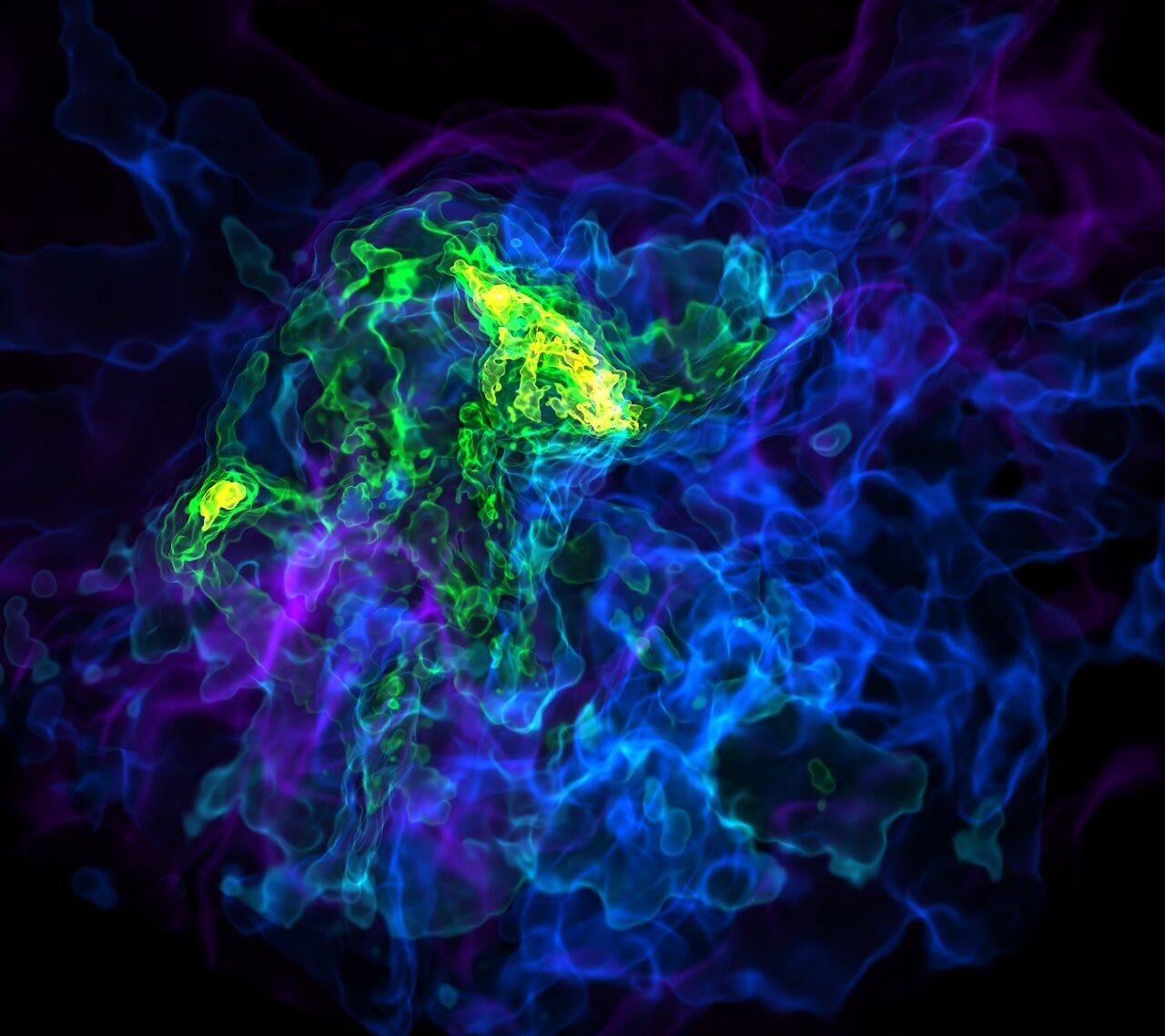
Just a few hundred million years after the Big Bang, the universe was a dark, simple, and seemingly quiet place, devoid of complex galaxies, planets, or heavy elements such as carbon and oxygen. Instead, vast clouds of primordial hydrogen and helium drifted through space, slowly gathering into invisible gravitational structures called `minihalos`. These small dark matter cocoons acted as cradles for the first stars of the universe, known as Population III stars. Recent advanced simulations of these primordial halos have shed light on how cosmic storms—understood as turbulent motions and energetic collisions—played a crucial role in shaping the formation and evolution of these earliest stars.
The scientific context behind the first stars
In the early universe, just a few hundred million years post-Big Bang, the composition and structure were profoundly different from today`s cosmos. Baryonic matter was predominantly hydrogen and helium, while heavier elements essential for planet formation and life, such as carbon and oxygen, were absent. Dark matter, which cannot be observed directly but exerts gravitational pull, gathered primordial gas clouds into compact structures known as `minihalos`. These mini-universes were the birthplaces of the first stars. This step was critical in cosmic evolution because these stars initiated the nuclear synthesis of heavier elements, laying the groundwork for later stellar systems and planets.
Recent simulations have been vital in exploring this virtually invisible process in the primordial cosmos. By modeling the intricate details of gas collapse and dark matter dynamics, scientists have been able to visualize how minihalos behaved, how turbulent gas flows and energetic interactions enhanced or suppressed star formation processes.
Key findings from primordial halo simulations
One surprising result was the significant role played by `cosmic storms`—the intense turbulence and violent collisions within the early interstellar gas. These phenomena not only accelerated gas condensation, but also shaped the mass distribution of these Pop III stars. The turbulence influenced whether these stars grew massive, short-lived, and gigantic or remained smaller with longer lifespans and different cosmic interactions.
The simulations also revealed that this complex gas dynamic was highly heterogeneous—some regions were dominated by intense cosmic storms while others experienced more tranquil conditions. This variability led to a diverse range of primordial stellar populations, indicating that the first stars were not a homogeneous group, but a dynamic ensemble with varied properties. These insights carry major implications for the subsequent evolution of galaxies and the cosmic chemical enrichment.
Why these findings matter for astronomers and astrophotography enthusiasts
For astronomers, these results provide a clearer framework to understand the initial epochs of cosmic evolution and better interpret early universe signals detected by cutting-edge observatories. Additionally, it helps estimate the contribution of the first stars to the reionization of the universe and the introduction of heavy elements into space.
While these stars no longer exist today and cannot be observed directly, simulations offer a `map` of what occurred during the universe`s early phases. For astrophotography enthusiasts, these discoveries enrich the understanding behind breathtaking images of deep space captured by modern telescopes. Consequently, photos of distant stellar nurseries or galactic halos gain broader significance, linking the visual art of astronomy with fundamental cosmic physics.
The future of this research
Moving forward, researchers plan to refine simulations by including extra factors such as the radiation emission of primordial stars and their interactions with surrounding media. Furthermore, with the aid of new telescopes like the James Webb Space Telescope and next-generation ground-based observatories, indirect detection of these first stars` influences will become possible, helping to validate simulation predictions.
In summary, studies of primordial halos and cosmic storms continue to deepen our comprehension of the universe’s origins and evolution, providing a fascinating glimpse into the earliest moments that allowed light, complex matter, and ultimately life, to emerge.
Source: Phys.org Astronomy