
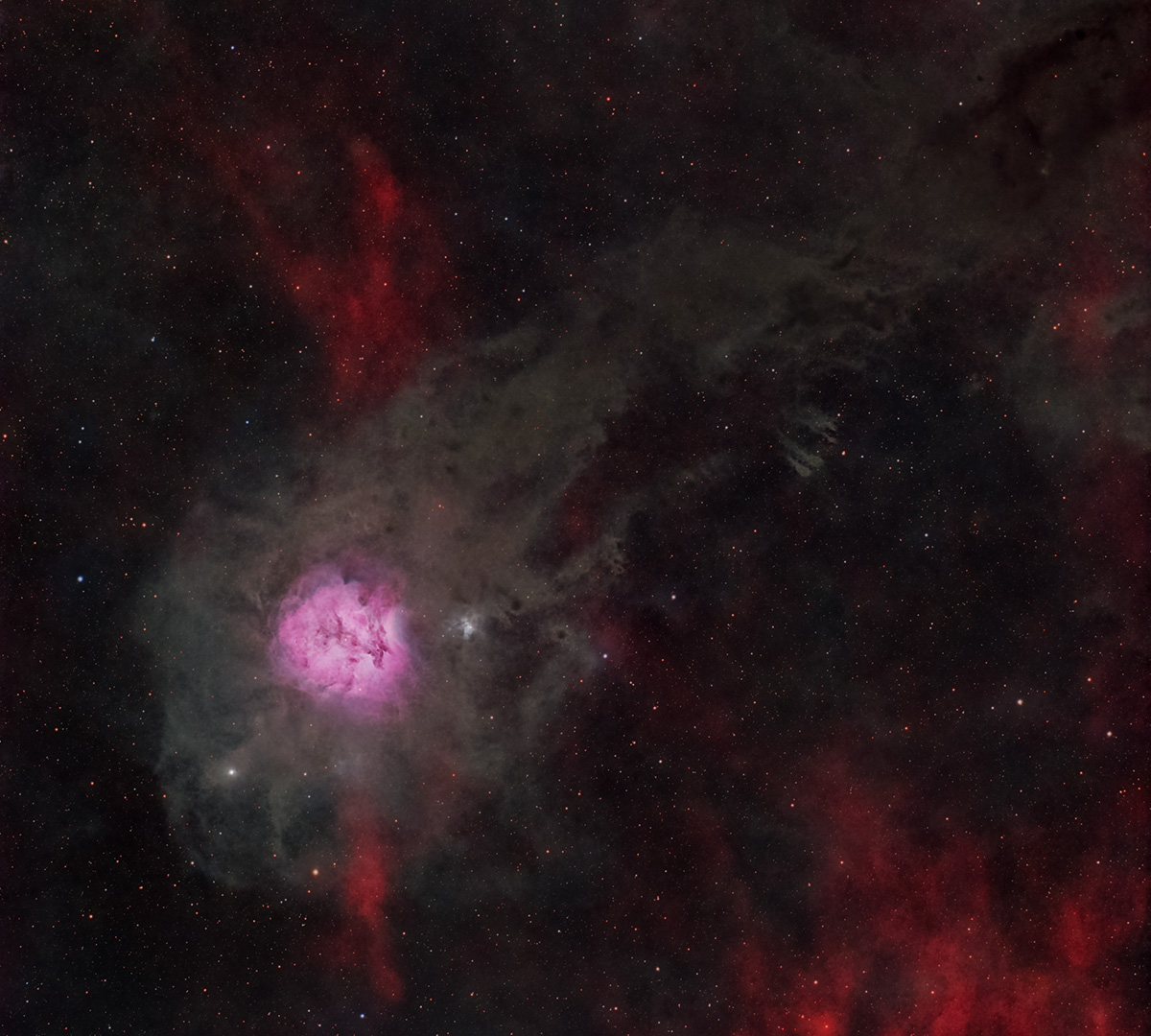
- name: Cocoon Nebula (IC 5146 / Caldwell 19)
- coordinates: RA: 21hr 53' 29"; DEC: 47º 14' 46"
- distance from Earth: approx. 2700 light-years
- magnitude: 7.2
- apparent size: 8.2' x 8.2'
About the Cocoon Nebula
IC 5146, also known as the Cocoon Nebula, is a complex emission and reflection region located in the Cygnus constellation, at an estimated distance of approximately 2700 light-years from Earth.
The nebula has a diameter of about 15 light-years and is closely associated with a vast interstellar dust cloud — the dark filament Barnard 168, which appears to “open up” right at its location, like a cocoon giving birth to a star.
At the center of the nebula lies a young star cluster (designated Collinder 470), composed of newly formed stars whose ultraviolet radiation ionizes the surrounding gas, producing the characteristic reddish hydrogen-alpha (H-α) glow.
The denser dust in the region reflects the blue light of these young stars, while opaque areas mark regions still embedded in the primordial cloud, where star formation is still ongoing.
To photograph it, dedicated astro cameras (or DSLR cameras modified for astrophotography) are required, along with telescopes/lenses with relatively short focal lengths (200–600 mm). Imaging sessions using simple UV/IR filters can be combined with those using dual narrowband filters. If using mono cameras, it is worth combining RGB sessions with Hα & OIII data.
A very interesting framing is a wide-field composition that captures the dust tail, making the final image resemble an apocalyptic comet with a reddish head.
The optimal imaging period is summer or early autumn.
I photographed this nebula in two sessions:
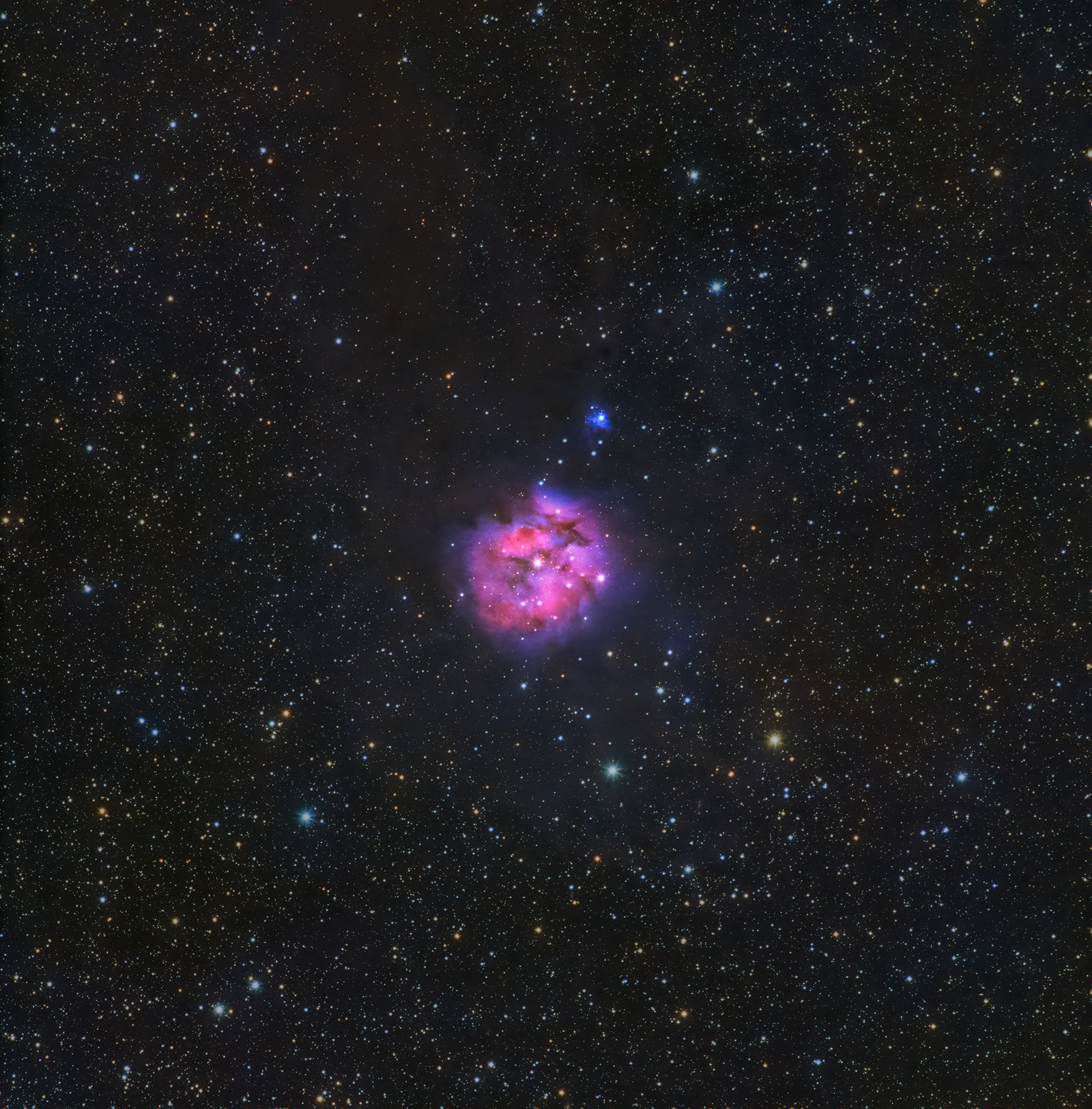
- On July 16, 2023, from Orlești - Vâlcea (Bortle 4–5), from my backyard. I collected 99 light frames of 3 minutes each, totaling 6 hours. Equipment: EQ6-R mount, Sigma 150–600 lens (@600mm, f/7.1), Optolong L-Pro filter, ASI 533 MC camera (-5°C, gain 101), ASIAIR+.
- In the summer of 2025, on August 28 and 29, also from Orlești - Vâlcea (Bortle 4–5). I collected 6 hours and 40 minutes of RGB data using a Baader UV/IR filter and 6 hours and 21 minutes using the Optolong L-eXtreme filter. This time, instead of the Sigma lens, I used a SW Esprit 100ED apochromatic refractor with a TS-Optics reducer (443mm, f/4.3). The goal was to combine the signal extracted from the L-eXtreme data with the RGB frames. The results were better than in the first session.
How to find the Cocoon Nebula in the sky
The Cocoon Nebula is officially located in Cygnus, but visually it lies somewhere between Cygnus, Cepheus, and Lacerta.

Summer 2025, August 28–29. Orlești-Vâlcea. Integration time: 6h 40min (RGB) + 6h 21min (L-eXtreme). Esprit 100ED telescope with reducer.
Representative image (with reduced stars)
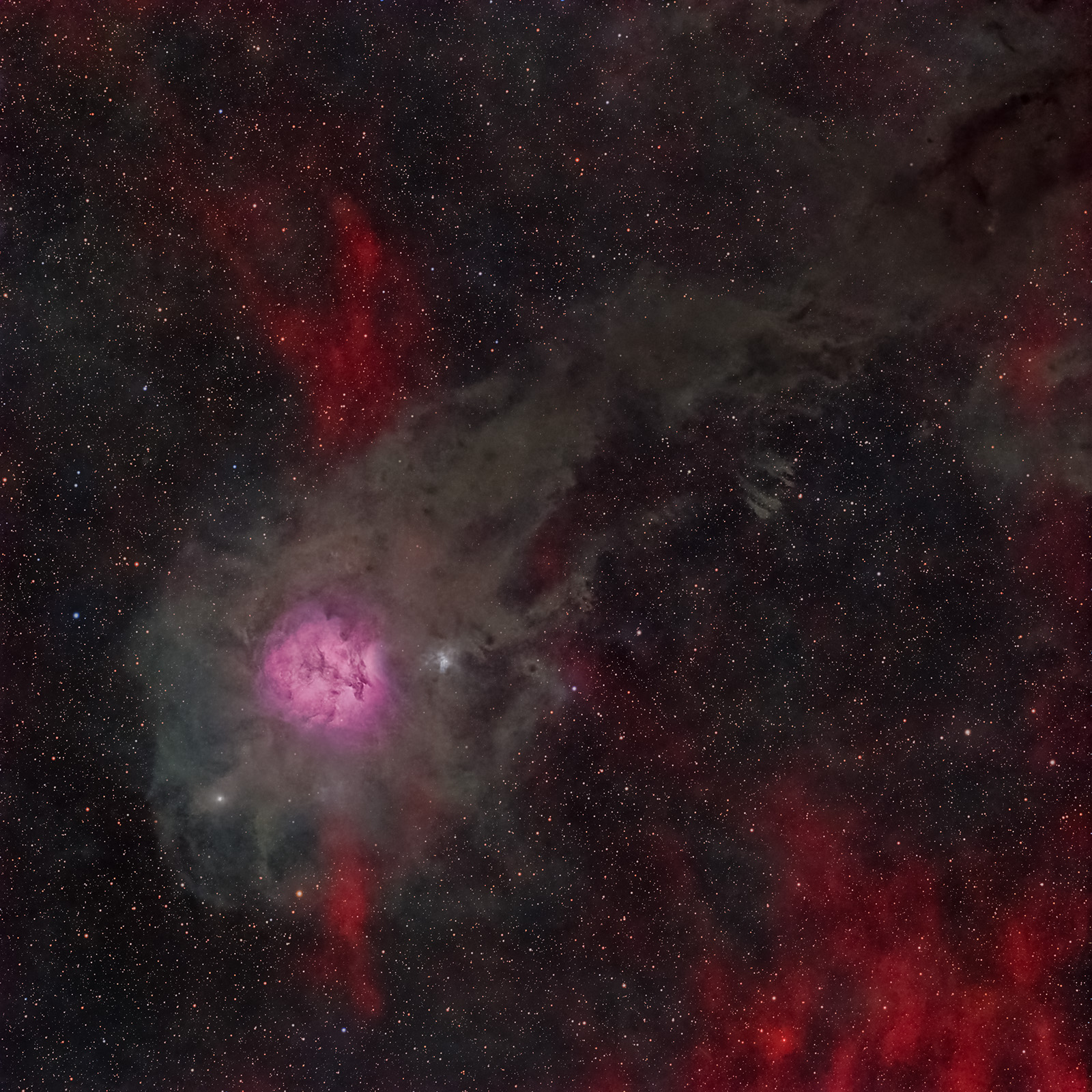
Image with original stars
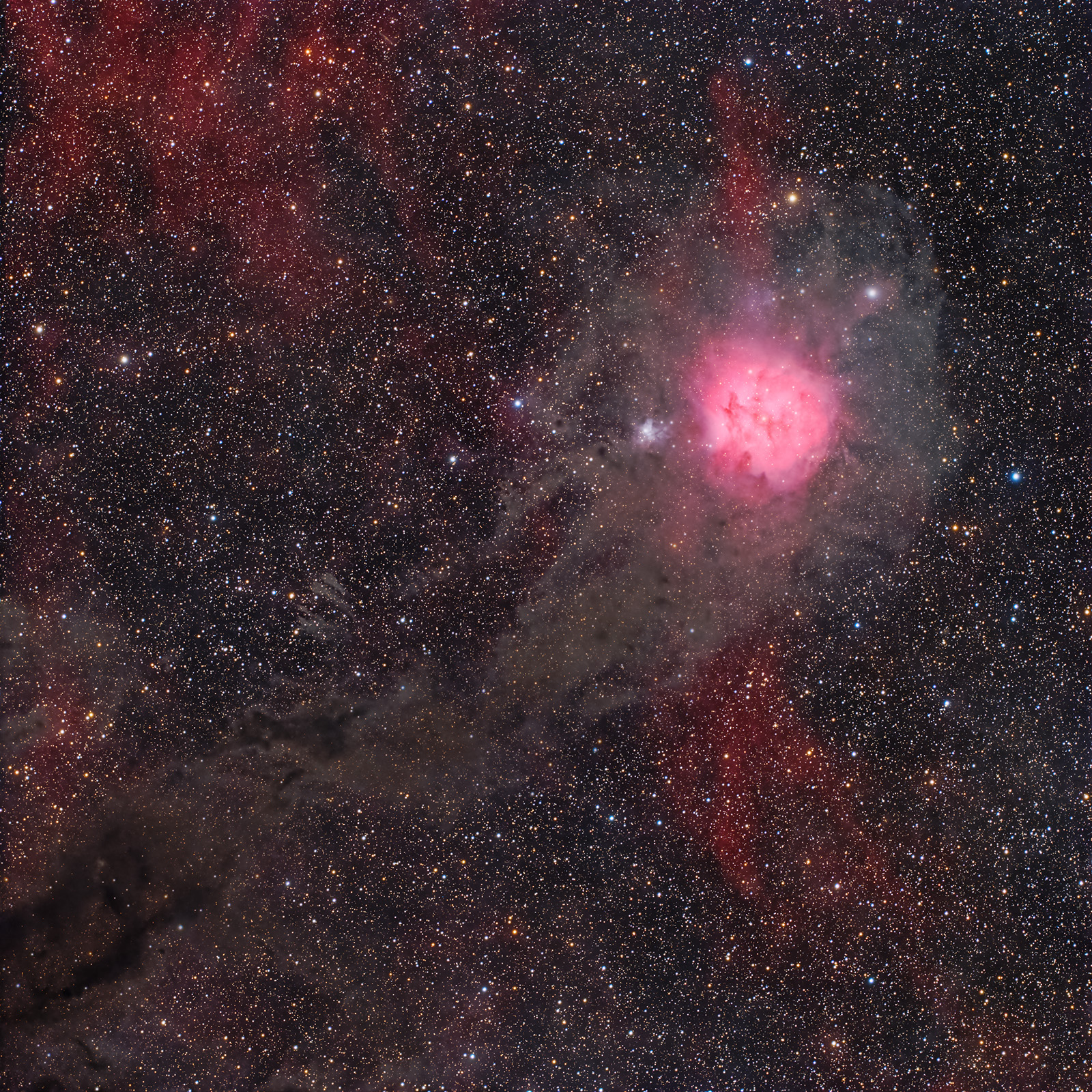
Starless image
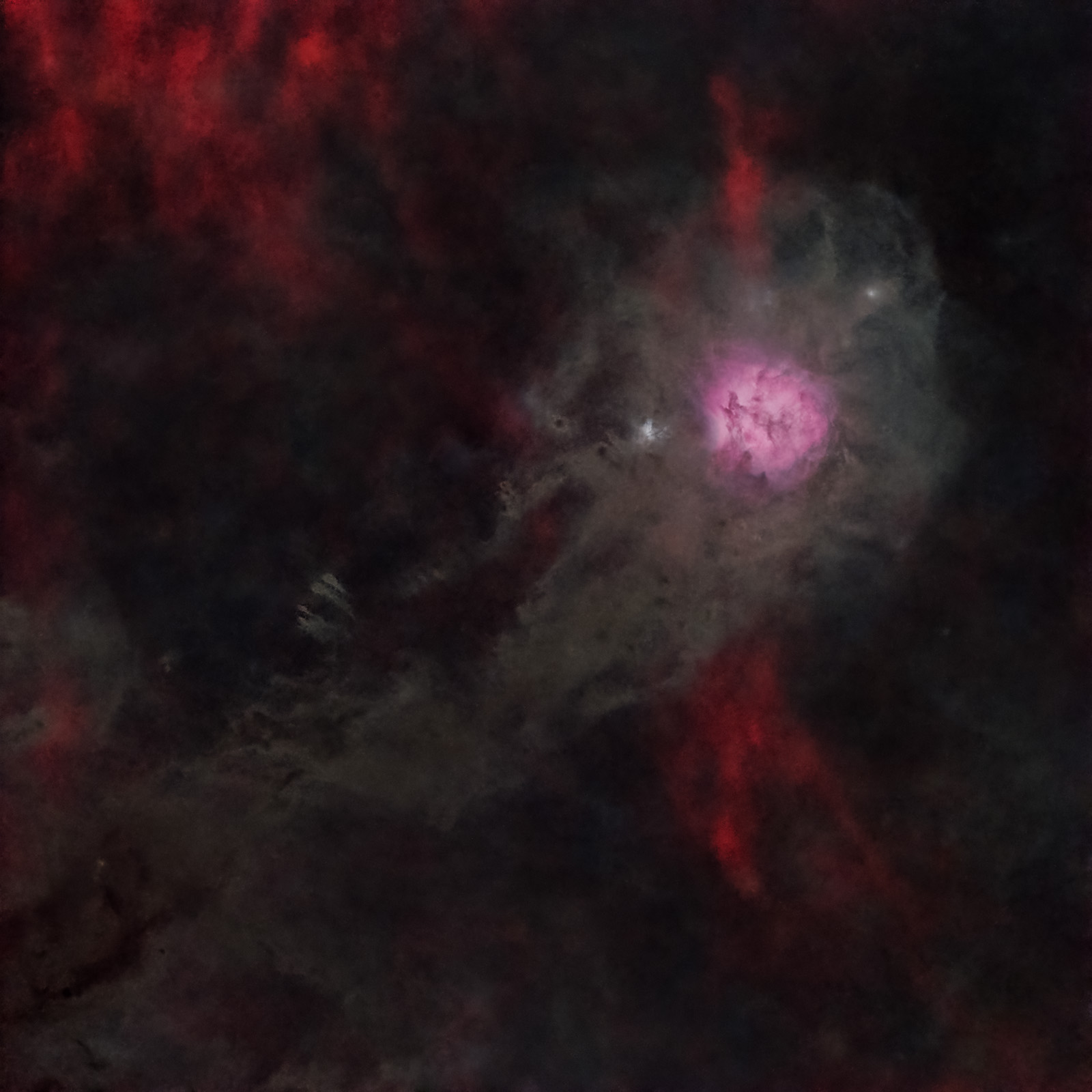
Images from July 16, 2023, Orlești - Vâlcea, total integration time 5 hours
1. Version with original stars, Sigma 150–600 lens (f/7.1, 600mm), L-Pro filter, ASI 533MC
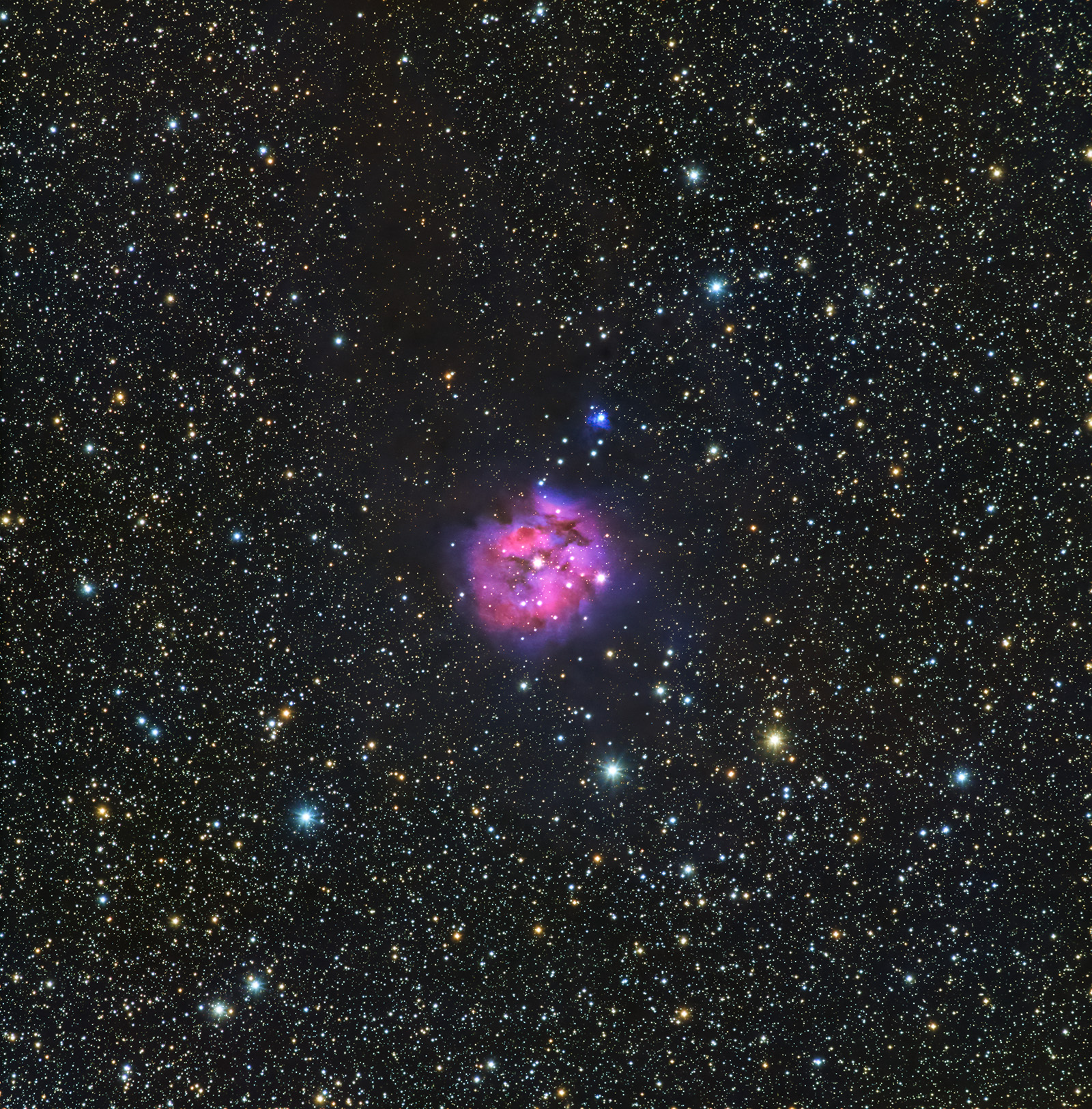
2. Version with reduced stars, Sigma 150–600 lens (f/7.1, 600mm), L-Pro filter, ASI 533MC
Useful tips for photographing and processing the Cocoon Nebula
I recommend the tutorial * NEW* Adding H-Alpha To RGB Data Made Extremely Easy!, which presents one of the simplest methods for adding the Ha signal extracted from dual-band filter (L-eXtreme) data to RGB images.