
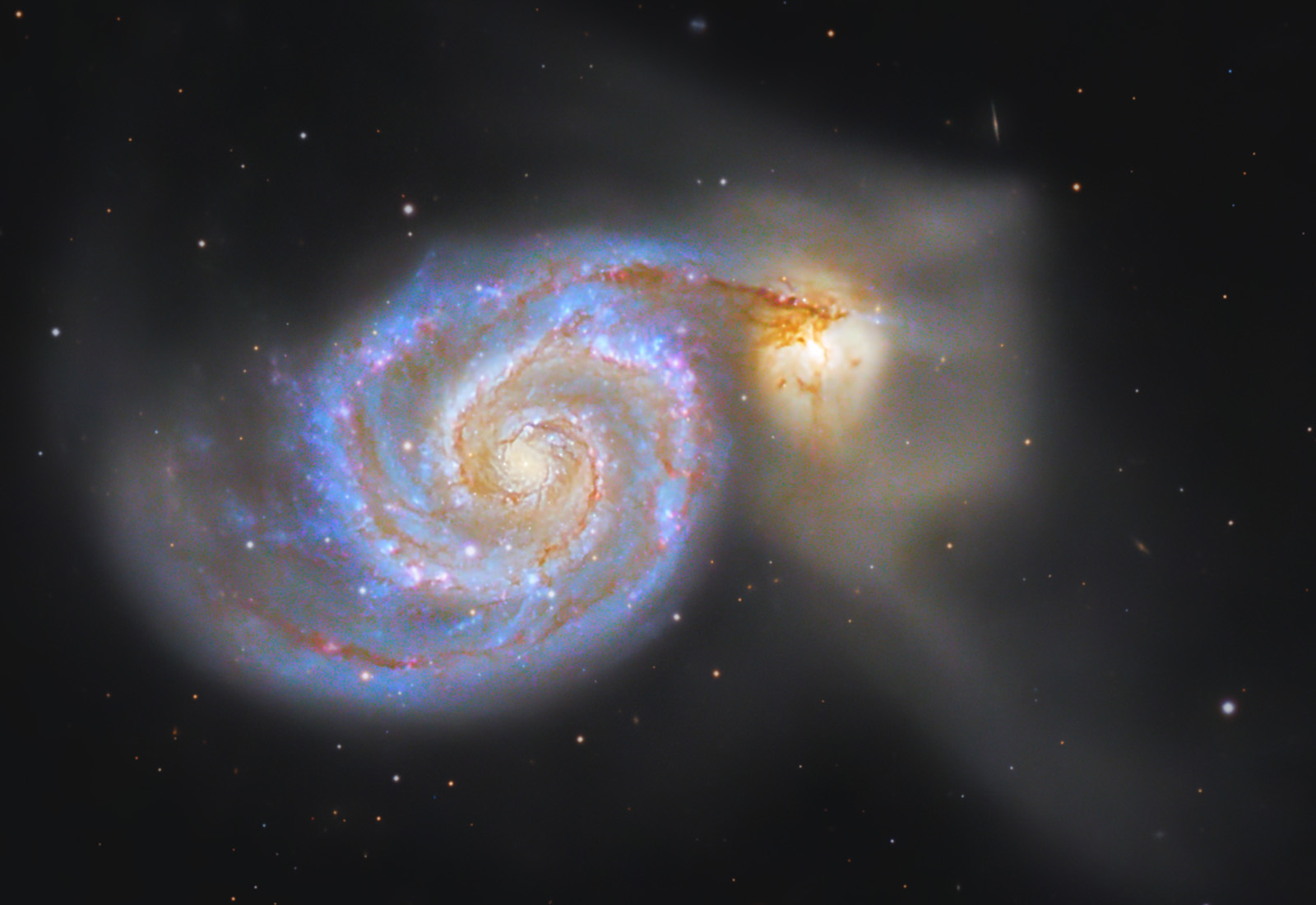
- name: The Whirlpool Galaxy (M51)
- location: Canes Venatici constellation (located very close to the Big Dipper)
- RA: 13hr 29' 53"; DEC: +47º 11' 44"
- distance from Earth: 31 million light-years
- magnitude: 8.4
- apparent size: 11.2' x 6.9'
About the Whirlpool Galaxy (M51)
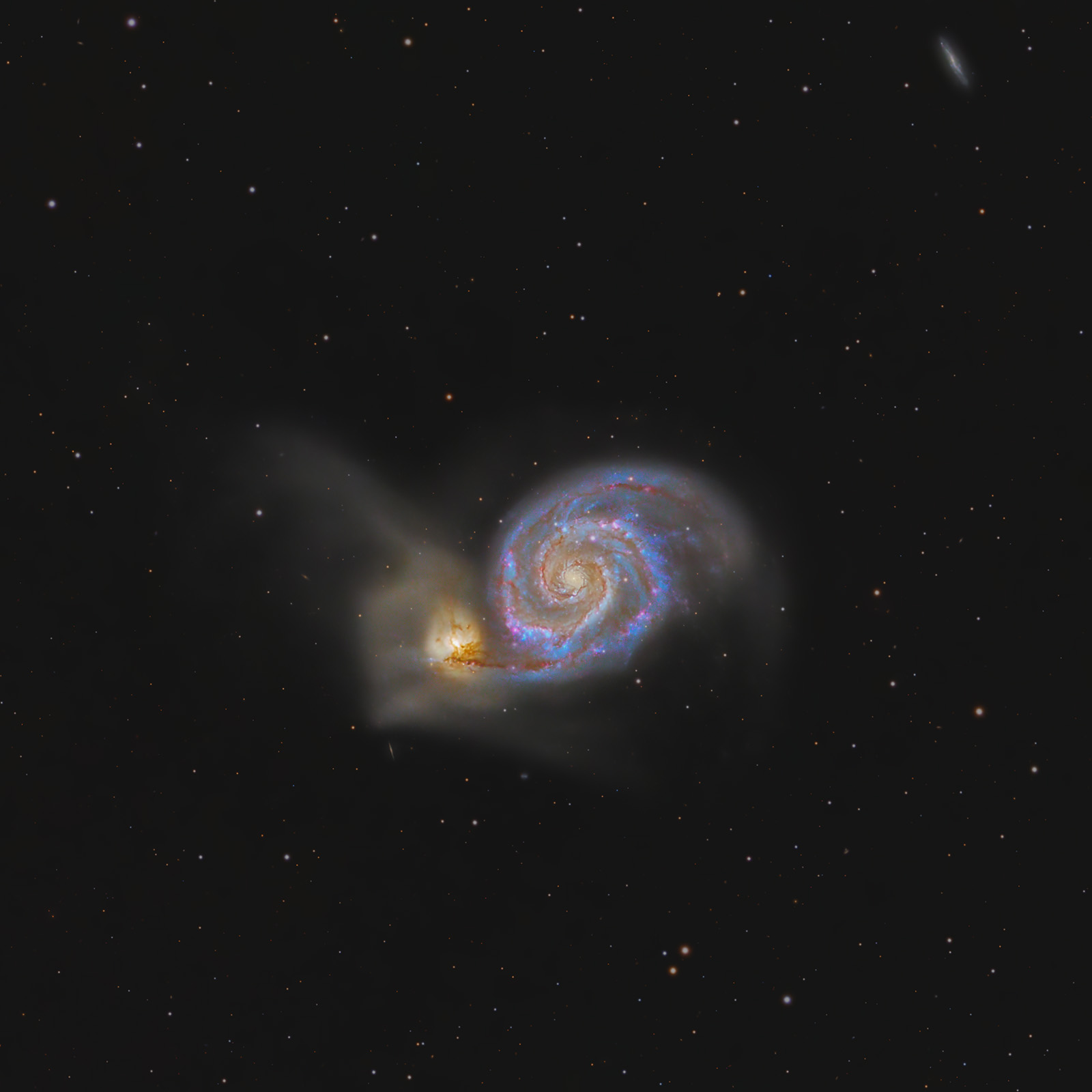
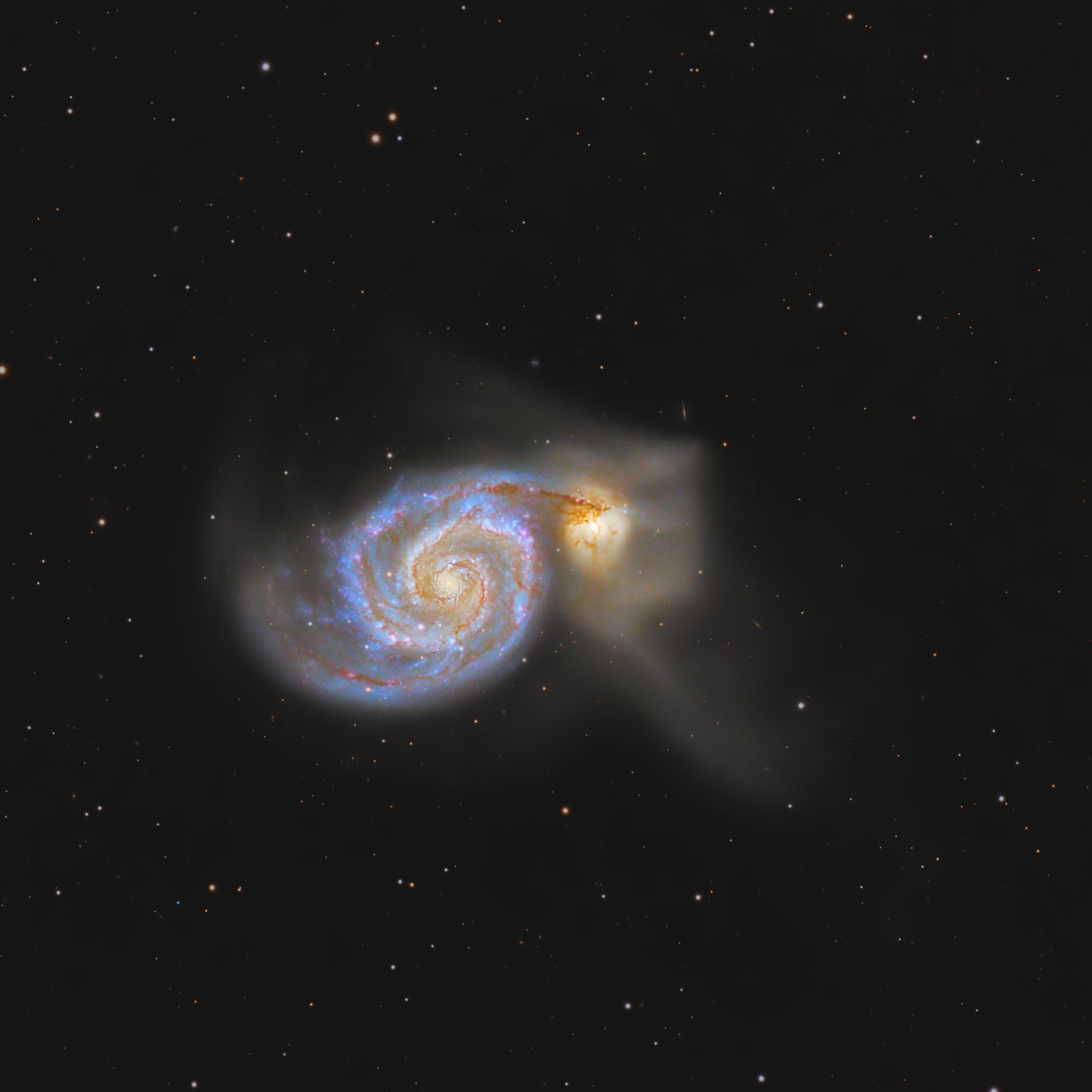
The Whirlpool Galaxy (M51) is one of the most spectacular galaxies that amateur astrophotographers can capture. I was fascinated by this galaxy the very first time I saw images of it, and I have always wanted to photograph it. In fact, the Whirlpool Galaxy is designated M51a in the Messier catalog or NGC 5194, and next to it lies a smaller galaxy, M51b (or NGC 5195), which resembles a tail. Therefore, we are actually talking about two galaxies, the larger one (M51a) gravitationally interacting with the smaller one (M51b). However, they are part of the same representative cosmic structure from an astrophotographic perspective, simply called M51.
In the core of the Whirlpool Galaxy there is a massive black hole, formed over time as a result of the intense gravitational interactions between the two galaxies.
The Whirlpool Galaxy M51a (the larger galaxy) is a spiral galaxy and was discovered in 1773 by Charles Messier. Eight years later, in 1781, Pierre Méchain discovered the second galaxy, M51b (NGC 5195), completing the overall picture. M51b is a lenticular galaxy strongly distorted by its larger "companion."
Although the Whirlpool Galaxy technically refers only to the larger galaxy (M51a), from an astrophotography perspective, when we say we are photographing the Whirlpool Galaxy, we are referring to the entire pair: M51a + M51b, simply known as M51.
I must admit that the shape of this galaxy always reminds me of a famous image from the Chora Church in Istanbul, where, at the end of time, an angel gathers the scroll of time depicted as a cosmic spiral shell.
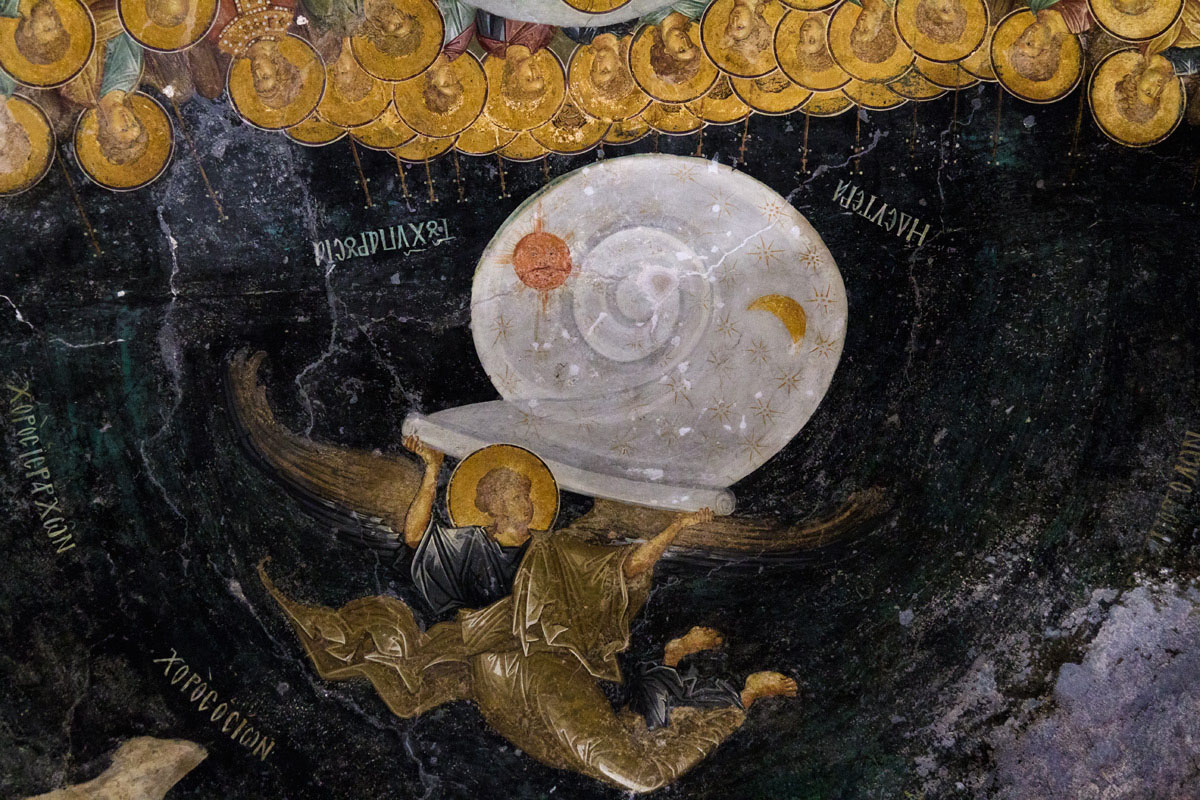
Image Gallery – The Whirlpool Galaxy (M51)


How to find the Whirlpool Galaxy (M51) in the sky
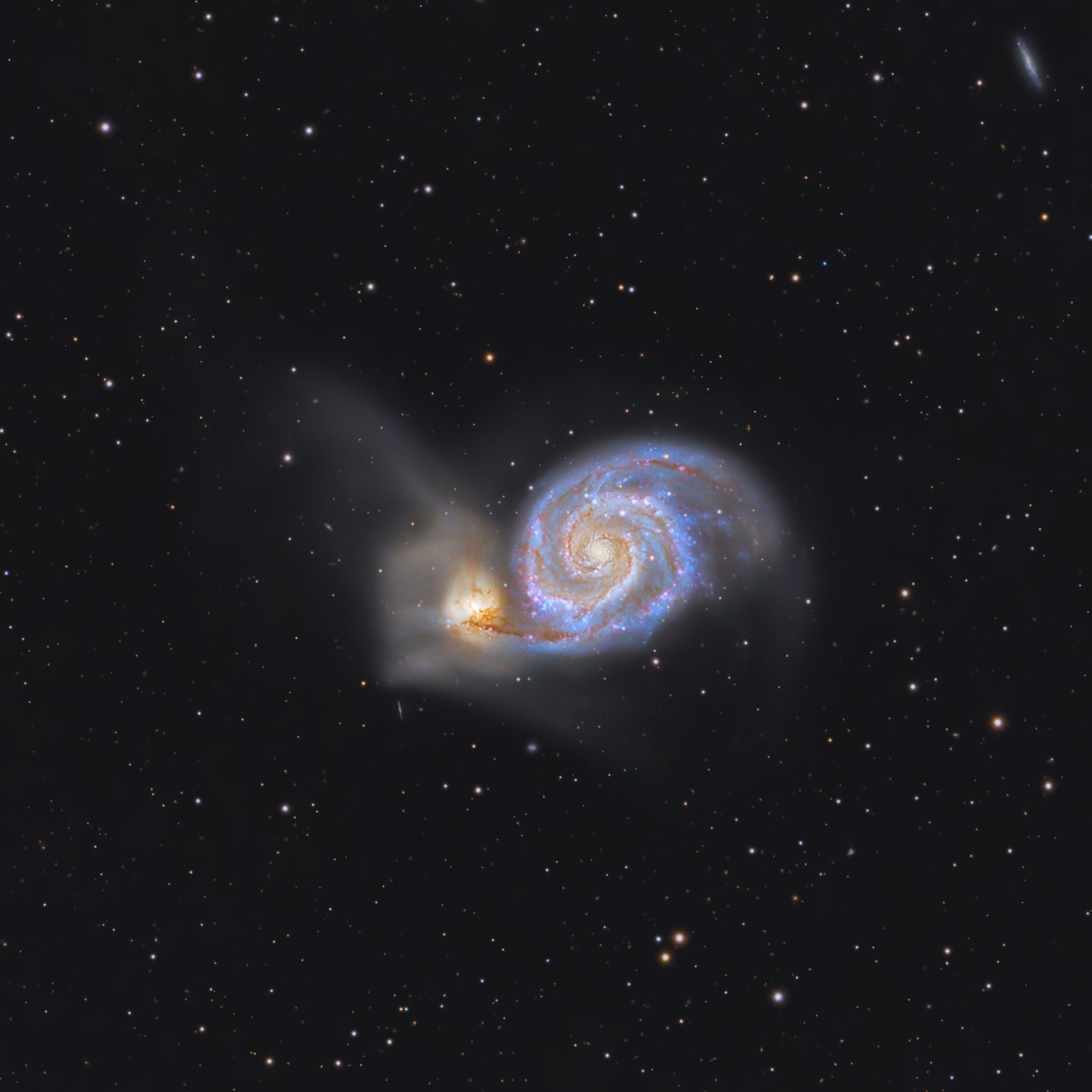
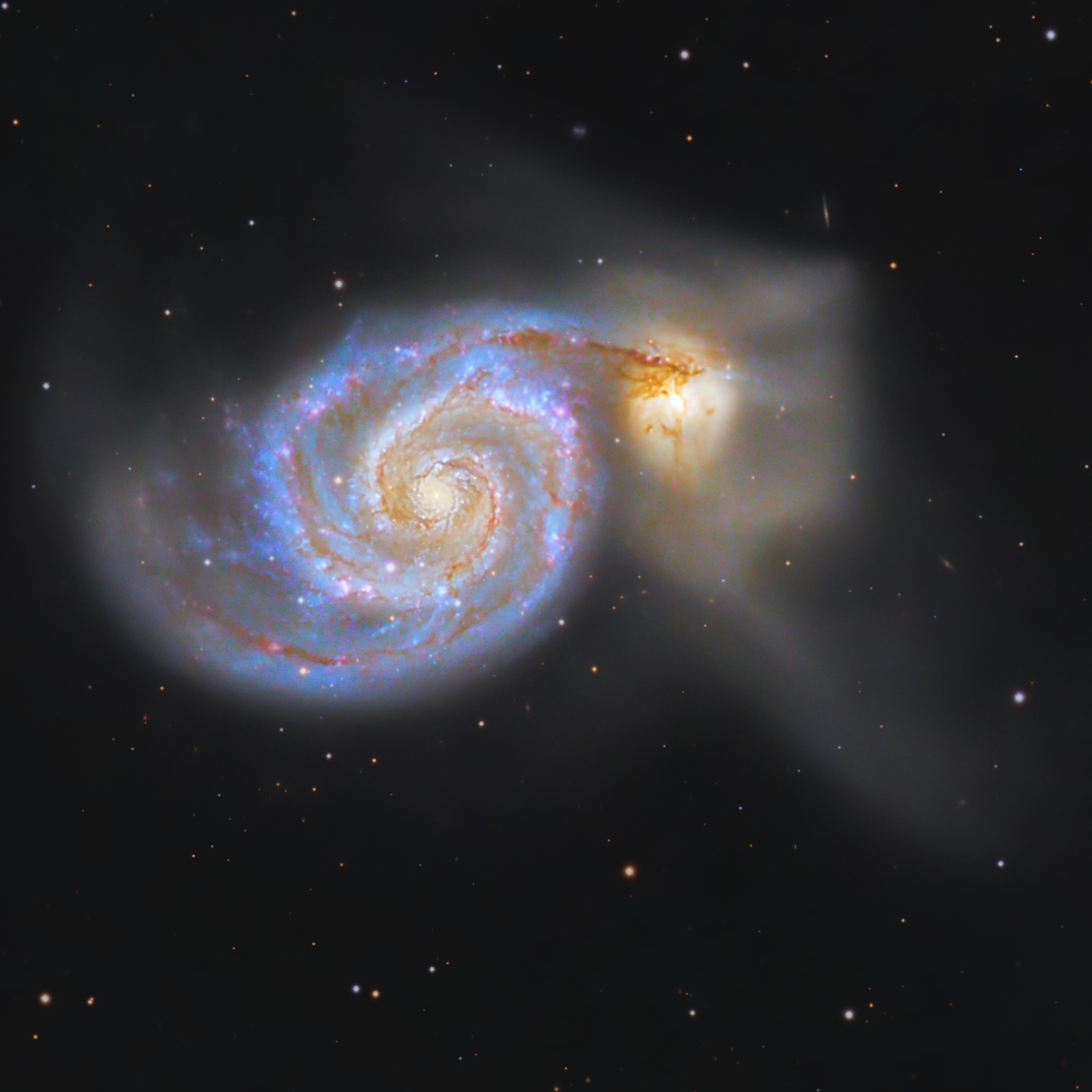
The Whirlpool Galaxy (M51) is officially located in the constellation Canes Venatici (a constellation that many beginner astrophotographers may not have even heard of), but visually we can say it lies in the Big Dipper (Ursa Major). As shown in the image, M51 is located very close to the star Alkaid, at the end of the Big Dipper’s handle. As an approximate rule, you can find it along an imaginary axis perpendicular to the line connecting the first two stars of the handle (Alkaid and Mizar), starting from Alkaid, at a distance of about half the separation between Alkaid and Mizar.

Useful tips for photographing the Whirlpool Galaxy (M51)
I photographed the Whirlpool Galaxy for the first time on August 3, 2021. That summer I started doing astrophotography, and that’s also when I learned about this galaxy. Having no experience in identifying and photographing galaxies, it was extremely difficult at first to locate it in the sky and then frame it properly, using reference points from the Big Dipper. Using a SkyGuider Pro and not knowing more advanced targeting methods such as plate solving, everything was done manually. It often took more than an hour to find, focus, and properly frame the galaxy, while sitting in a rather uncomfortable position just to see the images on the Canon 7D screen. The moment when the faint, spiral silhouette of M51 finally appeared in a 600 mm frame was a true “WOW” moment.
There is no strictly optimal period for photographing the Whirlpool Galaxy (M51). Since it is located in the region of the Big Dipper—a constellation visible throughout the entire year—M51 can be photographed both during galaxy season (February–May), as well as during summer or autumn. In winter, however, there are many other more attractive targets.
Below is a list of all my attempts to photograph the Whirlpool Galaxy (M51) up to the time of writing this article:
- The Whirlpool Galaxy (M51) photographed with an unmodified DSLR – August 3, 2021: it was enough just to capture the silhouette of the galaxy
- Canon 7D (unmodified), several frames at ISO 1600 and 3200, Sigma 150–600 Contemporary at 600mm, f/9.0, one Dark Frame. I had very little time before the galaxy disappeared behind a house roof. The image was taken from Vâlcea, Bortle 4 sky. No guiding.
- Processed in Starry Sky Stacker (Mac image stacking software) and Photoshop.
- The resulting image is of very poor quality, but it felt incredible just to see the galaxy’s silhouette appear.

- Canon 7D (unmodified), ISO 2500, Sigma 150–600 at 600mm, f/8.0. Image taken from the Vâlcea area, Bortle 4 sky. No guiding.
- Processed in Starry Sky Stacker (image stacking software for Mac) and Photoshop.
- The resulting image is still weak, but I started extracting more signal and experimenting with colors… although the resulting colors were not yet accurate.


- Sigma 150–600 at 600mm, f/6.3. Image taken from the Otopeni area, Bortle 7 sky.
- Guiding via PHD2 (on a laptop).
- Processing in PixInsight and Photoshop.
- The resulting image improved, the master frame obtained by stacking is much less noisy than the one from the Canon 7D RAW files. Colors are somewhat more accurate, but the integration time was very short (under 1 hour), and the Moon was nearly full. I used an Optolong L-Pro light pollution filter.
- The main issue was poor guiding caused by incorrect balancing on the declination axis: in practice, the camera + telephoto lens were heavily front-loaded toward the front of the lens. Because of this, the stars were not round. Additionally, the optics had some issues, producing stars with distorted corners.


- Sigma 150–600 at 600mm, f/8.0. Image taken from the Vâlcea area, Bortle 4 sky.
- Guiding via ASIAIR Plus.
- Processing in PixInsight and Photoshop.
- I used an Optolong L-Pro light pollution filter.
- Guiding improved with a more precise balance on the declination axis.


- Processing in PixInsight (95%) and Photoshop (5%).


- Processed in PixInsight (95%) and Photoshop (5%).
In conclusion, the Whirlpool Galaxy (M51) can be photographed even with a standard, unmodified DSLR. A longer total integration time is highly recommended. Although a focal length of 600 mm is relatively short, it still allows capturing the main structural details. Ideally, a focal length of over 800 mm—perhaps even 1000–1200 mm—would be better, which means moving from a telephoto lens to a telescope, preferably with a larger aperture.
A color astro camera such as the ASI 533 MC-PRO is more than capable for a broadband target like M51. It can also be imaged with a mono camera using LRGB filters, and in some cases an H-alpha filter can be used to capture an additional frame, later blended with the LRGB data to highlight certain red regions within the galaxy.
Equipment used:
- Mount (star tracker): iOptron SkyGuider Pro with iPolar (polar alignment using a laptop)
- Camera: ZWO ASI 533 MC-PRO or Canon 7D (unmodified)
- Lens: Sigma 150–600 f/5.6–6.3 Contemporary at 600mm
- Filter: Optolong L-Pro 1.5"
- ASIAIR+ or guiding via PHD2 and a laptop
- Guide camera: ASI 120 MM
- Tripod: Manfrotto CX PRO3
- Remote shutter release (for Canon 7D)
- 2 dedicated batteries: Omegon Pro Powerbank 96k LiFePO4 307Wh 12V + Celestron Powertank Lithium Pro LiFePO4 159Wh
Tips for processing images of the Whirlpool Galaxy (M51)
The first step is loading the frames (Light, Flat, Bias, etc.) into PixInsight using Script >> Batch Processing >> WeightedBatchPreprocessing in order to stack them, after which the software will export a single final frame to work with. I prefer this simpler approach with minimal settings, although there are many other, more advanced stacking methods (including within PixInsight). There are also numerous alternative software solutions: DeepSkyStacker (the most widely used on Windows), SIRIL (Windows, Linux, and Mac), or Starry Sky Stacker (Mac).
Below you can see how a single unprocessed frame (.FIT) looks in the case of the ASI 533 MC-PRO camera and how a (.RAW) frame looks for a Canon 7D when using PixInsight. You can also see the final file resulting from stacking all images (the master frame), which serves as the starting point for processing, both for the Canon 7D and the ASI 533 MC-PRO:


Then several processes are applied in PixInsight:
- First step is removing the green background and correcting the gradient as much as possible: you can experiment with BackgroundNeutralization or AutomaticBackgroundExtractor; for more complex gradients, DynamicBackgroundExtractor can be used
- ColorCalibration
- SCNR
- Noise reduction (EZ Denoise)
- Splitting the image into two: a starless image (all stars removed) and a stars-only image, using STARNET2. These two images are then processed separately, allowing adjustments to nebula/galaxy areas without affecting the stars.
Final color adjustments were done in Photoshop, then at the end I re-imported the edited images back into PixInsight and generated the final image by combining the star-only image with the starless image.
This galaxy is definitely worth re-imaging with a telescope at a focal length of over 1000 mm and a mount with Go-To capability!