

- name: Heart Nebula (IC 1805)
- location: Cassiopeia Constellation
- RA: 02hr 32' 42"; DEC: 61º 27' 00"
- distance from Earth: 7500 light-years
- magnitude: 6.5
- apparent size: 1º
About the Heart Nebula (IC 1805) in the Cassiopeia Constellation
The Heart Nebula is an emission nebula discovered by William Herschel in 1787. In the lower part of the nebula, one can identify its brightest region, known as NGC 896 (as seen in the image below). Also in the lower area, ionized gases form a colorful structure resembling a “fish head” (IC 1795).
A large portion of the nebula’s light comes from its central region, where an open cluster called Melotte 15 is located.
The nebula contains significant amounts of ionized oxygen and sulfur, as well as ionized hydrogen (Ha), which allows it to be photographed using mono cameras with narrowband filters (OIII, SII + Ha), producing spectacular images dominated by blue and orange tones. For those using color cameras (OSC – One Shot Color), as I do, the dominant color will be red-orange. However, there is a special processing technique that allows selective extraction of color channels (R, G, while B is reconstructed from R and G), resulting in images similar to those captured with mono cameras. A tutorial for HOO or SHO palette processing can be found here: View Link.

Image Gallery – Heart Nebula


Image Gallery – Heart Nebula Center (Melotte 15)


The Heart Nebula is often photographed together with the Soul Nebula. I photographed them separately. Below you can see the gallery of images for the Soul Nebula.
Image Gallery – Soul Nebula


How to find the Heart Nebula in the sky
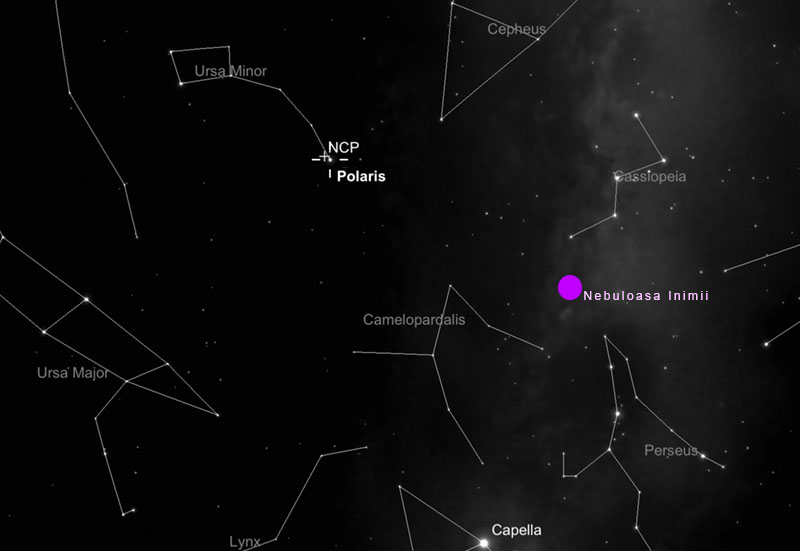
Once the Cassiopeia constellation is identified in the northern sky, the Heart Nebula is located very close to it, as indicated in the image below.
Useful tips for photographing the Heart Nebula
Since the Heart Nebula is part of the Cassiopeia constellation, which is circumpolar (meaning it never sets and is visible all year round, being close to Polaris), it can be photographed in many seasons. However, at convenient nighttime hours it is often located quite low on the horizon, which makes imaging difficult unless there is a clear northern view. For this reason, it is easier to photograph when it is higher in the sky, typically from summer to late autumn.
I photographed the Heart Nebula once, in a Bortle 4 sky in the Vâlcea–Drăgășani area, on April 25, 2022, during the Orthodox Easter period.
Since it is a large nebula, a relatively short focal length can be used: 250 mm in my case, with a ZWO ASI 533 MC-PRO camera, gain 101, cooled to -15°C.
There are three main ways to frame this nebula:
- capture the entire nebula, as I did
- focus on specific details such as the bright center or the lower “fish head” (IC 1795)
- use a shorter focal length (85–135 mm) to include both the Heart and the nearby Soul Nebula in the same frame
Equipment used:
ZWO ASI 533 MC-PRO color astro camera, Sigma 150-600 lens at 250 mm and f/8.0. The camera was cooled to -10°C.
To reduce light pollution, I used an Optolong L-eXtreme 1.5" filter, a dual narrowband filter that isolates Ha and OIII wavelengths.
ASIAIR+ handled focus, plate-solving, camera settings, and guiding.
Additional equipment: ASI 120 MM guide camera, Manfrotto CX PRO3 tripod, and two astro batteries (Omegon Pro Powerbank 96k LiFePO4 307Wh 12V + Celestron Powertank Lithium Pro LiFePO4 159Wh).
The SkyGuider Pro with iPolar also performed well.
Since this nebula is relatively bright, it can also be photographed with an unmodified DSLR/Mirrorless camera, although a modified one is recommended. The best results are obtained with a mono camera and narrowband filters (Ha, OIII, SII). The setup I used (color astro camera + dual-band filter Ha+OIII) is also a reasonable option.
Processing images of the Heart Nebula


Single frame (.fit) vs. final processed image
The first step is loading the frames (Light, Flat, Bias, etc.) into PixInsight using Script >> Batch Processing >> WeightedBatchPreprocessing in order to stack the frames, after which the software exports a single final image that we will work on. I prefer this simpler method, with fewer settings, although there are many more advanced stacking options (including in PixInsight). There are also several other software tools: DeepSkyStacker (most commonly used on Windows), SIRIL (Windows, Linux, and Mac), or Starry Sky Stacker (Mac).
Below you can see several frames:
- an unprocessed frame (.FIT) captured with ASI 533 MC-PRO, where the silhouette of the nebula can be distinguished, especially the center, the edges, and the lower area (“fish tail”)
- the master frame resulting from stacking all images in PixInsight
- the partially processed master frame with the stars removed using STARNET2
- the extracted stars frame. The stars can be reduced in Photoshop or PixInsight.
- the final frame. Standard version.


