
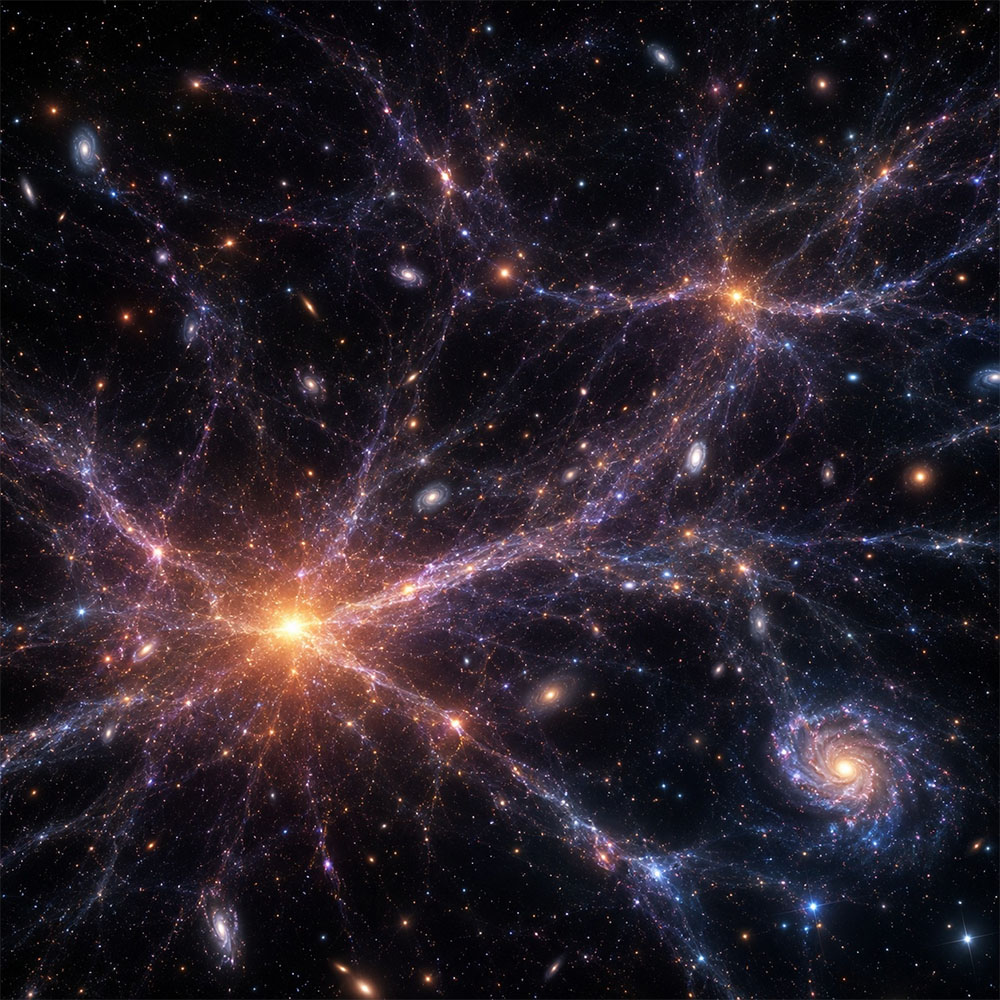
The James Webb Space Telescope continues to redefine modern astronomy. Following one of the largest observational projects ever conducted, astronomers have published the most detailed map of the gigantic structures forming the “skeleton” of the Universe: the cosmic web made of galaxies, galaxy clusters, and dark matter filaments.
The new map was produced as part of the COSMOS-Web project, the largest survey ever performed with the James Webb Space Telescope (JWST). The observations totaled approximately 255 hours of exposure time and allowed scientists to identify more than 164,000 galaxies, some located so far away that we see them as they were when the Universe was only a few hundred million years old.
For astronomers, this achievement is extremely important because it provides a much clearer picture of how galaxies formed and evolved across more than 13 billion years of cosmic history.
The cosmic web represents the large-scale structure of the Universe. Galaxies are not evenly distributed through space; instead, they are grouped into enormous interconnected filaments separated by vast nearly empty regions. These structures are strongly influenced by dark matter, the invisible component believed to make up most of the Universe’s mass.
Thanks to Webb’s extraordinary infrared sensitivity, researchers were able to observe extremely faint and distant galaxies that previous generations of telescopes could not study in such detail.
The results suggest that the cosmic environment plays a major role in galaxy evolution. In the dense regions of the cosmic web, young galaxies formed stars at extraordinary rates. Today, however, many massive galaxies in these same regions have dramatically slowed their star-forming activity.
Astronomers believe this process is influenced both by massive dark matter halos and by the supermassive black holes found at the centers of galaxies.
For astrophotography enthusiasts, discoveries like this provide a fascinating perspective on the objects we photograph from Earth. Spiral galaxies, galaxy clusters, and deep-sky structures captured in astrophotography images are only tiny fragments of this immense cosmic network stretching across billions of light-years.
Once again, James Webb proves that modern astronomy is not only about spectacular imagery, but also about understanding the deep architecture of the Universe.
Sources: