
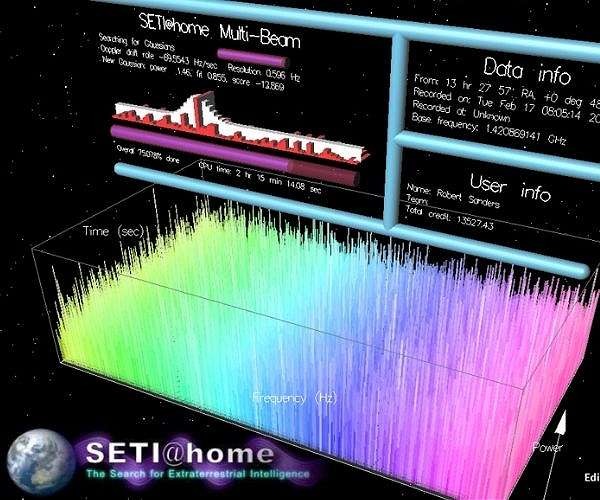
In an era where technology and science go hand in hand to unveil the mysteries of the cosmos, the SETI@home project stands out as a striking example of public engagement in space research. For approximately 21 years, millions of volunteers worldwide have donated the computational power of their personal home computers to the University of California, Berkeley, to scan the skies in search of potential signals from extraterrestrial civilizations.
Launched in the 1990s, the SETI (Search for Extraterrestrial Intelligence) initiative has evolved alongside technological advances, and SETI@home became a flagship platform that harnesses the computing power of ordinary home computers for processing massive quantities of radioastronomical data. This initiative works by breaking down the data collected from radio telescopes all over the world into small chunks, which are then analyzed step-by-step on the volunteers` machines equipped with specialized software.
Over the span of 21 years, the project generated approximately 12 billion detected events – an astronomical ocean of potential interest that ranges from background noise and radio interference to signals that might be connected to other civilizations. However, not every detection is relevant or meaningful, and the major challenge was to filter through this gargantuan dataset to identify only the truly promising targets.
The filtering process involved rigorous multi-level steps: eliminating terrestrial radio interference, conducting blind synthetic-signal tests to validate the analysis algorithms, and performing meticulous manual reviews of the most intriguing findings. These procedures were aimed at removing errors and false positives to ensure that the selected data had a genuine chance of originating from an extraterrestrial source. After a decade of analysis, researchers managed to narrow down the initial 12 billion signals to an impressive, yet manageable, set of about 100 significant targets.
One of the key takeaways from the SETI@home endeavor is the way collaboration between ordinary people and science can yield invaluable results. The millions of volunteers contributing their computers` processing power have demonstrated that broad access and inclusion in research can accelerate the pace of discovery. Additionally, the project became an educational platform inspiring astronomy and astrophotography enthusiasts to engage and better understand the vast complexity of the universe.
Within a broader scientific context, SETI@home is part of international efforts seeking to determine whether we are alone in the cosmos. Astronomers employ radio telescopes to capture signals possibly emitted by extraterrestrial civilizations, and analyzing these signals requires significant computing horsepower and meticulous attention to detail. By sophisticated filtering of the serendipitous noise in radio emissions, researchers hope to detect intentional communications that would confirm the existence of another intelligent life form in the universe.
The next steps for the project include a deeper examination of the 100 identified targets using highly sensitive radio telescopes, such as China`s Five-hundred-meter Aperture Spherical radio Telescope (FAST), to confirm or rule out the nature of these signals. Should any prove to have an unusual and non-terrestrial origin, it would be a monumental discovery, forever changing our understanding of humanity`s place in the cosmos.
These recent results have been enthusiastically received by the astronomical community and astrophotography aficionados alike. Many have expressed the desire to contribute to the project`s forthcoming phases, either through personal observations or continued participation in SETI@home software testing.
Thus, SETI@home not only reflects the technological progress of the digital age but also exemplifies the power of a community united in pursuit of a shared dream: answering the fundamental question, `Are we alone in the universe?`.
Source: Space Daily